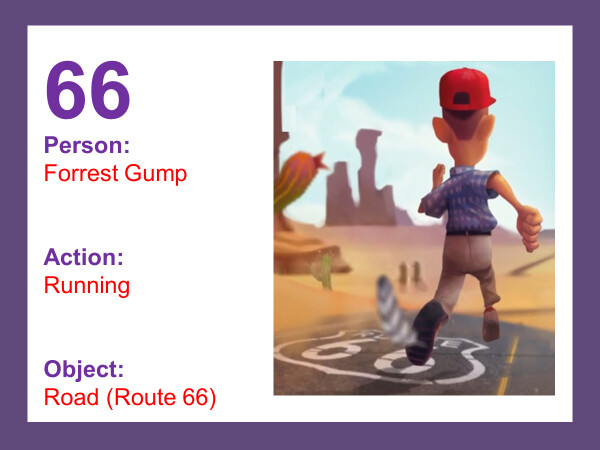
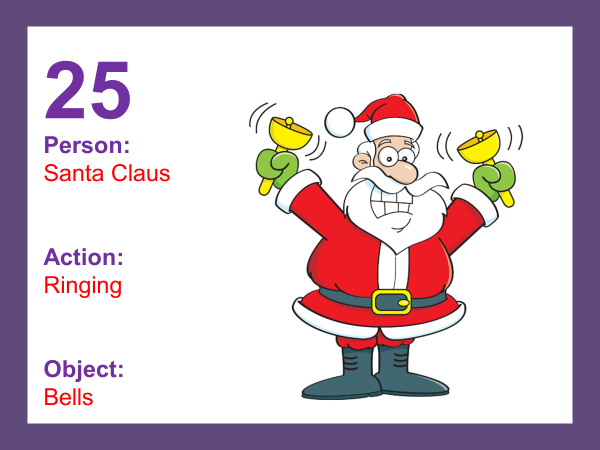
I was just wondering if anyone else is using an Unencoded PAO System for their cast of 100 characters from 00 - 99. I think it would be far better to not need to decipher letters into numbers and numbers into characters which is effectively what both the Major PAO Systems and Dominic Systems do. For example, I have Forrest Gump representing my number for 66. Hope the connection isn’t lost on anyone. To me, Forrest Gump ranks as one of my all-time favorite movies and Tom Hanks as one of my all-time favorite actors. Add: Running as (AN ACTION) and a route marker as painted on the road as (AN OBJECT) and you’re good to go for #66. Santa Claus ringing a bell is an obvious choice for #25. James Bond shooting through barrel of a gun works for #7. Ludwig Von Beethoven would fit #5 playing his 5th Symphony on a Piano. Yes I know it takes a whole orchestra to play a symphony before anyone jumps down my throat! Bobby Fisher works for #64 as he died at age 64 and there are 64 squares on a chess board. Ect. etc. Any ideas of other characters from 00 - 99 that doesn’t need to use a Major Code or Dominic Code to decipher?
I was using FiSHerman for F-SH but I think I will instead use bobby FiSCHer.
He was a kind of an idiot savant extremely paranoid, anti-semetic, and misogynistic. In interviews he seems almost child-like.
That would work for 86 in the conventional Major System encoding. But what I’m trying to achieve here and I hope it doesn’t get lost is to devise a whole cast of 100 characters (00 - 99) that one jumps to any of the 100 chatracters by an immediate association. Take #27 in my Unencoded PAO System, I have Nelson Mandela as he was imprisioned for 27 years. His action could be: Breaking-Free (think of breaking Hand-cuffs) and his object could be ‘hand-cuffs’

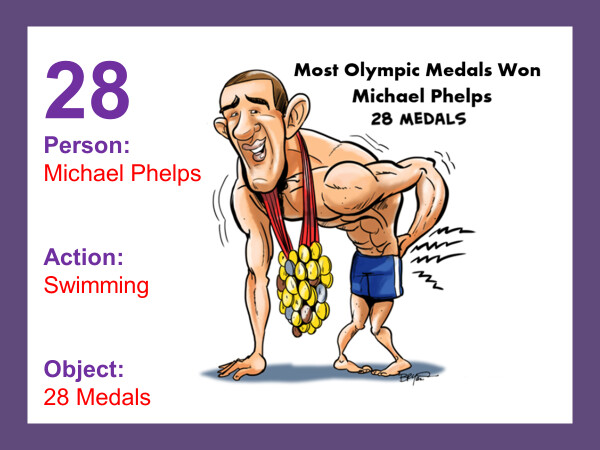
By the way I have Michael Phelps at #28
I’m finding it quite fun to concoct these images too!
Just asking for some further ideas of people associated to numbers without using Major or Dominic Coding systems as it will speed up both my encoding and memory recall for numbers using but rather by using an UNENCODED PAO SYSTEM. Not shouting just empathsizing what I’m trying to achieve. But if FiSHer works for you in your number system, nothing wrong with using him there. All points you raised about Bobby Fisher incidentally were unfortunately true (if youtube is to be believed). The saddest part of his life story for me, was that he apparently celebrated the terrorist act of bringing down the Twin Towers in Manhattan NY (USA). Sought political assylum in Iceland. One thing that no one can however take away from him is he was at one time (during the Cold War) the best chess player on the planet. Computer chess wasn’t around then
Michael Phelps is a nice rich character to build stories from because he not only is the decorated swimmer he also had all the news media around smoking weed and getting DUI.
Its nice when you could imagine him on a winner’s podium, swimming in a pool, drunk driving or wasted with a bong yelling “grip it n rip it”.
LOL! Yes there is that side to him too!
@fred2, I’m definitely a fan of this one-step type of conversion since it lessens the mental load.
Most digit conversions involve a two-step process of creating sounds first and then keywords second. This creates two separate tasks of mental processing. Some, like @Erol’s Shaper system, or classic rhyming system depend on visual or aural features for speed making them very popular one-step systems as well for converting digits directly to images.
This approach uses the elimination of the intermediary step by a related datatype (subject, elaboration, action, item, or terrain) such as seeing 88 as a piano keyboard since it has that many keys and then selecting a subject like the flamboyant popular performer Liberace. 45 could be seen as Clint Eastwood carrying a Colt .45 in his early films.
It’s an alternate approach and fairly easy as a starter system without the burden of the Major or Ben systems. But it only reaches easily up to 100. I look forward to seeing more entries in this system!
Thanks for the heads-up Doug. Interestingly, I would have used Clint Eastwood’s character’s gun the .44 Magnum that he brandishes as (Detective Callahan a.k.a “Dirty Harry”) in the movie of the same name. Still if he used a Colt .45 in his earlier Westerns that would work fine too. I am stealing the idea of a piano having 88 keys and will use the flamboyant Liberace as my #88 going forward. This now means that I have had to fire a previous pianist I had in my original cast of characters at #5 which was Ludwig Von Beethoven (Composer of the 5th Symphony). This now means I have to select our country’s (Springbok’s) number 5 - Lock = Eben Etzebeth as my new #5, sorted! As always Doug thank you for your insightful input and constructive criticism. Your points made about a 3-digit system being superior to a PAO system is noted. There is however the investment that needs to be made in encoding 1000 images which is exactly what I’m trying to avoid in putting together an unecoded PAO System. At this stage it’s still work in progress so please feel free to provide me with any additional ideas for, lets call them the INTUITIVE CHARACTERS that might make up my cast of characters 00 - 99. I leave you with two of my favorites 25th December and 26th December below:

I understand where you are coming from, but I would like to explain something on the side of using a system.
Lets assume you set out to build a house. If you never build a house before, you might want some instructions. Sure, you could build a house without them, you know what a house looks like and you know what it has to do, but if you never build a house before you could still use instructions. You might still need these instructions for your second, third, fourth house. Eventually, you fully grasp the house building process, and you no longer need the instructions.
That is similar to the use of systems. We dont use them to memorize, we use them to create the images that we use to memorize.
Early on, I was like “okay. 67. 60 to 69 were star wars characters. 7 looks like a gun. Oh yeah, 67 was han solo” in my mind. However, after some practice, my mind went straight to “67 = Han Solo”.
The true advantage comes during the little stage between getting used to the system and being able to use the system, where you know 90 of the images by heart, get 8 of them pretty quickly, an 2 happen to be pretty annoying. Having a system can help you find those images pretty easily. In the end, it makes no difference how you create your system.
TL;DR:
Systems help you create the images. After creating the images and spending some time practicing, you no longer use the system.
@fred2, maybe you could use Michael Jackson for your #5 since his rhinestone glove has five fingers?
Mayarra I see what you’re driving at. I already have an existing Dominic System of 00 - 99 characters as a PAO. I am experimenting though with this option of having an unencoded system as opposed to the Traditional Major coded system: 0 = s,z; 1 = t,d; 2 = n; 3 = m; 4 = r; 5 = l; 6 = sh, j, ch; 7 = k; 8 = ph, f, v; 9 = p, b or Dominic encoded system: 0 = O; 1 = A; 2 = B; 3 = C; 4 = D; 5 = E; 6 = S; 7 = G; 8 = H; 9 = N.
I take from what your saying that an absolute novice would preferably need a ‘blueprint’ or set of house plans before embarking on the construction of their house. If they chose the traditional Major System and wanted to devise a list of 100 characters for a PAO system, I think it would be as clear that they would have to follow the tried and tested recipe of converting numbers into letters and letters into images of people. Eg. For 88 in Major System, one would say 88 = FF = Freddie Flinstone (Person). Its easy thereafter to find actions and objects for the whole 100 cast of characters you choose. My point is (and I suppose it could be argued otherwise once you are able to automatically translate any given number instantly into its corresponding character) that you are going from NUMBER to LETTERS to PERSON. Surely, if you have a good feel for what number 27 represents for you then can’t you throw away your house plans or blueprints? E.g. #27 to me always represents Nelson Mandela as he was imprisioned for 27 years as a political prisioner by an Apartheid government. I have just shortened (and I believe?) strengthened my memory encoding speed as I have merely gone from a NUMBER to a PERSON. It’s like I have just dispensed with the encumberance of having to go to the LETTERS the previously stood in between my NUMBERS and my PERSONS. For example if you are trilingual and can speak say: English, Zulu and Afrikaans, and wanted to translate a phrase from English to Afrikaans, would it be necessary to go from: English to Zulu and thereafter from Zulu to Afrikaans?? Just go straight from English to Afrikaans. It’s far less complicated and less time cosuming. But I do see what you are getting at, which I think (but please correct me if I’m wrong) is that your LETTERS are an additional crutch to help you remember your PERSONS from your NUMBERS and ipso facto your NUMBERS from your PERSONS too. So let’s say in the Dominic system I want to go from number 28 to my person. This would be my steps: 28 NUMBER = BH LETTERS = Benny Hill or going the other way round: Benny Hill = BH LETTERS = 28 NUMBER. In my proposed UNENCODED SYSTEM, I would merely go 28 NUMBER = Michael Phelps (Why? 28 Olympic Medals to his name) or if I am given the person (Michael Phelps), I would go the other way round, namely Michael Phelps = 28.
Your argument of course is premised on the assumption … “Let’s assume you’ve never built a house before” (end quote). My response to you would be: ‘Let’s assume we can all build houses!’ (The analogy being made of course is let’s all assume we fully understand and can apply both the Tradional Major System and Dominic System). Obviously using an INTUITIVE UNENCODED PAO SYSTEM the cast of characters need not comply with any rules. Don’t worry the foundations are strong enough for me to go from #69 to Niel Armstrong knowing he was the 1st man to walk on the moon in July 1969 (#69). That being said I am able to go straight from my existing Dominic systems PERSONS, straight to CHARACTERS. So for me, Caster Semenya = #36. I didn’t need to put in the extra step of LETTERS being CS in this case. But I know my Dominic’s cast of characters very well. In closing, in devising one’s own system of PAO (and I am well-aware that you have compiled one comprising 000 - 999 characters) how long would it take one to compile from scratch? (No one difinitive answer I know!) Horses for courses I guess??
That is a possibibity but it’s 20 minutes past midnight here, so I will go to bed and proverbially speaking “sleep on it”. You would be amazed at what sometimes just pops out of my head when I’ve had a good nights rest. Apparantly Paul McCartney’s song: “Yesterday” came to him that way. Just imagine the royalties he has earned over the years on just that one song, that has been covered at least 2 200 times (if Google is to be believed by various artists!). The best I’ve ever had was struggling to find a Dominic Character for 84 to complete my cast of characters. Couldn’t find any. Went to bed and woke up with …“All the Kings Horses and All the Kings men…” on my brain. Paul McCartney goes to bed and wakes up with "Scrambled Eggs… the original lyrics for Yesterday). I go to bed and wake up with Humpty-Dumpty as my number 84 and he hadn’t even fallen off the wall to be scrambled either! LOL!!
This is sort of similar to my current system where i use categories but also Michael Jordan is 23, Wayne Gretzky is 99.
@fred2, I think that @Mayarra has described the three stages of learning a language well. Mnemonics are a visual language. I’m no where near proficient as she is yet so I’ll choose another language I know well. Music.
We learn to read notes, convert them to letters, and then find those letters on the keyboard. The ones we practice the most become easy but then there are those ones that we rarely see using ledger lines and they cause us to pause. Sometimes they use extra symbols to move up or down and octave. That’s the converting/learning stage of your language. You might call it the vocabulary stage.
Then there’s the reinforcement stage of your language which becomes more comfortable as you practice. Practice becomes enjoyable as you "have conversations"and learn new ways to say things. Some notes become easy, others you think a little about, and others you have recognize by going back to the converting stage. You might call this more of a grammar stage.
The last stage is the fluent stage. You are fluent and you start to express yourself well. The images become vivid characters enacting a scene as you see the numbers, cards, etc. without thinking. Music flows out of your fingers without thinking that you are reading notes and you can hear the printed symbols. You might call this the conversant stage.
I agree with @Mayarra. Systems do help you learn. Whether it’s Every Good Boy Does Fine or light-up colored keys, you eventually discard the system because it’s a learning phase. If the goal is to know 100 PAO images well, I like this one-step related datatype method better. I found that learning a card system might be better this way but I have little time to explore that.
I agree totally. I used Dominic System for my PAO and when I could not remember a certain personality for my number the Dominic System helps me get there and reach the person using the initials quickly, but now that I am accustomed to the PAO I seldom use the original link but the original link is still there if there is a need any time.
same goes for any skills , I guess.
For example - • I memorized lots of Rubik’s cube algorithms, whenever I forget, I just recall what’s the algorithm.
But now it’s on my tip, I literally never recall the formula. I directly do it.
Now I forgot the algorithms but if I have a cube in my hand I can solve it.
• I learned lots of simple hacks for solving mental calculation problems, in the beginning it helped me. But now I know the answer already so I don’t need it.
And so on…


Maya’s comment that systems do help you learn, I believe is irreputable. Nowhere in my response to Mayarra did I impute that that is not the case? Mayarra is 100% on the money there. I also take your points about about music and arriving at the fluency stage as you’ve put it. This is similiar in essesense to the “unconsciencious competentence” model. The only point I was trying to make is that I believe an unencoded PAO System would be better than either a Traditional Major System PAO or a Dominic System PAO in my opinion? Indeed when explaining his system, Dominic O’Brien says that one should think of PERSONS that automatically come to mind for any given numbers 00 - 99. I believe he also used the example of the then current Prime Minister of the UK being: Tony Blair as #10 as he is associated with 10 Downing Street. Dominic O’Brien’s suggestion taken to the extreme if one were able to give PERSONS for each and every number 00 - 99 (without using his Dominic Code, would be definition and default be an Unencoded PAO System!
Whatever system one is ultimately deciding to use say to recall huge tracts of numbers has got to be ‘fit for purpose’. I am not saying for one moment that systems such as Traditional Major System’s PAO or the Dominic’s System PAO won’t do the job well, obviously they would. My point is however that an unencoded PAO system would (in my opinion) be superior to either the Traditional Major PAO System or the Dominic’s PAO systems in terms of speed of encoding (I’ll use the caveat “to commence with”), given the “Unconscious Competence model” previously alluded to. In my suggested Unencoded PAO method however, I am basically throwing the crutches away to commence with of NOT having any LETTERS in the system whatsoever. To the purists out there, many people would prefer to learn their chosen PAO System using LETTERS to encode which gives them an additional backstop in working out their chosen cast of 100 characters to begin with, I accept that. I also accept that not everyone uses PAO as their preferred technique or tool for encoding numbers too. Other system’s such as Errol’s Number Shaper Systems exist which also do the job quite admirably. I can’t speak for competitive mnemonists as I am not one myself, nor can I vouch for the pros and cons of using larger systems of 000 - 999, which both you and Mayarra would be in a far better position to comment upon as you both use such systems. My occupation is that of a Lecturer so any theories learning related are of interest to me. Coming back to the initial point you made (or rather Mayarra made), systems help you learn - I do not disagree with that contention at all??
My 0-99 PAO system was built using random characters grouped as action stars, cartoon characters, singers and tennis players. I used standard peg systems to assign numbers for them and it worked.
@fred2, I didn’t know about the unconsciencious competentence model. I see it applied to mnemonics when students think they can read and remember without mnemonics (unconsciencious incompetentence), become aware of the ability, learn some basic techniques and then master those techniques (unconsciencious competentence).
The topics we are discussing are two: the ramp up stage of learning and the mastery stage. Your point about coming up to speed faster with a one-step conversion instead of a two-step Major/Ben/Dominic is what I agree with and the issue is that it hasn’t been that common so it takes some work. I congratulate you on pushing through to make it happen.
The other issue that @Mayarra brings up was more about mastery saying that once you get there, how you got there doesn’t matter. But I like to get there faster. Walking in to town and driving in to town both work, but it takes the addditional skill of operating a car which some people may not find that they are up to.
So, what was the connection for 84? I didn’t get it. Counting the letters for Humpty-Dumpty gave me 66 and even “scrambled eggs” is a 94.
In Dominic O’Briens pao system.
According to dominic’s letters -
8 => H
4 => D
so, 84 => Humpty Dumpty