2 Card System

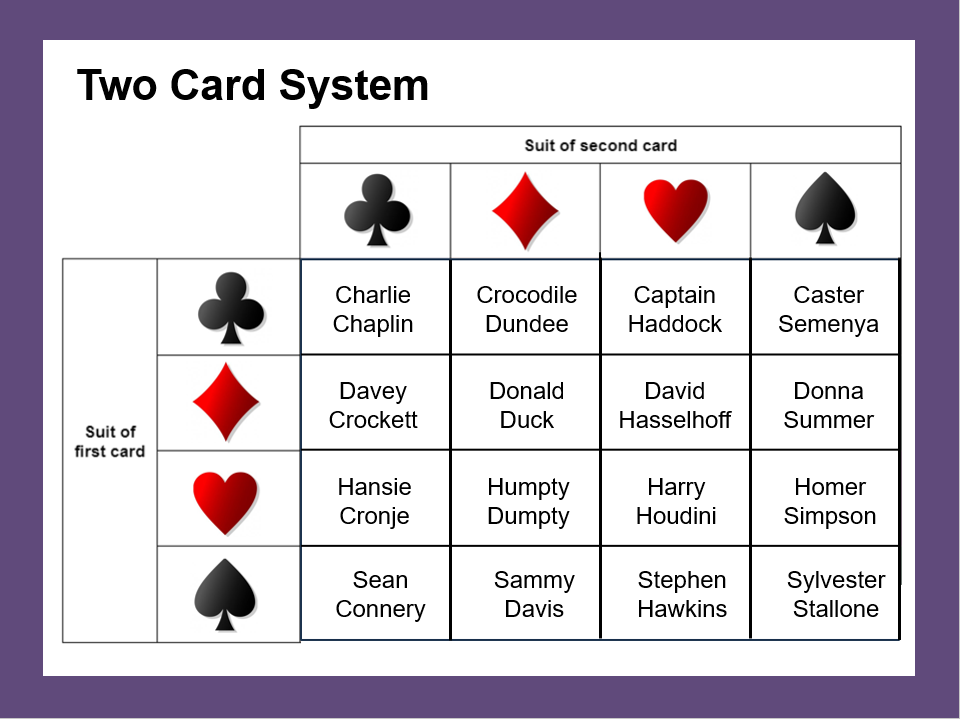
I was thinking that you could quite easily chunk cards in sets of two and place them in a memory palace for easy recall. This is not novel in and of itself but the method I am proposing (and the limiting factor is it probably will only work effectively for single deck recall) is to encode the 16 different suit pairs of cards using people:

You thereafter encode objects for each card pair using a modified form of the major system.

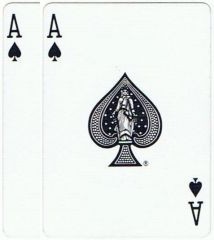
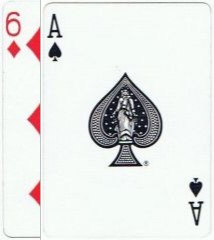
For example if the first two cards in a randomly shuffled deck are 6D and AS this would encode into Donna Summer for the suit values and a JeT for the numeric values of 6 and Ace. So you could imagine Donna Summer flying a JeT at your first loci, which in my case is the Statue of Liberty (using the number shape method).

Any thoughts?

This is a one card system man, 1 card 1 image. Sorry but I don’t think it can be competitive

1 Like

If I only require 26 loci to remember a whole deck of cards, how can you call it a 1 card - 1 image system? You will certainly get recurring persons in the deck due to there only being 16 different configurations of suits: Heart -Heart, Heart-Club, Heart-Diamond, Heart-Spade, Club-Heart, Club-Club, Club-Diamond, Club-Spade, Diamond-Heart, Diamond-Club, Diamond-Diamond, Diamond-Spade, Spade-Heart, Spade-Club, Spade-Diamond, Spade-Spade. I am encoding two cards as they occur simultaneously. You can easily use two digit peg words that you have encoded from 00 - 99 for numeric order of the value of the cards Ace through to Ten. Jack, Queen and King combos will require a different trick though. The beauty of this system is that there is nothing further to learn if you already have a 26 stage loci system and a 00 - 99 number peg system, other than the initials of the people representing each of the 16 suit pairs. There is however some refinement needed to recall the pairs if a court card: Jack, Queen or King appears but that is a minor obstacle to overcome which I am sure many of you can go figure out for yourselves.

If you use 26 loci and have 2 images per LOCI, sorry to tell you that but it is a one card system. a 2 card system is using around 13 loci. You have to go twice as fast as me to get to the same speed. simple : 2 cards - > 2 images - > 1 card system
2 cards - > 1 image - > 2 card system

@IceLegend is absolutely right, @fred2.

With your proposed system you are encoding two very specific elements for every two cards. This means you need to encode and decode 52 unique elements to memorize the deck. Whether each element encodes a complete card, or, like in your case here each element encodes half of one card info and half of another, you still end up with a 1:1 compression ratio of element per card.

This is no more effective than a “standard” single card P/O system. In fact, it may be less effective because instead of using each element to encode a complete card, it makes it more complicated by each element encoding only half of each and the user would need to spend extra mental effort “recombining” them when recalling the deck.

The number of loci needed has nothing to do with anything really. With a true 2-card system, you can use 26 loci, with one element per loci, or you could use one loci with 26 elements stacked there, or you can decide to put 2 at each, using 13 loci… or you can even spread them out randomly, 1 element here, 3 there, 5 there, as sometimes happens with 2-block systems. The crucial thing is how many cards worth of information you can compress into a single ELEMENT.

A 2-card system means that you see two cards and translate the indices together somehow into a SINGLE visual element that only requires 26 unique “things” to encode a deck. So instead of seeing
6dAs
and needing to encode it as “Donna Summer flying a Jet” (2 distinct elements), you’d be able to see that same card pair and read and visualize it as “ShooT eM”
613shootem

and use just that single mental element to encode both of those cards. Do you see the difference?

There are 2704 possible pairs of cards if you allow for duplicates like
AsAs

This means you’ll need a system capable of generating 2704 unique single images to gain the advantage of a 2-card system. (It can also be done with half of this, 1352 elements, using a 2-block system, which we’ve discussed before, or 676 if you combine block techniques in something like the double2block system.)
1 Like

OK I understand what you’re getting at with the 2704 unique single images for all combinations of two cards (including duplicate cards). I am sure there is a mathematical formula out there that explains how you arrive at the figure of 2704 precisely, without having to write down all 2-card combinations? But I digress. I know too that we have discussed a 2-block system elsewhere, could you kindly provide me with the link so I can again get my head around how we go from a 2704 image system, to a system that is half that namely: 1352 images (duplicate cards included).

No more silly ideas to be posted by me though, least they are shot down by the ‘mnemonic police brigade’. As always Tim, thank you for your response and candid reply which you have ‘constructively criticized’ and contributed value to my understanding of the topic.

@IceLegend it looks like its back to the drawing board for me in trying to refine alchemist’s gold or in this case a card recall system that can improve upon my PAO card system which is not yielding fast enough times for me. Incidentally, @IceLegend, I was in no way comparing my suggested system with any system that you are using, so I’m at a loss as to why your comment: You have to go twice as fast as me to get to the same speed. simple : 2 cards - > 2 images - > 1 card system
2 cards - > 1 image - > 2 card system?

Enough said.

1 Like

If you allow for duplicates, there are 52 options for card one (every card in the deck) and 52 options for card two (every card in the deck).
52 x 52 = 2704.

If you don’t allow for duplicates there are 2652 total combinations. Found by taking the 52 options for card one (all cards in the deck), and 51 options for card two (all cards except the card that was used for card one).
52 x 51 = 2652

haha, there’s nothing wrong with ideas! If this system you’ve proposed makes sense to you and you can quickly convert that data and memorize with it at a speed you’re happy with, then embrace it and use it!

Here’s a couple links explaining how you arrive at the 1352 total, by cutting the total elements needed for the pair combos via the 2-block system:

1 Like

I get the “ShooT” part of your 6 and Ace pairing but how does eM supposedly signify the suit order Tim?

In my system, the suit combos :diamonds: :spades: and :spades: :diamonds: are phonetically mapped to the M sound.

So for “shoot em”:
SH = 6
T = Ace
M = :diamonds: :spades:

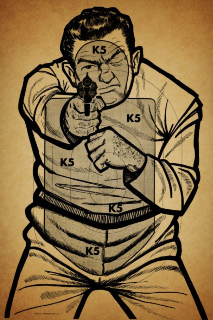
I “read” the indices of the pair as “shoot 'em” which reflexively triggers the visualization of this gun range target. When I go to recall, I see that visual in context of the loci and whatever other elements are involved in the scene and know that in that specific place in the deck I have the 6 :diamonds: and A :spades:. I know the suits are :diamonds: :spades: and not :spades: :diamonds: in one of two ways depending on which system I’m using to memorize. If it’s my 2704 element Person/Object system, I know that the target is an object and I’ve structured my element mapping in such a way that all of the red-first pairs are objects. If I’m using my 2-block system, if this element appears last at it’s loci, I know it’s the red-first version of the suit combination.

I edited my previous reply to include links that further explain the 2-block (1352 pair) approach for you!

1 Like

Yes.

If you can make a Donna Summer palace with 169 loci, but instead of that have a unique meaningful Donna Summer pair . . . never mind, I am getting confused.