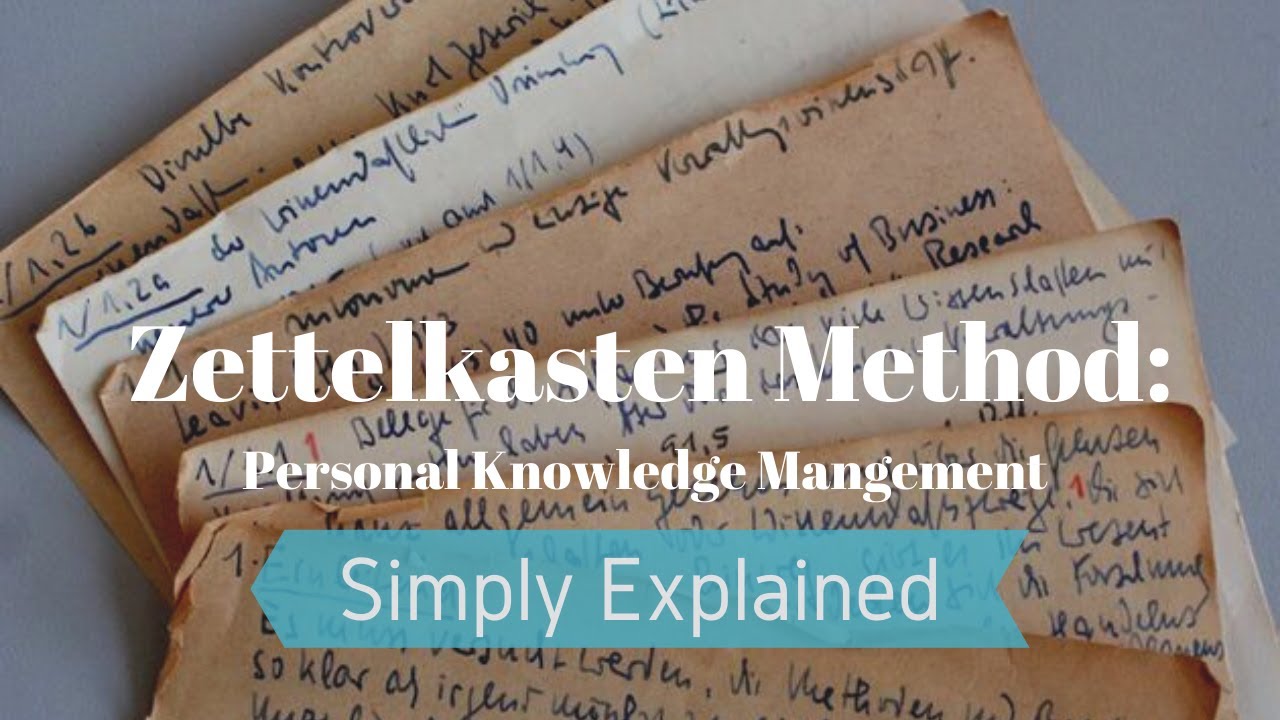
I would like to mention about this book here>> How to Take Smart Notes: One Simple Technique to Boost Writing, Learning and Thinking – for Students, Academics and Nonfiction Book Writers
It is a great book written not only on “Zettelkasten” theory in depth,but on 'effective learning,long term memory,creative thinking,writing",etc.
With Zettlekasten,we connect our notes/ideas/writtings in a meaningful way with one another in order to cultivate knowledge. The author says:
Learned right, which means understanding, which means connecting in a meaningful way to previous knowledge, information almost cannot be forgotten anymore and will be reliably retrieved if triggered by the right cues. Moreover, this new learned knowledge can provide more possible connections for new information. If you focus your time and energy on understanding, you cannot help but learn. But if you focus your time and energy on learning without trying to understand, you will not only not understand, but also probably not learn. And the effects are cumulative.
Here is a problem, I myself experienced with Flash cards in Anki, that the author mentions in the book:
Just by working with the slip-box, we retrieve old ideas and facts on an irregular basis and connect them with other bits of information – very much how experts recommend we learn (Bjork 2011, 8; Kornell and Bjork 2008). This is also the idea behind flashcards. But even though flashcards are much more effective than cramming or reviewing information within the context of a textbook, they also have a downside: The information on flashcards is neither elaborated on nor embedded in some form of context. Each flashcard stays isolated instead of being connected with the network of theoretical frames, our experiences or our latticework of mental models. This not only makes it much more difficult to learn, but also difficult to understand the implications and the meaning of information (cf. Birnbaum et al., 2013). A scientific term or concept only becomes meaningful within the context of a theory – otherwise it would just be a word.
Here is an interesting article on “The Collector’s Fallacy” and how to solve this problem with “Zettelkasten” system! The Collector’s Fallacy
All these years,I had been collecting articles,notes,writings one after another. And I never created meaningful connection among my collections. I feel,I also suffered from ‘collector’s fallacy’!
Let’s call this “The Collector’s Fallacy”. Why fallacy? Because ‘to know about something’ isn’t the same as ‘knowing something’. Just knowing about a thing is less than superficial since knowing about is merely to be certain of its existence, nothing more. Ultimately, this fake-knowledge is hindering us on our road to true excellence. Until we merge the contents, the information, ideas, and thoughts of other people into our own knowledge, we haven’t really learned a thing. We don’t change ourselves if we don’t learn, so merely filing things away doesn’t lead us anywhere.