One of my 2024 goals is to get started with zettelkasten. So far I’ve only been experimenting, but the least I can do is keep experimenting until it’s a habit. I wish to keep myself accountable somehow, such as by journaling about it.
I’m very curious what you mean by hieroglyph cards, so feel free to expand on that!
I’ve also been trying to get into zettelkasten recently so I’m very excited for any future updates.
By hieroglyph card I mean I draw a hieroglyph and write down the pronounciation and meaning on one side of a card, such as “ankh - [hieroglyph named ankh] - life” on one side, and a designation, such as “EGY-2a” on the other. Then related 'glyphs like “plant” and “tree” are “EGY-2b” and 2c. I don’t know if it’s the best way yet, but I’ll just have to try something.
I didn’t know about it either, thanks for posting the link and @Ylva thanks for sharing!
I have recently started using Obsidian for consolidating general notes (neither evernote nor onenote worked very well for me) and it seems like it might be a good tool for a digital Zettelkasten…
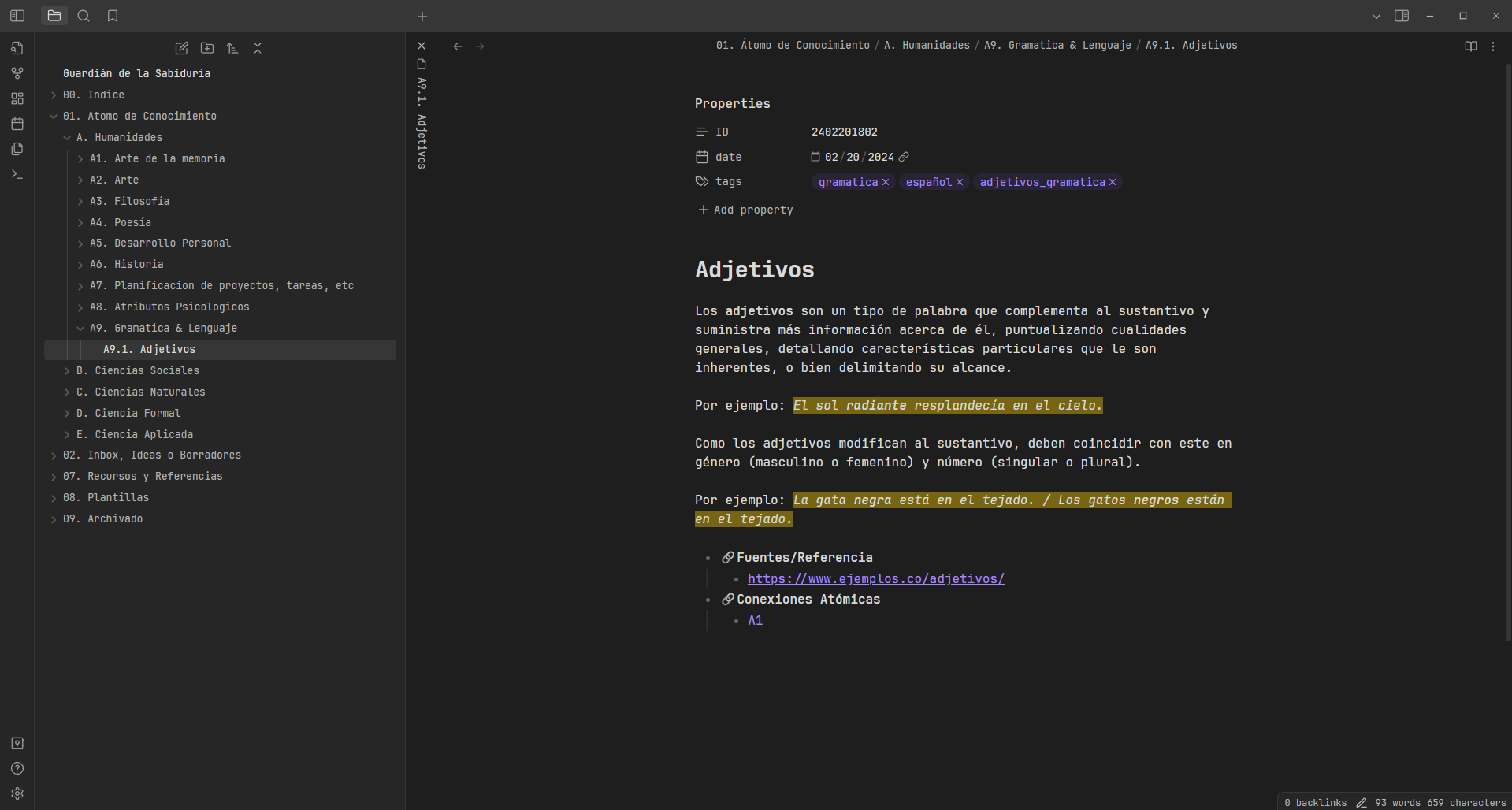
I’m sorry because my notes are in my native Spanish language but I use an atomic structure for most of my notes, but for some notes the atomic structure may be merely impossible, I like obsidian for my notes because I can connect them easily, it’s true which requires an initial learning but it is not an overwhelming learning… For my computer science study notes I cannot use atomic notes and what I do is make technical notes which I put aside, if possible I create specific notes outside the technical note to complement it and thus not have too extensive information in a single note… The best thing for the notes is that they are not extensive, but rather atomic, that by themselves they can give you the necessary atom of knowledge and all together a depth in a topic .
I was very demanding in the past with my knowledge since I wanted everything as detailed and extensive as possible, this is not a bad thing, but it usually happens that you want to trace the original text of what you study, read, etc… I’m sorry for quoting so much This character in this forum, but thanks to him I learned a lot and he is Giordano Bruno, in one of his works he talks about ideas and self-knowledge, the value of our ideas and how wonderful they are, ideas are not perfect if they are not May you sit in the shadow of truth between light and darkness, with the shadow in the middle being neither truth nor falsehood. So if you do something wrong, you will correct it as you find your truth, do not despise your own ideas… I have a book that I could share with you, although I do not follow its advice to the letter, it was very helpful to me to implement zettelkasten now. which is very detailed about this… You can send me a private message and I will share it with you.
Along the way you will look for your way and what suits you best.
Well, my NY goals were to implement the following memory habits:
Zettelkasten
Henner method (do a search)
200 vocab words a month (via goldlists)
Here’s how it’s going:
I got bored with zettels, mostly because I had to index everything. I did however discover that I enjoy making Pokemon cards for subjects/items of interest.
I do in fact relive things a fair bit. Needs work, though.
I’ve cooled on goldlists a bit. It worked just fine, great really. I got between 20% and 30% right of a hundred words a day. It’s a lot of work, though.
I’m considering variations and alternatives, so if anyone has any suggestions I’m all ears.
---
ID: "{{date:YYMMDDDHHMM}}"
aliases:
date:
tags:
---
# Descriptive title

(Write the central idea or concept clearly and concisely, making sure it is self-sufficient).

## In-depth (optional)

(If necessary, add additional details, examples or context that enrich the main atomic idea).

## Visualization
(Describe how the information can be represented visually. Include diagrams, pictures, schematics, or any other visual form that helps to better understand the idea).

> [!info]- Reference information.
> - **🔗🔗Sources/Reference**
> - **Type (Book/Article/Video/Web)**: Brief details of the source. [Link if necessary].
> - **🔗Atomic Connections**
> - [[Other related note (atom) ID]]
> - [[Other related note (atom) ID]]
Example:
Atomic Notes
Atomic notes are small units of information that focus on a single concept or idea. Each note should be self-contained and contain clear and complete information on a specific topic.
Synonyms**: Stand-alone notes, micro-notes.
Example**: An atomic note on “photosynthesis” might explain only the process by which plants convert sunlight into energy.