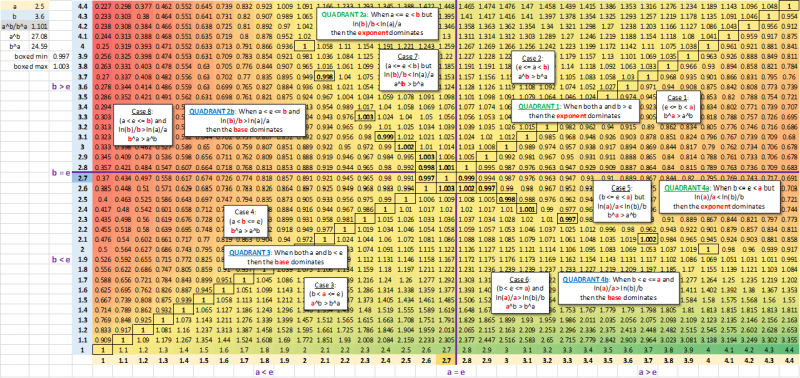
Here’s an unusual challenge for mental calculation, and I’ve made it to a point where I could use some help from the mental math calculation in this forum.
The challenge is: Given two different positive real numbers, a and b, quickly determine in your head which is greater, a^b (a to the power of b) or b^a (b to the power of a). Ideally, this should be done without mentally calculating the answers themselves.
Having done some work and research on this on my own (links below), I’ve found 3 simple patterns:
Which is Greater: a^b or b^a?
e^pi vs pi^e
-
If both numbers are equal to or greater than e (2.71828…), the smaller number to the power of the larger number (such as 3^4) will be greater than the larger number to the smaller power (such as 4^3).
-
If both numbers are equal to or less than e (2.71828…), the larger number to the power of the smaller number (such as 2^1.5) will be greater than the larger number to the smaller power (such as 1.5^2).
-
If either one of the numbers is e (2.71828…) itself, then e^b will be greater than b^e, regardless of which one is larger.
This just leaves one variation challenge to which I haven’t found a simple rule. What do you do when given two different positive real numbers, where a is less than e and the b is greater than e?
I’ve put together a tool in Desmos, Above/Below e, to work out when the smaller number to the power of the larger number becomes greater than the larger number to the smaller power, focusing on intervals of 1/10th. The points graphed are where this occurs. For example 2^4.1 is greater than 4.1^2. But once b (the larger number, above e) drops below that point, you have either equality (2^4 = 4^2) or the reverse relationship (2^3.9 is less than 3.9^2).
Note that the graphed relationship is that of an exponential curve, which can make this difficult.
Is there a simple mental way to work out which is greater via a rule, like the 3 above, when a is less than e and b is greater than e? If not, is there any other simple mental way to work out which would be greater without performing a^b and b^a in your head directly?