Now, a new study shows that mice prevented from eating at all hours avoided obesity and metabolic problems — even if their diet was sometimes unhealthful.
Researchers at the Salk Institute for Biological Studies in San Diego and elsewhere began experimenting with the eating patterns of laboratory mice in a previous study. On that occasion, some mice consumed high-fat food whenever they wanted; others had the same diet but could eat only during an eight-hour window. None exercised. The mice that ate at all hours soon grew chubby and unwell, with symptoms of diabetes. But the mice on the eight-hour schedule gained little weight and developed no metabolic problems.
"Meal times have more effect on circadian rhythm than dark and light cycles," Dr. Panda says. And circadian rhythm in turn affects the function of many genes in the body that are known to involve metabolism.
The body needs time to adapt to fasting, if you’ve been eating every couple hours most of your life. In a week or so, should be fully adapted. What schedule are you using? 16/8? 18/6? 20/4? (16h fasting, 8h for eating). 2 day fasts(complete, no ‘caloric restriction’) are amazing . Glad you’re testing it out
With some research I couldn’t find anything to justify me being against corn. I must have been mistaken, my bad.
On aflatoxins, it seems logical that they would increase if you tried to ferment the corn, since they are produced by a fungus.
Restricted calories and fasting are apples and oranges.
Sure, they both have sugar… Or however the metaphor goes, but they are completely different. Good luck
With fasting you enter ketosis, start burning fat for energy, some would argue this is the natural state for humans. Restricted calories just give you less sugar, causing it to drop, making you crave more sugar, etc.
Evernote is good. I use both, but I haven’t figured out how to send articles into Evernote from my phone without getting them mixed up with my other notes. I use Pocket for articles, and Evernote for notes that I write.
This brief test on the BBC will let you know if you are an Constant Craver, Feaster or Emotional Eater and then give some tips on the three diet types.
I use Pocket and Evernote too, I use Pocket less and mainly use it to read later articles that interest me (It was previously called read later IIRC). I want to try incremental reading at some point but I can’t get on with Supermemo and haven’t got the hang of it with Anki.
Anway, on Android you can install Evernote and then just “share” the page with Evernote which saves the whole thing. Or you can forward the page to your evernote email address and it will just save the link.
I removed my restriction on nightshade family vegetables except for potatoes. I think I’m also going to add a small serving of meat once per month.
I figured out a way to like sweet potatoes – bake them instead of steam them. When they are baked at 375° F, something happens to the flavor. Maybe the sugars are caramelizing. I wonder if baking improves the taste of squashes too.
I’ve been trying many different varieties, and these two are my favorite (see below). The one on the bottom left is purple all the way through. I’m pretty sure that it is a sweet potato and not a purple yam, but I will have to check next time I go to the store. I don’t know if I have ever cooked true yams, but I will see if I can buy some tomorrow.
The one on the top right is whitish inside, but turns off-white when cooked. I like the dryer texture. It might be a boniato.
I haven’t eaten any sugar* in a few months, so maybe that’s why these things taste so good. Or maybe I am craving calcium. I’m not sure if I’m eating close to the recommended 1000 mg per day.
(* There is a small amount of sugar in my picked herring, but I rinse them off before eating them.)
I’m doing some more research on how cooking methods affect the sugar in sweet potatoes, and it isn’t looking good:
For GI [glycemic index], anything below 55 is low, and anything over 70 is considered high. Numbers from 55–69 are medium.
The same foods can have a very different GI and GL [glycemic load] depending on how they are prepared. A boiled sweet potato has a low GI of 44 and a medium GL of 11. But if baked for 45 minutes, the same sweet potato has a GI of 94 and a GL of 42, both extremely high. Baking has essentially turned the sweet potato into candy.
…Have you ever noticed how sweet beets taste after baking or microwaving? That’s because much of their carbohydrate content has been converted into glucose.
There is more info on the GI and GL over here and here.
Not eating sugar(pop, candy, fruits) is interesting. There have been times where I completely stopped eating all simple carbohydrates(sugar+fruits+bread/chips/all white carbs) for a period of time, only eating complex carbs for sustained energy. When I reintroduced those simple carbohydrates, I always started feeling bad, emotional swings, hunger swings, more sustainable to sickness. It’s basically the same thing everywhere in life; simple fast and easy vs long term investment.
Your tastes also change tremendously. If you’ve been eating junk food all your life, then stop for even a month, you won’t be able to stomach it. It just tastes so bland, like cardboard compared to real food. When juicing, after a while pure vegetable juice tastes good and sweet to you. I’m at a point where if I ‘slip’, and buy 72% dark chocolate instead of 85%, it tastes as sweet as a snickers bar used to taste. Bitter taste almost doesn’t even exist anymore(other than very burnt foods).
It’s also interested me lately how different ways of preparing foods can change the properties of that food. Ie: if you mince garlic and let it sit for 10 minutes, allicin and allucin(those aren’t correct), which are usually separate in garlic cells, combine to form the very beneficial alacin(again, not correct). Now baking vs steaming either raises the GI of sweet potatoes or lowers it respectively. Interesting.
I don’t have any craving for candy at the moment. I don’t eat any refined carbs, except for one time when I got stuck without food before a meeting and only had time to get some avocado rolls with white rice. I think that the white rice was my only “cheat” in several months, and only because I had to keep my brain working for the meeting – otherwise I would have gone home for food.
When I was 18, I was living off of Taco Bell and junk food. I was able to eat at MacDonalds. These days, I would rather go without food for a day than eat it.
I think that industrial scale fast food is engineered to be addictive, but that it only becomes tolerable if you eat it a few times. If one can stop for a period of time, the cravings will turn into aversion. Sense of taste will return. Learning how the food is made helps too (sawdust, chemicals, animal abuse, etc.).
My next food project is to figure out how to be sure that I’m getting the recommended daily intake of calcium without eating dairy.
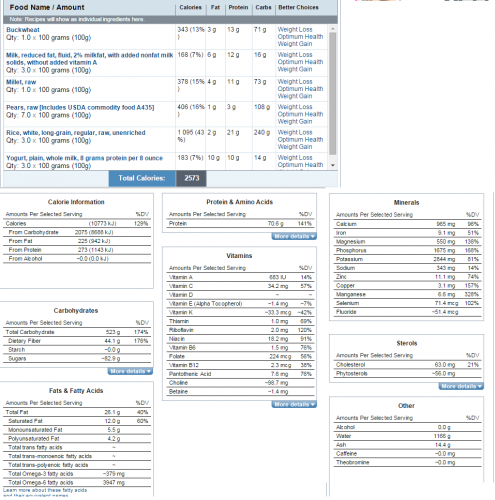
You can use nutritiondata. Just search for the foods you currently eat, add the right amounts and put them in your tracking list (you have to be registered for that). It calculates everything - total calories (and shows cals in each food independently), cals in [protein, fat and carbs], vitamins, minerals, amino acids…I discovered my diet lacks in some vitamins.
I looked up chopped garlic, and Wikipedia has some information on the allicin page. I eat a fair amount of garlic every day. Maybe I should let it sit for a little while after chopping.
I just registered for the nutrition data website.
It seems tricky to get 1,000mg of calcium per day just from minimally-processed vegetables, though the first 3 items have more calcium than milk:
Collard greens, cooked 1 cup 357
Tofu, processed with calcium sulfate* 4 ounces 200-420
Tofu, processed with nigari* 4 ounces 130-400
Turnip greens, cooked 1 cup 249
Tempeh 1 cup 184
Kale, cooked 1 cup 179
Soybeans, cooked 1 cup 175
Bok choy, cooked 1 cup 158
Mustard greens, cooked 1 cup 152
Okra, cooked 1 cup 135
Tahini 2 Tbsp 128
One of my favourite things in my kitchen is a little garlic plate. You drop a little oil on it, then grate the garlic, then use a little brush to get the grated garlic into your pan.
I find it gives an almost purer flavour of garlic than by chopping. I’ve often thought that I’d like to prepare a couple of dishes in exactly the same way with the exception of the garlic method and see if it makes a difference.
There isn’t a “best” nutrition for everyone. However, there are some guidelines.
About 1/4 of us can have all the flour, sugar, fruit we want and handle it just fine. It’s a genetic accident, not a sign of superior character!
The rest of us will generally do better eating a lot less carbohydrate. There is a full spectrum of carb-related abnormalities all the way from a little plump around the middle all the way to frank type 2 diabetes, and eating less carbohydrate works very well for almost everyone.
I personally follow “The New Atkins for a New You” by Eric Westman MD, a Duke medicine professor. NO, Atkins won’t kill you; that is a persistent myth! Many recent studies past fifteen years; it is an excellent way to eat.
For exercise, I personally like “Body By Science” by Doug McGuff MD. It is once a week, weightlifting on machines to momentary muscle failure over about 1:30-3 minutes per exercise. It’s really intense but with machines it is very safe and there are studies that whether you use free weights or machines makes little difference. It’s 30 minutes per week; highly efficient. I’m 60 and pushing over 330 lbs on a Nautilus Leg Press for over 2 minutes; it’s a real workout. McGuff claims that is all the “exercise” a person needs and the rest of the time just “be active.”
For brain and memory, there is an additional “tweak” you might consider, and that is nutritional ketosis. When you go low carb and eat enough fat, your metabolism switches from glucose-dependent to a more flexible ketone burning, and there is some evidence that you get mentally sharper in ketosis. (Note that this is NOT ketoacidosis, a medical emergency that diabetics occasionally have; they are completely different despite the similar names.) You can also get into ketosis by addition of coconut oil or MCT (medium chain triglyceride) oil to food. Best intro is probably Jimmy Moore, who has a book called ‘Keto Clarity’ and a website called “LivinLaVidaLowCarb.com”.
Good luck. Lots of links to all these on my website, PaleoPathologist.com. And I’m not selling anything there.
Various ways of eating probably work differently for people. I was into a book called Nourishing Traditions for a while (lots of meat and dairy), but I gained a lot of weight and didn’t feel well. High-protein, low carbohydrate diets don’t seem to work for me. I know that some people have success with it though.
I was a vegetarian until I was 12, so maybe I didn’t develop the microorganisms required to easily digest a lot of meat. I also didn’t eat much sugar and never drank a soda until I was about 17. That surely must affect gut bacteria.
I looked into the Paleo Diet a little bit when it first became popular, because I had a strong interest in hunter gatherer cultures for many years. The way I eat is partially based on my research from that time, but I came to some different conclusions than the authors of the Paleo Diet. (E.g., I eat significant quantities of whole grains and whole vegetables but not a lot of meat.) I’m definitely not an expert on nutrition though, and consider all of it to be self-experimentation.
I think I finally solved my calcium problem. I ate a lot of Napa cabbage today, along with salmon, tahini sauce, and tofu. I also picked up some collard greens (giant nutritious broccoli leaves) for tomorrow. Definitely made it past 1000 mg.
The thing about using free weights is you also build balance; you learn to control the weights, keep them from moving left and right, up and down. This involves a lot of small muscles that are not necessarily activated when using machines.
I’ve looked into MCT oil [http://healthimpactnews.com/2014/mct-oil-vs-coconut-oil-the-truth-exposed/] recently, and it looks like a marketing scam(by dave asprey).