There’s an online version of a test based on those ideas here:
I’ve taken it three times about a year apart and always get the same answer. I’ve found that the resulting description is uncannily accurate for the most part, but I’m not sure if it’s a Forer Effect or if they are just rewording my answers and repeating them back to me.
Has anyone taken the MBTI assessment, and what do you think about it in general? Do people who are interested in memory fall into certain categories? (e.g., “introverted”)
This question came up once in an online discussion among bloggers, and most people said that they were INTJ with a couple of scattered other types.
It’s interesting. Jung’s analysis of archetypes is more interesting. MBTI is somewhat of a boiled down version, and Color Q is boiled down further. With Jung, there is a focus on “styles” and functions of cognition; two “preferred” ones work synergistically in each person’s psyche, and the psychic consequences are analyzed. The most important way that it differs from MBTI is that “attitudes” are portrayed, but behaviors are not. It is therefore closer to soundness: behavior is contingent upon far too many factors for amperson’s actions to be confined to one of 16 blocks, and the reader of a Kiersian profile will have to monitor themselves for confirmation bias. I see that you have done that.
There was an philosopher, who probably has earned his doctorate by now, who used to post detailed analyses of the cognitive functions of types, types’ introverted or extroverted attitudes, and their implications. This was about 5 years ago, when I used to frequent MBTIcentral (or typologycentral; the name changed one way or the other). He called himself “Bluewing” at first, and then “SolitaryWalker.” His avatar is Spinoza. I don’t think he ever completed the analyses of “S” types - only the 8 “N” types. They are very entertaining if you have an interest in the subject.
I assume that you are an INTJ? Or ENTJ, perhaps? I am an xNTP. I don’t prefer the company of people if I have the choice, but speak with less reserve, and with outwardly direction, than one would usually see in an INTP. Still, I identify with INTP more.
The INTP.org page that is linked to from that page is mind-bogglingly accurate in many ways, but it’s difficult to be sure that I’m not getting played by some kind of sophisticated astrology.
Example 1: “INTPs enjoy hearing music that they heard and enjoyed when younger (provided they can still appreciate it now)”
Translation: “INTPs like music that they used to like provided they still like it.”
Example 2: “An appreciation of modern classical music, as well as perhaps contemporary jazz, is therefore common with them.”
Translation: “You might like this kind of music or that kind of music or maybe not.” (sounds like cold reading)
But then the conclusion of that section applies very strongly:
"Such music types are usually too complex to be understood after a single hearing, which hence provides excellent material for analysis, exciting the INTP no end. [yes] Once the basic developmental structure of the music has been assessed, Ne provides the impetus to derive a general meaning of the piece. What does the composer wish to convey, for example? Why was that particular development chosen? Indeed, the Ne is usually hard at work during listening sessions, trying to grasp the meanings behind the often fascinating combinations of sound-world evocations, structural developments and nostalgic impressions."
The INTP page seems really accurate about some things, even using some of the same words that I use to describe my ideas to myself. Not all of it is accurate, but where it’s correct, it’s uncanny.
There are some interesting cognitive bias’ in play here.
Self validation bias - you think things are specific to you when they may not be so (basis of forer effect)
can’t remember the name of the cognitive bias but basically you focus on the things that are true and disregard the rest ‘The INTP page seems really accurate about some things, even using some of the same words that I use to describe my ideas to myself. Not all of it is accurate, but where it’s correct, it’s uncanny.’
you should look up the various cognitive bias’ and see how many apply to these tests,
I don’t know much about them, are they basically personality tests like what you would find in a magazine
Yeah… that’s my hesitation about it. The Wikipedia page also has some interesting criticism. Still, it was very interesting reading. I spent three or four hours reading the page yesterday, and might go through a printed copy with different colored highlighters to see exactly which statements apply and which statements appear to be reaching ambiguously…
Hopefully you find some time to Read SolitaryWalker’s INTP analysis. It is brutally objective, and like I said, stops short of suggesting specific preferences or behaviors, unless the reasons behind them are clearly stated.
I just read it… One part seemed to be completely different than my personality, but where it’s right, it’s pretty close.
That is an interesting statement, because my test score was “100% introversion”. When I asked someone else to take the test, their scores were all moderate (25-44%). Maybe this is why I always get the same result, where some other people apparently get different results each time they take the test?
I’m fascinated by the idea that there might be a system for categorizing personalities. I found another list of tests here, but I haven’t looked at them yet:
Lately, I’ve been getting interested in machine learning and data visualization. I’m wondering if there would be a way to create a Facebook app that gives people a personality test once per year. It could track what kinds of personalities become friends with each other, and which types of personalities tend to shift to other kinds of personalities on a retake. I would need to figure out how to create an MBTI-type test though…
If I recall, the MBTI is 72 questions built to inform the levels of the eight “axes” or “extremes” I, E, T, F, J, P, N, S.
That means that it is most likely to have nine statements that ought to be favored by a person who is characteristic of any one of these axes. Nine questions, so there cannot be a tie. (Actually, there are nine questions for the opposite end of the spectrum, so I guess there really could be a tie).
There is a personality test based on MBTI that is called Color Q, I think. It is arranged in a tree, so no single person answers every question. It is a lot like the MBTI, and based totally upon it, but it is pared down immensely - I think each oerson only answers 14 yes or no questions total, and there are only 28 possible. It is in the book “Career Match.” I might still have access to that book online through the school library, and maybe I can post some of that here. There four dominant colors, like the humors, NT, NF, SJ, & SP, and inferior colors as well, but I think each dominant color can only have 2 inferior colors, making 8 types, if I’m not mistaken. But I found it accurate, and some of my friends found it startlingly accurate, moreso than the MBTI.
A pared down test like this may be what you’re looking for.
I’m definitely interested in trying to build something like that at some point (though probably won’t have time until 2014 unless there is a set of existing questions that are freely usable). If you find any interesting resources, I’d be interested in checking them out.
I’ve taken this personality test I believe 4 times so far. the first time I didn’t put much attention to it, because it was so long ago and during a phase when I was doing all kinds of tests online (including a lot of rather unmeaningful fun tests with estimated 10 questions per test such as stuff like which fabulous creature fits your personality best etc. :D) and so it was just more like one of many tests to me. But when I took the test again years later I remembered that I had taken it once before and I was able to look back in my mail inbox and found out that I got the very same test result again. That made me a bit more curious about it for a while because it appeared to be one of the more meaningful tests. When I read about it in the descriptions I also found a lot of it was fitting for me. I also learnt that being a male INFJ puts me in the rarest category which led to ambivalent feelings about it. Anyway, rather soon I would forget about it again. However another few years later when encountering someone who was at that moment really interested in the Myers-Briggs test I took the test for a third time and again I got the same result. I dug in even further this time and ever since then it sort of has stayed present for me to the degree that I sometimes watch Youtube videos or read stuff about my personality type, which in a bunch of cases helped me to look at certain aspects about myself, my life etc in a different way and sometimes these videos even provide help for problems you are either specifically having due to your personality type or specific solutions that are suited for your personality.
However I also try to keep in mind the limitations to it. Some aspects of INFJs for instance aren’t typical for me either. Not every INFJ is the same after all. And we are not dichotom beings either aynway. When I got my result some of my traits were much closer to the middle than to the edge for example. And there can be other influences altering your results. For instance I don’t think I’m as strongly introverted as my results stated. Because I have social fears etc. A lot of us due to psychological problems aren’t living out our personality. I’m still probably more introverted than extroverted, but more towards the ambiverted middle than many people would assume about me. But I believe that in some cases it might result in some people receiving letters they don’t actually fit. Also the bias resulting from wrong self-perception seamagu mentioned I’m aware of.
Anyway. the reason why I searched for previous topics on this board is because I had a theory that people with introverted intuition (IN) are most likely to follow a hobby such as memory sports. Your few statements actually seem to support that theory. But I would love to hear from more memory athletes about their Myers-Briggs type. The reason for my theory is that introverted people probably are more likely to enjoy sitting in front of a computer memorizing all kinds of data rather than extroverted people to whom social interaction probably would be missing. about the intuition trait my theory is that while memorizing people work with reduced amounts of senses. Most of what is happening is happening in your mind. And above all you use your fantasy/creativity to form working mnemonics. Of course you might add more or less senses in your imagination. More importantly I would assume that creating your own memory system in the first place in order to use it is something that intuitives probably enjoy much more. I don’t think that sensors are not interested in these techniques per se, but when they are, I’d assume they on average are more interested in them as a tool rather than as a hobby they’d enjoy.
What are your opinions on this and what are your personality types? Should we make a poll?
One Christmas I took a MB questionnaire to a large family gathering at Christmas. It was one of the most meaningful gatherings we ever had as a family.
I believe it brought us together because it afforded us the opportunity to think about who we are and led us to meaningful conversations after listening how other perceived themselves. Each person got a chance to express who they are and everyone listened.
That said, I don’t think MB should be used to screen for team compatibility for work or anything else. It’s bad juju to say some people are inherently not compatible.
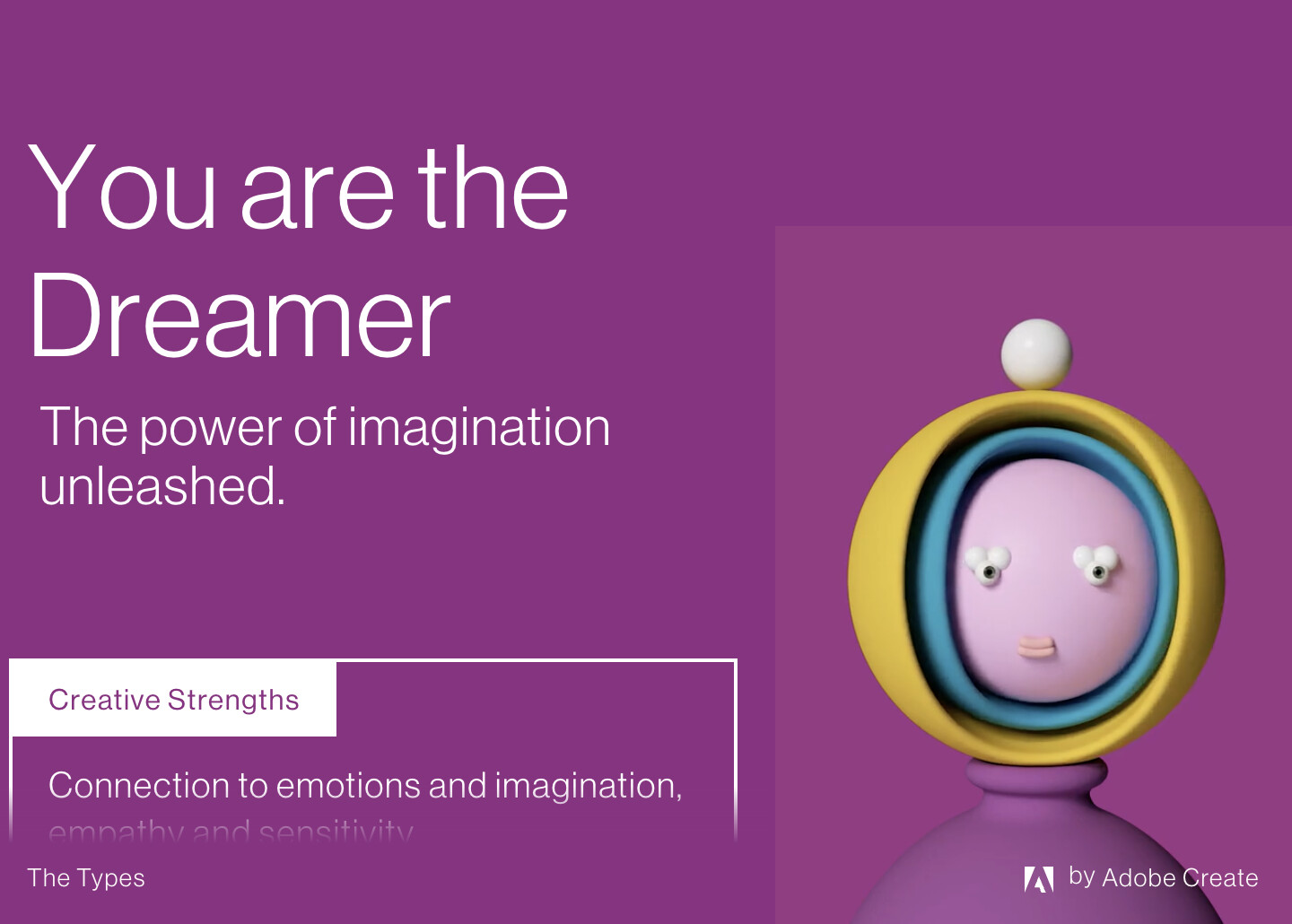
Here is a ‘test’ created by the folks at Adobe to discover your creative personality. It was developed by psychologists. The graphic and motion design of the test is exemplary.
@Josh Was there a theme to subjects of the blogs?
I’m a 505/50 split between INTP and INFP. (I work in design, illustration, and writing about memory.)
Re: introverted. The best description I’ve found is that an introvert seeks time away from people to ‘recharge their batteries’.
I’m an introvert, but I’m not shy. I have no trouble with public speaking or talking with strangers. I just need time to myself to be zen. :- )