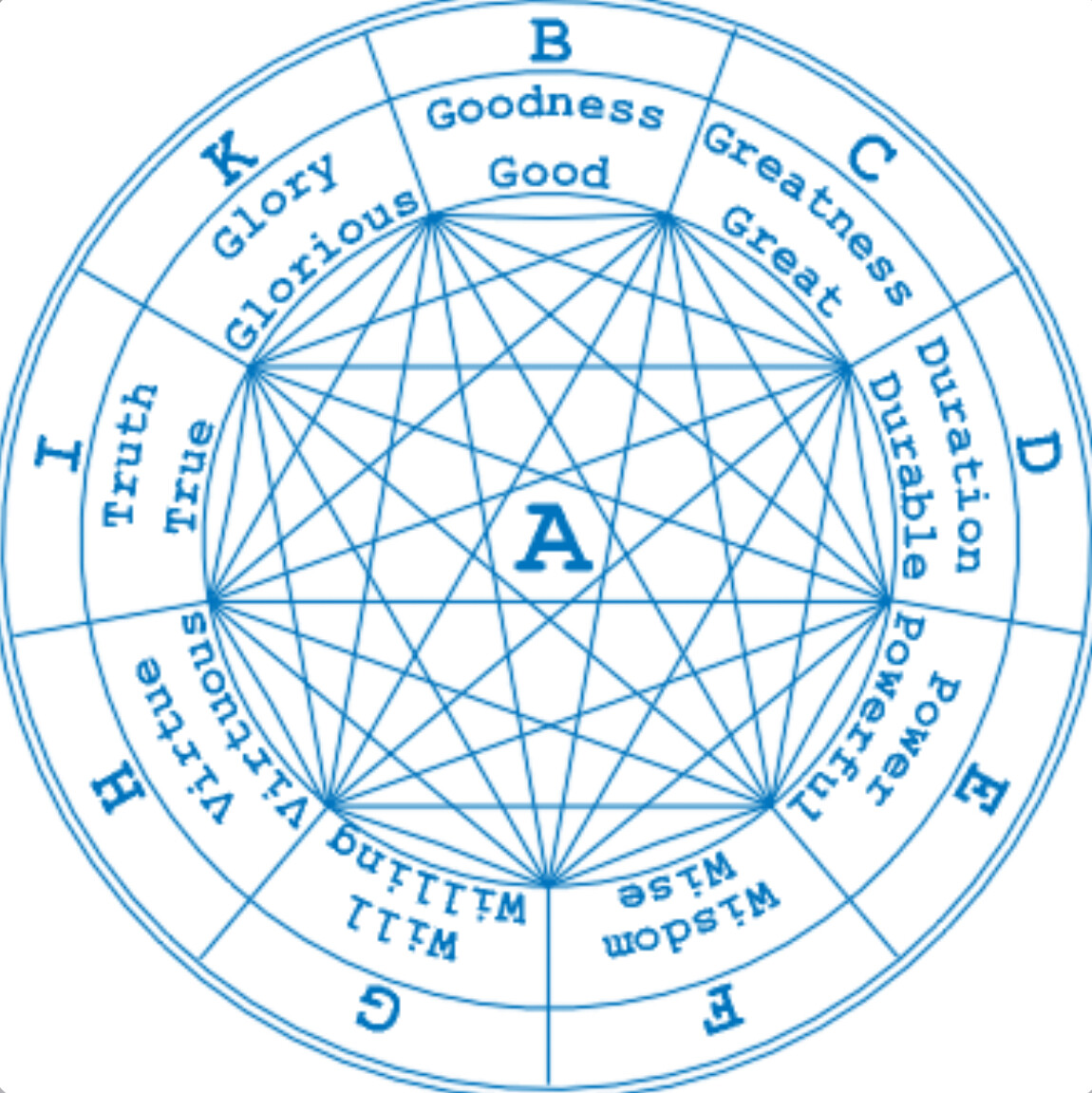
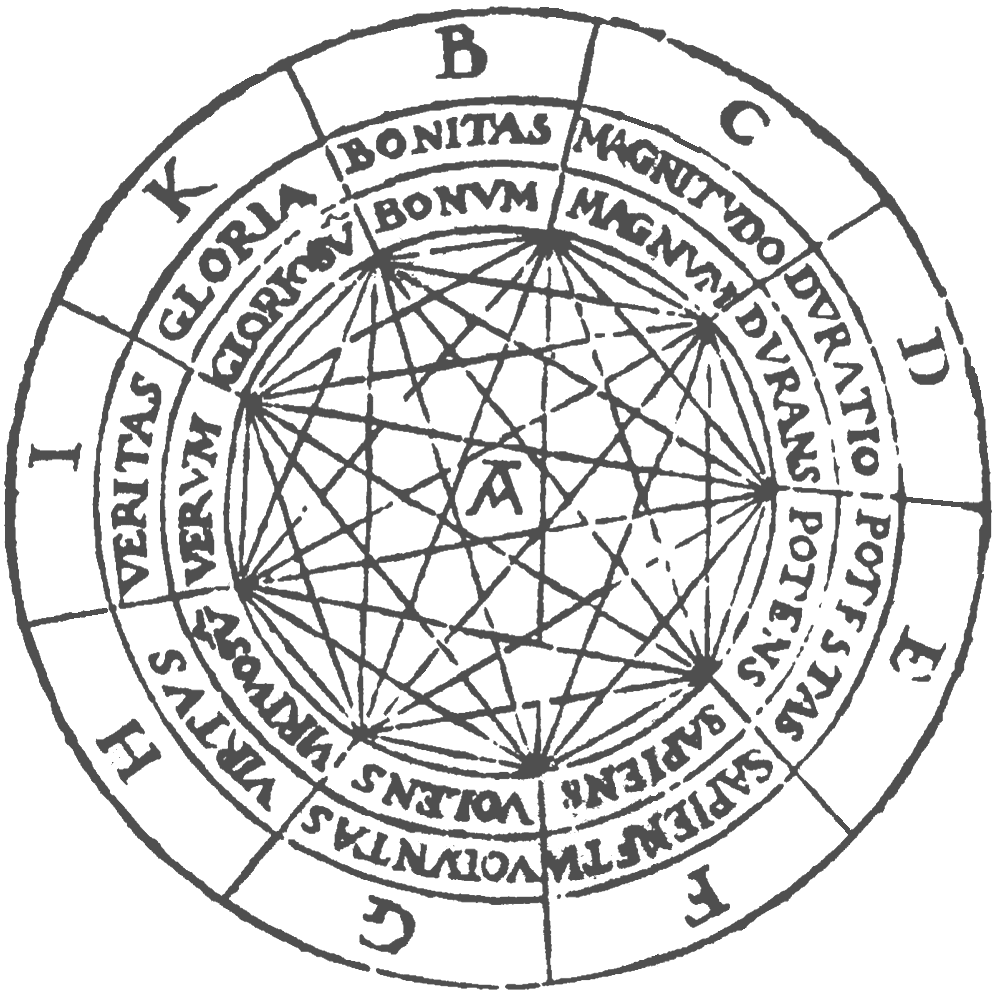
I’ve been researching these lately for the purpose of adapting them to the field of law, so I’ll share what I’ve found so far. Lull used his wheels in order to dynamically generate statements and questions about the world, starting with common premises and concepts of the three abrahamic religions he’d encountered. Bruno does this as well with by combining philosophical notions such as in the first part of De Umbris Idearum, but also, as you’ve noted, uses them for his PAO system. For ease of reading, I’ll include the wheel you’ve already sent here (labelled ‘Wheel A’):
As you can see, it is filled with both nine divine attributes (concepts) like ‘glory’ and the corresponding nine adjectives like ‘glorious’, here positioned under the letter ‘K’. This is by no means the only meaning that can be inferred from the letters A-K though, as Lull also uses nine relational categories (qualitative difference, being greater than, etc.), nine questions (‘What?’, ‘How?’, etc.), nine subjects (angels, humans, god, etc.) and nine virtues (justice, piety, etc.), with each member of these delegated to one of his letters. Now image a three-tiered wheel like wheel ‘A’ above, with each tier being filled with one of these categories, let’s say they are questions on the outermost wheel, adjectives on the second and subjects on the third wheel. You would then rotate the wheels like those on a combination lock to wind up with different combinations, for example B - H - E, which with the afforementioned values gives you ‘What’ - ‘Virtuous’ - ‘Human’.
The next step is interpreting these combinations into workable statements. For a PAO, it would of course be very obvious that ‘Batman’ - ‘kicking’ - ‘top hat’ is to be interpreted as ‘Batman kicking a top hat’. Were we to take a similar approach, the combination we generated above would be something like ‘What makes humans virtuous?’ or ‘What is virtuous in humans’? However, Lull goes a step further by introducing a letter ‘T’ which can be inserted at any position a given combination ‘XXX’. So both ‘XTXX’ and ‘XXTX’ as well as a number of others are permissible, though Lull excludes others such as any combination which would place the same letter at on the same side of ‘T’ twice or anything categorically impermissible like linking the subject ‘plant’ and any virtues (since plants cannot be virtuous’) or linking the subject ‘angel’ and any vices (since angels are supposed to be morally perfect).
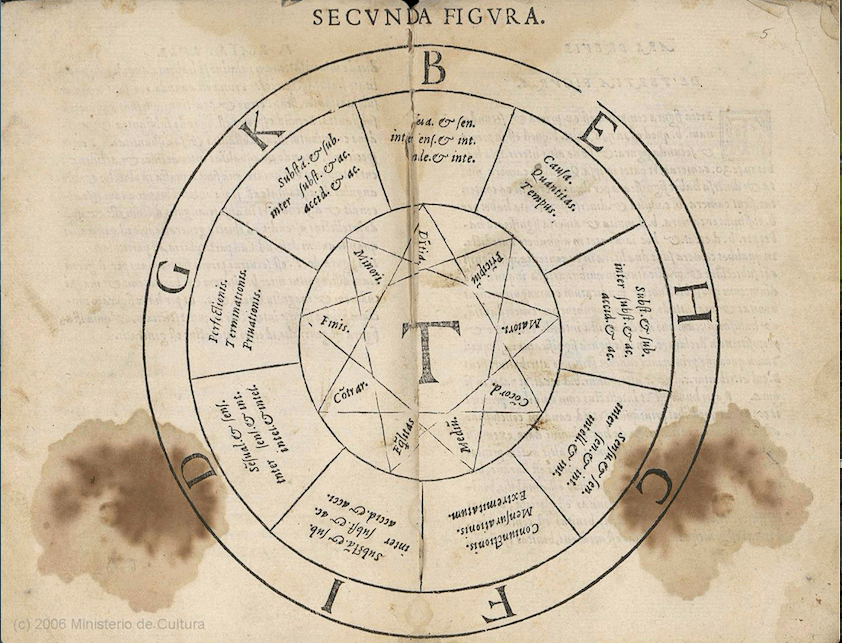
Now, the letter ‘T’ is itself interpreted using this wheel right here:
As you can see, there are three triangles. Each of these signifies a relation at each of its corners, eg the first triangle has difference, identity and contrariety respectively. These are then further subdivided, such as in difference between physical and physical, physical and spiritual and spiritual and spiritual. What division and subdivision is to be picked is, again, directed by several rules. Coming back to my earlier explanation, a given combination ‘XYTZ’ may be interpreted as ‘Why is Y different from Z?’ given one distribution of the categories onto the wheels, ‘X and Y are greater than Z’ given another.
Now, why go through all these steps just to wind up with seemingly random statements? For Lull, the answer lay in his missionary work: Provided he could get whomever he wanted to convert to accept his grammatical/interpretative rules, these statements would be equally valid given the same content was associated with the letters A-K. After all, christians, jews and muslims all believed in an omnipotent, all-knowing god (and that plants could not be virtuous). If you held the rules to be valid, and common premises to be valid, then the answer to any theological disagreement could be objectively calculated. In a similar vein, a theologian could expand his knowledge by himself using the wheels in generating new questions to seek answers to. In that sense, it could be viewed as a spiritual ancestor to the modern computer.
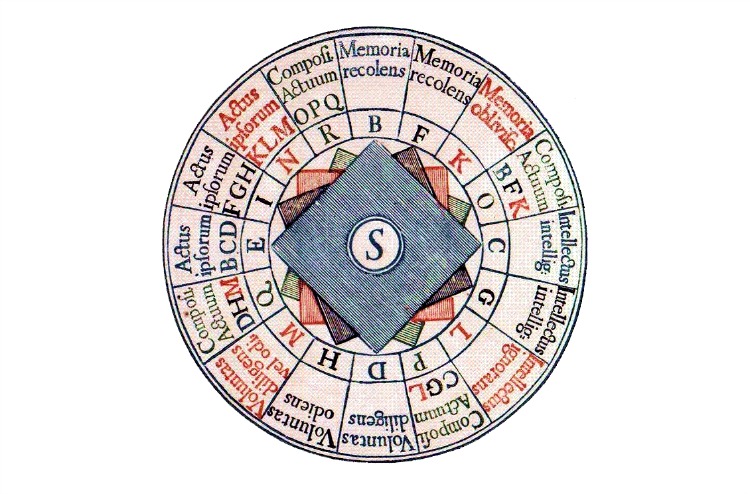
As mentioned, Bruno uses these both in a conceptual way similar to the one above and as a PAO, for example in ‘On the shadows of ideas’ and ‘The Seal of Seals’.