I’m at a crossroads in my life. I need to change to a profession where having a good memory helps. I have done some research on the web, but most of the results I’ve found I didn`t like. So I would like to ask you, the smart people of the Art of Memory Forum. What kind of jobs do you think will work great if you have an excellent memory? Accounting, being an economist, a lawyer, or a doctor. What do you think are some of the best jobs to go for if you have a good memory?
Having a good memory would probably be useful for any kind of skilled job, so if you have that base requirement, then the decision about the career could probably be based on other things.
Maybe it would help to look at each profession that seems interesting to you and then ask some questions:
Do you like doing the kinds of daily tasks that are required for that career?
If you didn’t have to work, what would you enjoy doing with your time? Are there any jobs that involve those same tasks?
Will this job provide financial stability throughout your life? (Automation is going to eliminate some kinds of jobs over the next few decades.)
There are more questions that might help with ideas on this page.
You were asking about Power BI in another thread, and that seemed like an interesting direction, because data analysis and visualization is creative, intellectually challenging, and seems to be in demand.
Problem is that Im now starting to learn POWER Bi, but I dont know if I will be able to actually do something to it. Because of my illness and it might become too hard in the same way which Ive tried to learn photoshop Ive begun the training, but then I couldn`t go on because it went over my intellectuals capabilities
Search for Workday jobs and cater your resume to them if possible.
List yourself on LinkedIn as a Workday consultant in your headline and recruiters will find you.
4 year degree and IT project management or IT testing experience.
Review training videos on YouTube that mimic the official trainings. Official certification blocked a bit need to get some experience first usually, it’s only available if you work for one of the 20 partner firms.
The first jobs you will get likely will be working directly for a company implementing workday who is also working with one of these consulting firms but wants some less expensive help than what the firm is billing them.
So you`ve learned your trade from Youtube, and there I can find everything I need to know on how to be an ERP consultant. And then I apply to a lot of firms?
It depends what your other past experience is and what your resume looks like. YouTube knowledge is no guarantee of jobs just a resource for Workday specific knowledge.
IT testing and IT project management experience in past jobs is ideal.
I’ve been self-employed for a good while. Currently trying to break into freelance web dev work.
I know something major that freelancing taught me is that getting paid for any job is about doing something for someone else that they can’t or don’t want to do themselves. So at times, I try to think, “What’s a good favor I can trade?” I’ve done all kinds of interesting things as a freelance VA (virtual assistant), though I’m not sure I can say it’s a high-paying job. (It can be I guess, depending on what you do and your definition of high-paying.)
If you’ve been researching the best paying jobs and you don’t like any of them, I imagine the reason isn’t because they don’t pay well enough, right? You don’t like the idea of what you’d have to do or don’t think you can do it. And that overrules how much the pay is.
So, what are some ways you currently like helping people? Is there something you currently do with your memory skills to help others? Though it may not always give a helpful answer, if you could pick your job and get paid a fortune no matter what, what would it be? You might find some helpful hints or clues in those answers for which direction to look into.
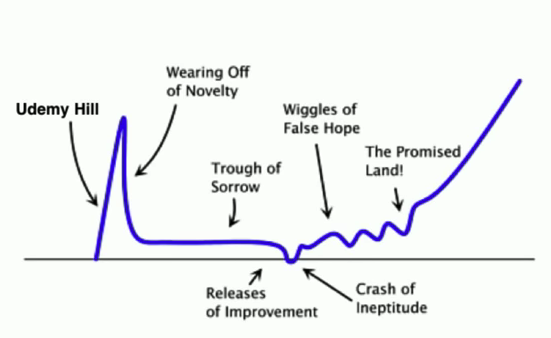
That said, anything of complex skill is going to take time to learn. And you’re likely going to hit what many call the “trough of sorrow,” which can be a very tough time of struggle. To steal an image used by Leon Noel of #100Devs, the journey looks something like this:
The trough of sorrow and its fellow dips can be a very difficult time. Finding a community of individuals with similar goals where you can help support each other seems to be the best route through it.
I’m not sure how much this will help, but I hope something here is helpful at least.
The problem is Ive been bullied a lot in school since then, I cant seem to be able to do consistent work with something that requires me to give out of my brain a lot of solutions. Programming I loved it, but now I can`t sit down and look at the errors in my code. I get very fast, frustrated pissed off, and leave it there.
Ive tried getting back in the game about 3 times I thought memorization would help me go better through the material. But from some of the discussions here, Ive come to realize that stuff related to the engineering field is not for me anymore.
I know I can do with people here helping me with the GMS course, then I can add to my skill set a good memory and use that to get a good job. I`ve had my spirits lifted today I talked to my psychiatrist, and she told me that I can go for a government job as long as it doesn’t involve guns and it involves a lot of paperwork.
A job in the public administration is a good option for me after GMS, I would have to memorize some laws a couple of hundred pages and then make decisions based on those laws it`s a decent pay a lot better at first the most multinationals, but it will open doors for me I could save money and invest it.
And after I have some work under my belt and maybe increase my focus level after dealing with people on a day-to-day basis, I could try to be a life coach, college professor, and other more high paying jobs.
What do you think about 1-hour customer service courses? Are they any good Ive done a couple, and I can say it really helped a lot, mainly how to reframe complaints, but Ive also downloaded the top 10 books on customer service, which are about 200 pages each.
I’m not sure if it helps, but I used to get frustrated about programming to the point where it was affecting my life. After a while I realized that I was able to get through those kinds of bugs with enough work, and that finishing the problem would increase my skills by another level.
So I stopped looking at bugs as frustrating obstacles, and started to see them as “free programming lessons” instead. That’s really what they are. Books and courses are good for the fundamentals, but the real learning happens when you push your brain to work through bugs and difficulties.
Two techniques that I think are essential to solving bugs are rubber duck debugging and the “Feynman technique”. Another thing that reduced stress for me was to take advantage of typing features. I switched from JavaScript to TypeScript and started using mypy in Python. It significantly reduces the cognitive load for me.
There’s a period when you start learning how to code that is frustrating for a period of time — I’d estimate about 6-18 months. After that, many things will become embedded in muscle memory and you won’t have to think about them any more.
Programming isn’t the right field for everyone, but frustration is normal, and I think there are ways to manage it.
This happens to most adults learning programming, it’s very normal. Adults seem to be more easily frustrated and quit things than children do.
If you can find kind people to reach out to, what you can do is ask for help if you’re stuck and not making any progress on something for 20 minutes or more. Avoid spending hours struggling and torturing yourself. Taking breaks and sleeping on problems are helpful options, too.
Searching online for solutions is not cheating either, though this should count towards your 20 minutes.
Do you know how many languages it took me to understand objects and classes? Three.
I’m not an idiot, those are rather complex. Only on the third language did I have a teacher who explained it to me nicely. It all finally clicked, and I was so happy! Still, I might’ve gotten more help and understood it sooner if I made an effort to ask sooner, but honestly, I didn’t have people I felt I could turn to.
And when you ask for help, you need to be as specific as possible. Too many beginner coders expect the other person to be psychic or magically see the issue at a glance. This is one of my favorite reads on how to debug and ask for help: Teaching Novice Programmers How to Debug Their Code
Memory by itself is not that valuable. We have long been a literate culture and we store information on paper records and these days digitally. We have little need of human archivists the way a non-literate, oral society might. In fact we’ve managed to discard most of our memory skills - this site is a witness to that.
Like many other talents, such as facility with numbers or even intelligence itself, people might be impressed but they aren’t going to pay for that alone. Such abilities are valuable when they support a marketable professional skill.
We live in an age where things change rapidly and professional skill sets are subject to constant advancement. I learned to do engineering calculations with a slide rule, then I learned do program them into a computer in FORTRAN. Since then I have had to learn at least a dozen different programming languages and profound changes in software design. There were no objects in early FORTRAN - character strings were an exotic and troublesome matter. From the Industrial Revolution to the start of the Space Age, the slide rule did the math. Yet today, most people wouldn’t recognize one if they saw it.
At one time I knew all of FORTRAN - all of it. Modern languages, like, say, Java are not only much more complex but they come with enormous frameworks which must be mastered to some extent. And all this too will be supplanted soon enough by newer, ever more complex technologies.
The days of learning a professional skillset in your youth and riding that horse for the rest of your career are gone - forever. A modern professional must be prepared to completely overhaul his skillset every decade and in that regard a strong memory together with a willingness to change is a powerful asset.