Visual Dictionary from (unlimited) Characters for abstract words (long term learning, not competition)

Hello DanteGaxiola

Thanks for the insight into the wonderful process that u follow.

Actually I m in a very flexible state regarding my method which is under gradual evolution.

I think the mistake i was doing was not having a stock of ready to use characters…

Can u add to the list of the source websites suggested by MaelJiL Mael for such characters.

I guess this will make my speed much faster but still i will make a memory journal and register my time per “unit”…

Will get back to u after experimenting a little…

Thanks to u too MaelJiL Mael for listing the source websites for these characters.

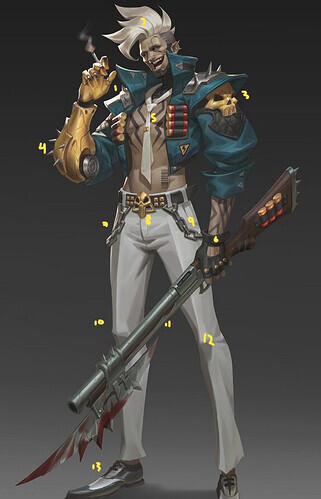
One more thing, do u guys keep these character images numbered like 1,2,3,4… written on different body parts or is it understood that every character has these many loci at these places?

2 Likes

Hello @ramanujansri
Yes, I actually note the locations on the characters’ body as @DanteGaxiola do.

For the sources, You are welcome. Just search « Character design » on each of those web site. Also you check pixiv for more characters

Hi, @MaelJiL!

That’s great! I took a lot of inspiration from discussions in the forum, so it seems logical that other people could get to the same conclusions I have. There are various difficulties to the method, though. I plan to start a new topic with more detailed information, but will gladly help you with what I can here.

What do you mean by visualizing and associating information to the characters? Do you mean the meaning of each character as in the Characters technique described in the original post? Or do you mean how to associate the characters to their loci?

Since my Characters have defined meaning for me, it’s relatively straightforward to know the meaning or knowledge they refer to in a specific memory palace/guardian. Generally, I encode between 2 and 5 characters in one location, with some rules to understand their relations (what I call “modifiers”). For example: Two characters passionately kissing = A is B. One character on the right shoulder of another = AB (B is an adjective for A), etc.

Or are you having difficulties with associating a character (mnemonic image) to a locus?

Let me know what the problem seems to be.

I personally save them in a folder called Guardians, and move them when used to another called Encoded guardians (or something like that, they’re actually in Spanish, haha).

Thanks for commenting! Cheers!

1 Like

It’s my pleasure, dude. Thanks for engaging!

That’s great! I actually continue to make changes to my system. It’s a little frustrating to review old Guardians since they don’t follow my current principles, hahaha, but I do believe that all the investments in this phase will be of great value for years to come, so…

Yeah, I find that to be very important. I shared more than 200 characters in the original post, did you download them? When I’m choosing a new character I try to force myself to select one of the first that seem even vaguely appropriate for the concept, since otherwise I could spend hours on that process, even having a stock already selected.

Artstation for the win, no doubt. I particularly enjoy this view: https://www.artstation.com/?sort_by=trending and recommend, if you are going to be selecting potential characters, to make an account and follow the artist that seem to fit your needs, so you can check on your notifications first. I currently have more than one thousand potential characters (besides the thousand already used, haha) so I’m fine in that regard, I guess.

Yep, the best approach I have found is to use barely the same ordering, so I try to select the potential guardians having the position and distinctive characteristics for the loci, as much as possible:

If I want more than 11 loci, 10 would be the knee on the left, maybe 11 something between the legs, 12 the other knee, 13 the left foot and so on. I do mark them on the computer, in Windows is very easy with Windows (Start button?) + Shift + S.

Let me know if there is anything else I can help you with. :wink:

2 Likes

@DanteGaxiola
I will try to illustrate my challenge with an exemple:
Let’s say I am trying to memorize the following 5 words
basketball Red Yellow Green Purple

I would pick a guardian(A character like the one you showed with the numbers) and I will imagine a Basketball pounding on his head, then on the right shoulder I can imagine that there a Huge Rose flower hurting him ( for red) etc…

But, taking an exemple of a memory palace, we usually visualize ourselves walking through the palace and review the mnemonic images on each locus. But using a guardian instead, I think that the best way to visualize the loci and associate information (mnemonic images) to them should be to imagine the character alive somehow ( To visualize him in my environment or in his own environment)…But I tend to have a hard time reproducing the entire character in front of my eyes in order to review the mnemonic images. I noticed that, in order to review the locations on the guardians body I mentally “Go back” to the moment I was looking at it in front my screen.

2 Likes

So I was curious to know what is actually happening in your mind when you try to associate a mnemonic image to a guardian… Particularly on the visual aspects. Do you see the guardian in front of your eyes? Do you see it in your mind as a picture? I am sorry if my questions are not clear enough…Or to sum up: where do you picture your guardians when you are trying to retrieve an information (mnemonic image) you associated to them.

Also, I tackled the problem of not being able to properly visualize the guardians by zooming on “one” specific part of their body like the head, shoulder, hands.

2 Likes

Alright, let’s see. I personally almost exclusively use characters as mnemonic images, since they seem to be far easier to interact with the loci and become memorable. I used to literally zoom on the parts of the guardian to imagine the interactions, but nowadays I only zoom in my imagination. I try to imagine the part being relatively big enough in front of me, with my eyes closed, for a few seconds, and the character interacting with it. For example:

imagen

In the first locus, and following your example, I would imagine a basketball smashing to the spikes in the shoulder at the left, and then deflating there. I would try to imagine this in front of me in a big size, not as small as it appears in my monitor. In the second locus, I would imagine my character for red in the head of the Guardian, entangled with it’s gray hair, maybe fighting to get off of it (I don’t really need that much of a scene, though). I easier for me to make characters and not objects interact with the loci.

So I actually make three different Anki cards per Guardian. One only to remember the character and what it represents (let’s say, “Memory Craft, Lynne Kelly - Chapter 3”, with the image of the Guardian in the other side and “Memory, imagination and the way our brains work” as notes for the card). Another would be a card to remember all the information (and to “elaborate” upon it, since I want not only to have access to the info but use it critically) in the Guardian, that I would review as if I were giving me a lesson on the topic. And another one, only to review the images in the guardian, reviewed as fast as possible (this takes me less than 4 minutes per Guardian, which tend to have encoded something like 40 keywords, maybe, about 3 or 4 per locus). I never imagine the Guardian alive, but always try to make the characters interact with their loci.

I seem to imagine them in a vacuum, generally with the color of the background of the original illustration, but sometimes more randomly. I try to imagine the guardian as a “small giant”. As I said, try to imagine every locus with a size approximately of a yoga ball held in front of me with my arms straightened. I also imagine the entire guardian in medium size (again, a yoga ball in front of me, kinda) for the first card described, but focusing in a few details, specially it’s head and general visual feeling, if that makes sens.

Let me know if that helps

2 Likes

Thanks for the explanation
@DanteGaxiola
I trully gained more insight on how to use this technique. :slight_smile:

1 Like

Thank u so much DanteGaxiola & MaelJiL Mael for enlightening me about the process.

DanteGaxiola, can u please elaborate further on your second and third Anki card designs. In your second card do u make a list of points in that topic? In your third card do u attach all images in image form or just write their detail? Can u share the picture of these cards…will b very helpful…

&
How to make a memory journal, what should b its content ?

1 Like

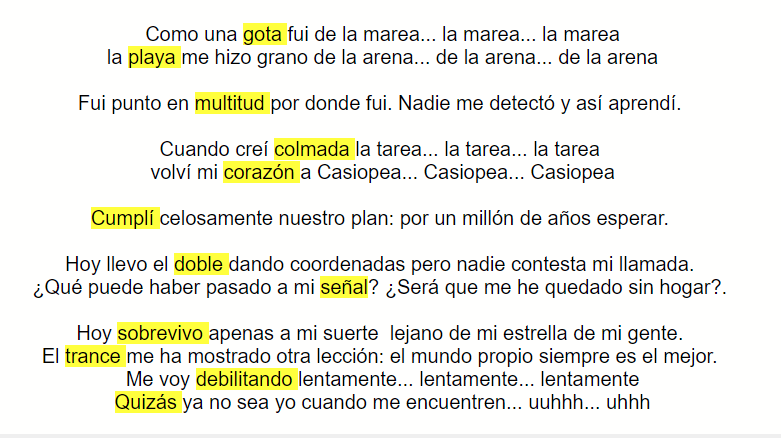
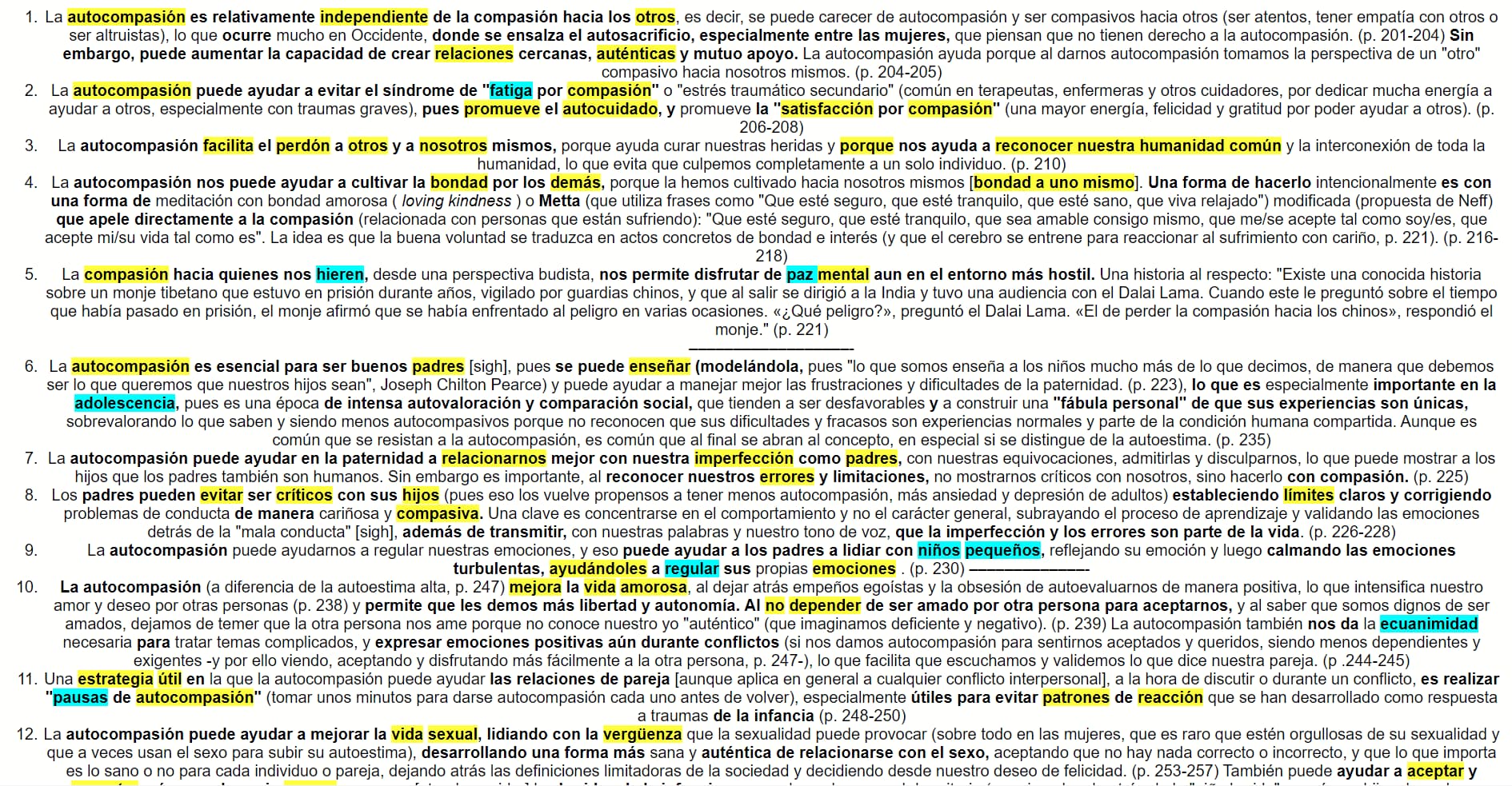
Ok. The second and third cards are the same, but the third one has a [Vel] (from “velocidad”, speed) added at the end of the front of the card. They are in different decks, one named “Guardians” and the other “Guardians (Speed)”. As I said, the front is the title of the Guardian, corresponding a book, article, chapter, etc. The back of the card has the Guardian and it’s content, something like this:


(This is a song i memorized using a guardian)


(This is a chapter of the book Self-Compassion, by Kristin Neff. I worked my notes to divide them in 12 points. The yellow parts are words already in my mnemonic language, mostly, and the blue are words I encoded as new characters for this particular guardian)

I try to encode each keyword in my mnemonic scenes, but not all of them are Characters. Most are, though.

I only attach the image of the Guardian to these three cards, and the information to the second and third. The first, by the way, is a Back (and reversed) card, and is in my Characters deck.

I don’t know what should be its content. Personally, I register my ideas, experiments and experiences regarding my memory work, in a very open schedule (not daily by any means).

Good luck!

1 Like

Thank u so much…will get back after experimenting a bit

1 Like

Hi Dante,

This is intriguing and thank you for sharing but I’m really struggling to understand how this is actually used.

Are you, for example, reading a book about a new subject, and then imagining walking through a memory palace, and each station has a character instead of a loci?

What’s the advantage to using a character?

Sorry if I’m being stupid.

Hey, @Woodym! I’d say you never should feel sorry for asking a question in a forum, definitely not stupid.

So, this technique is built on the common memory palace and keyword method, so you use normal loci as starting points for what I call memory scenes (small visual stories). The difference with the traditional keyword method is, instead of using spontaneous conections (i. e., for “money”, a known billionaire holding money) you use a specific character, for example:

(I made this image with leonardo.ia)

There are various benefits of using a specific character to represent a concept.

For someone like me (I understand this is not the case for everyone), persons/characters are a lot easier to remember than objects, especially if they are very visually memorable.

Also, they interact easier with each other. For example, if the idea is that “money makes you more greedy”, to say anything, you can have the character for money stabbing the character for greed (the action of stabbing with a spear for me always mean “produce/cause/provoke”).

They interact easily to the loci, too. If this little scene were to be encoded in a piano, “money” could easily be playing piano, then stabbing “greed”.

Besides that, the method is a way of developing what I call a “personal mnemonic language”, since every new concept is independently consolidated or fixated with an Anki card. Even if you don’t use characters, you can use whatever image you want and fixate it for a specific meaning. This “symbols” can then be reused in other memory palaces.

Just to clarify, all this is part of a daily memory practice designed to develop deliberate long therm memory, so is not meant to be a hack or trick, and also I don’t think is that great for memory sports, at least not that I have tested.

Hope that helps a little bit. Please feel free to ask any questions you want.

Do you have a memory practice already?
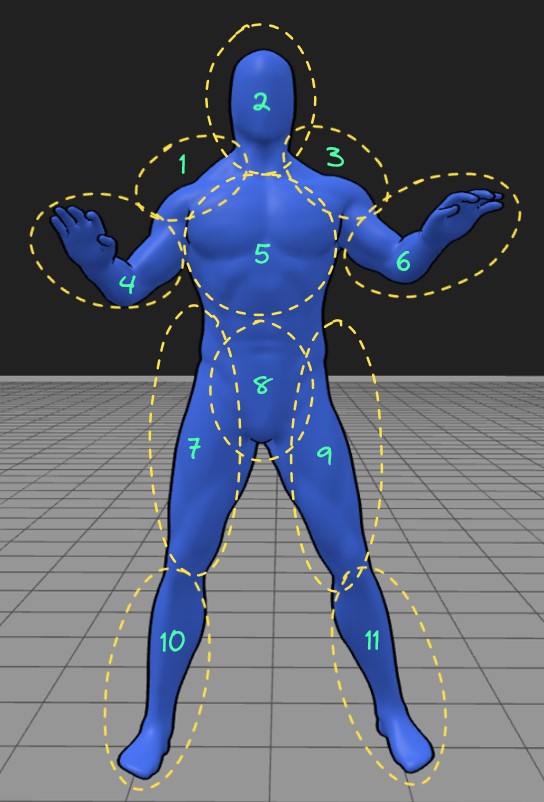
As an update, I have to say that I’ve moved entirely from the guardians memory palaces. I currently use a version of the roman room: with ten locations, always the same (walls, corners, roof and floor), constructed upon real spaces (or, if I don’t have new ones at hand, a “virtual” one from 3D/360° Tours). I use the loci around the places I’ve described as starting points for my memory scenes.

I keep maintaining (almost) all my guardians, but after reasonable testing I believe that real (or virtual, based in 360 tours) memory palaces are definitely superior, at least for me. It was a great experiment, though.

Maybe I’ll make a post in a while, with some more experience, about my current memory palace practices. The “visual dictionary” or “personal mnemonic language” are still golden for me.

1 Like

Really appreciate your answer Dante.

I’m currently building some journeys using the Assassin’s Creed tours. I want to learn Latin, and if that goes well if like to learn Ancient Greek next year. So I can create some journeys and palaces using AC Origins (the Alexandria section, using the Caesar character) to memorize some Latin vocabulary, and AC Odyssey to memorise Greek vocabulary. (I’m looking forward to using the Parthenon as a memory palace for Greek vocab!)

Now to be honest I’m sure there are better ways to learn languages, but this is as much to do with practicing and playing with memory techniques as it is to do with language learning.

I’ve also experimented a bit with our very own Slate’s number system, so I really want to combine these to make a powerful mental encyclopaedia.

Like you I’m also interested in using online resources, and have found a few greate YouTube videos of walking tours around the British Museum etc. The problem is, sometimes those this are too big and contain *too much * information, which then means you have to put a lot of effort into memorising the location itself. Also, I’m aware that although it seems nice to use a themed location, it can potentially lead to interference. If I’m using the British museum, say in the Ancient Greece section, and the particular location is the Elgin Marbles, and the thing I have to remember is actually something to do with Plato, then during recall I’m probably going to be wondering what the Elgin Marbles have to do with Plato, and get myself confused.

I am intrigued by the box rooms (I’ve ironically forgotten the name, fenaigle rooms?) but I just do not understand how I would get that to work without getting utterly confused. I guess the people who do use it have a much better visual memory than me.

1 Like

See the mini memory palaces thread; using everyday items and turning yourself into an ant running across them

1 Like

I loved all of your posts and now I am totally hoping you will share your information on how you use the roman room system. I means do you super impose this plane room onto your memory palace> so all the rooms look the same only in different locations? Thanks in advance for your insight!

Hi,Sarah! I’m really glad you enjoyed my posts. Feel free to ask questions or comment on your experience. About the roman room technique, you can check this post:

https://forum.artofmemory.com/t/extreamly-memorable-memory-palace-rooms-360-panoramas-designed-aided-with-ai-an-experiment

Is the most current technique I use, mixing it with real places that I take panoramas from (places I’ve visited), and put some more memorable loci in them with photoshop. See you around!