Dear @metivier, you know you have earned my respect but please don’t give me so much credit for holding up the other end of that debate. I choose to not engage (why? see 2 Timothy 2:14, 1 Timothy 6:3-5).
Doug
The notion of things boiling down to matters of perspective is precisely the point.
Something causes a perspective to form and change. Even if it’s “self reflection” that causes a perspective to change over time, something in the network, even if it’s just the alphabet that none of us invented, acts as the catalyst.
People love to go too far, however. They say the universe is “ordered” and get into matters of “meaning.”
A lot of that is evolution fending off despair. There’s no decent evidence that order/disorder binaries have any special meaning or that what humans call “meaning” is in any way actually “meaningful.”
These discussions lead back to the matter of perspective. Bounce up against this or that school which says the all form is empty and emptiness is form, and group hypnosis will work its magic…
Until you bump into something else and a new round of hypnosis begins.
Or, perhaps you’re lucky enough to get deep into a truly controversial philosopher like Bruno who exposes the mechanisms of what memory is and how it works in the semiotic contexts into which this or that person is born.
He didn’t nail it exactly according to what the brain scans and behavorial psychology reveals… but he was impressively close.
In any case, people may feel free to argue for “order” and “meaning,” but a lot, if not all of what they’re doing is playing out conditioning.
Indeed, there’s an alternative “theory” that I’m playing out now due to conditioning and training in how communication is done.
The question is, and this is ultimately by Bruno was put to the stake:
Is there a theory that is more correct than other theories?
If so, then it appears that in certain eras of history, correctness is so threatening to the dominant “order” that it will do all it can to stamp out the truth.
It’s memory all the way down, the way memory operates us, not the way we operate it.
In Points of View, A.W. Moore proposes that it is possible to have a perspectiveless perspective, and I’m confident this is what Bruno managed to achieve through intense memory practice.
It’s very similar to the yogic practices that give memory such an intense workout, as many of those who have memorized voluminous texts based around self-inquiry have noted.
The problem comes down to whether one argues that one “transcends” perspective or because immanent with and/or to it. Language doesn’t quite let one get at it, which is one of my reasons Bruno doesn’t make sense to people. He can’t say what he’s trying to convey directly because the philosophy of immanence requires what is sometimes called “luminous details,” ideas that only emerge from the collision of other ideas.
Anyhow, Bruno has been so cherished precisely because of these two things: his particular means of explaining the classic mnemonic tools have helped many people memorize more of the kinds of verbatim text that exercise memory enough to help you experience one simple thing (noting that the fact that you experience does not necessarily make it “true”):
That reality builds itself out of itself.
And we “witness” this through the lens of memory (Kant), but also driven by the engines of memory – assuming we’re separate enough to even dream of using such a word as “witness”!
Brain candy to be sure! Or as Buzan would say (who pulled his SEM3 directly out of Bruno):
Floreant dendritae!
2 Likes
Oh dear @thinkaboutthebible, to choose not to engage would involve silence, not proselytizing.
Credit awaits logical consistency, for as yet, I render only to Caesar and to God what is due to them. I have no choice! 
3 Likes
I only meant to say that cause and effect are (seeming to?) play out. “For what purpose?” is an imponderable; if I was smart enough to know the mind of God, I’d have his job.
What I get out of this: So there’s the universe, and there’s us, and the “content” of us is memories, which is just us trying to keep track of the universe, so it’s a Makarova doll, where the universe is containing itself. That’s pretty funny!
2 Likes
“Seeming” is a good choice here. I doubt any one amongst us knows, and due to the nature of information, matter and Becoming, it’s unlikely even as a collective, any of us will know for certain… except perhaps through inferences based on recursion.
It’s not really clear that there is a “universe” as such. These are words we use to describe observations.
The beauty of science, when it is treated optimally, is that we have an endless process of gathering evidence that helps us confirm or deny our propositions about the world.
By all means call it a container that contains itself… but is it true? The measurement problem suggests that any attempt to answer the question would require something “outside” that which is being measured, which would then need to enter the “inside” to convey the answer, not longer allowing it to be “outside.”
More brain candy…
2 Likes
I think this is where the problems really start. When you frame it like this, as a position of no knowledge, it start to look like either some degenerate nonsense (“I can do whatever I want! You can’t stop me Dad!”) or like you’re describing a way to hack the matrix to get super powers (In which case, please hack a few thousand dollars into my wife’s bank account.)
If that sounds reductive and dualistic, it’s because it is. But that’s what non-dualism sounds like from a dualistic perspective. I think this might be why they say, “those who don’t know teach,” i.e. “those who know don’t teach,” because even though you aren’t teaching nihilism, people are hearing nihilism.
1 Like
I’m not sure there are “problems” except from a dualist perspective.
The fact that Person A says X and Person B hears Y despite every opportunity in the world to understand the signal more charitably…
… this only provides more evidence for the absence of free will.
I’d bring it all back to memory and how it functions. There’s nothing nihilist about pursuing a scientific and intellectually honest description of it.
From my “perspective,” the pursuit of knowing what memory is and what it might really be like provides an endless source of joy.
3 Likes
So, I’ve been thinking about this, and testing it, and it seems like the component based system that I layed out here is sort of garbage. It’s not unworkable, but it’s sort of slow, partially because things aren’t moving enough, but also because you have to visualize each component, which takes more time; remember, you’re only getting a couple letters for component.
So how can I solve this? After some thought, you should obviously just use a PAO, and try to keep images to one word to make it easy to keep track of. If I use the same memory palace, there isn’t too much of a risk of skipping words, because it’ll be weird to miss that spot in my memory palace for just that verse.
So, since we’re using a PAO, what to use? I though about using pokemon, inpired by someone’s PAO for numbers (pokemon are numbered! And there’s over a thousand of them!) Since Pokemon use attacks on Pokemon, you’re PAO becomes PAP. You get the same compression while memorizing more stuff.
I actually did this: Pokemon Aleph-Beyt - Google Sheets And, it also kind of sucks. The problem is that I haven’t got most of the pokemon memorized, at least outside of the first 250 or so, so the letters aren’t good mnemonics for the pokemon names, the pokemon names aren’t good mnemonics for the pokemon images, and the images aren’t good mnemonics for the letters. Also, there aren’t nearly as many attacks in modern pokemon. Garbage all the way down.
Okay, but I think the PAP system could still work. And, if we use mounts for some words (cowboy riding horse shoots Indian riding donkey; horse kicks donkey) then we’ll even be able to get the very longest word in the Hebrew bible, which is 12 letters. Most words aren’t nearly that long, though, and a PAP will be plenty for them.
Starting over from the beginning. 2-letter PAO - Google Sheets
1 Like
Why not go for phonetics instead of letters? Just like the major system. For each pair of sounds, assign a person and an action. This should significantly reduce the combinations space.
2 Likes
Why not go for phonetics instead of letters? Just like the major system. For each pair of sounds, assign a person and an action. This should significantly reduce the combinations space.
I’m doing this in Hebrew, which already reduces the number of letters down to the 22 Hebrew consonants. If I was doing it in English, I’d only use the 21-ish English consonants. I already made this suggestion way back here:
Right, but have you thought about going a bit further by aggregating consonants that sound similar?
For example, this is the major system:
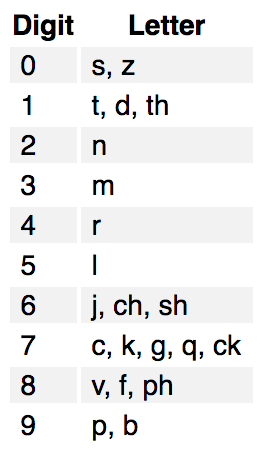
With 10 groups, one only has 10^2 combinations to remember. Much better than 22^2.
You could probably figure out a similar arrangement in Hebrew.
Then, to each combination, you assign your person and action.
2 Likes
Uh, it depends on how willing you are to mess with this sort of thing. In modern Hebrew aleph and ayin basically sound the same, but in older forms of Hebrew, they’re actually all make very distinct sounds. I’m not willing to do this, ideally moving to a form that holds each of the letters as very distinct. Also, you have to understand, that Hebrew has a dagesh system, for instance, beyt makes a v sound without a dagesh and b sound with one: we are already doing grouping by using just the letter.
Also, this is really me trying to my best for God; there’s a limit to my willingness to cut corners here, where normally things like this don’t matter.
1 Like
If you want to learn something verbatim, try vedic recitation method and hand gestures. The technique is best for poems and vedic verses. Ancient Indians were using this technique. For memorising numbers, it is not recommended.
Take the following stanza as an example
Deep into that darkness peering.
Long I stood there, wondering, fearing.
The first sentence has 5 words
Now number them as 1, 2, 3 , 4 , 5
Jatā Path ( DNA Method )
We will recite the sentence in following sequence. I name this method as DNA method because the sequence feels like a DNA
122112
233223
344334
455445
Deep into into deep deep into
into that that into into that
that darkness darkness that that darkness
darkness peering peering darkness darkness peering
Now,
Shikhā Patha ( Flame Method )
I call this flame method because in sanskrit Sikha means flame. The sequence feels like a glowing flame. Increases, decreases and then increases more
122123
233234
344345
4554
55
Deep into into deep into that
into that that into that darkness
that darkness darkness that darkness peering
darkness peering peering darkness
peering peering
I have remembered more than 100 vedic verses using these techniques.
8 Likes
It’s an interesting idea. Do you do it just do it once and have it memorized?
1 Like
Not once. In first attempt 1 or 2 words were missed in each verse. In 2nd attempt using these techniques, I was able to remember verses completely.
Peculiar part is that the next words come to the mind from the previous words using this technique.
But it is different from link method.
4 Likes
Months later rereading this and it’s immediately obvious to me what I used to remember “difficult circumstances’”.
“Difficult” was easy to remember because obviously it’s difficult as John is talking about war.
The whole monologue is about a difficult subject.
“Circumstances” was represented by the ball I mentioned.
“Circum“ as in round. Circumstance, circumscribe, circle, circus you get the idea.
The ball represents a “circ” falling. A round object “fallen upon us”.
2 Likes
Bruno was a genius. Not ony did he have an interest in mnemonics, he understood stars were suns in other systems. Of course they burned him. Mnemonics is afflicted. Us who like the subect are fools. Mnemonics was ridiculed by the church in the middle ages, and seen as sinful.
1 Like
What they did to Bruno is unforgivable.
1 Like
Memory is a mysterious subject. Reality is born, and dies in the very next second, like the shapes of a flame. Memory falsely binds images together iin the mind, antoher mysterious unit and creates illusions of unity. Have you ever had an out of body, or a no body experience? I have. The body is an illusion. And we have the illusion of space and time. Note how space is connected to our human memory - landscapes. Loci. Forgetting seems to be a tool the system uses so that we continue to be deceived, just like Plato said. Reincarnation is just watching another movie, with limited free will.
Sometimes I find Tom Campbells theories refreshing. The double slit eperiment makes sense with its doube erasure schpiel. Matter is a probability curve it can be in any one of a number of positions but no need to waste computational power by calculating everything if nobody is looking at it. Because, if life is a virtual reality, then this is all we will know, I think. But is the speed of light a constant?
1 Like
@maxvik I would contend the opposite to be true: While there were of course different views (as there were in antiquity and are today), influential Theologians such as St. Thomas Aquinas and Hugh of St. Victor argued in favour of mnemonics as a means of remembering scripture.
2 Likes