Time moves so fast! It’s already been 12 days since my first post.
Resources
Resources that have helped me quite tremendously the past week are:
- Book: Your Complete Guide to Building a Memory Palace by Graham Best
- Podcast: The Craft of Memory by Ronald Johnson
- Ronald Johson interviewing different people active in the domain of mnemonics to share their insights/practices…
- Spotify – Web Player
Your Complete Guide to Building a Memory Palace by Graham Best
- I recommend this book to any beginner, it has helped me a lot because it breaks down the process of building your first memory palace in easy to follow steps and starts with the fundamentals of the visualization process. Every chapter consists of an exercise that helps you solidify the learned concepts to different domains e.g. to do lists, grocery list, public speaking…
- Concepts
- Picture associations: Connecting pictures together to one. This is the foundation of a lot of the mnemonic techniques e.g. peg systems and memory palace
- Picturing non-picture words by soundalike words or similar words in meaning e.g. time => clock
- The book moves on to the concept of memory palaces itself and its application to different domains.
My Progress
I’ve changed my strategy a bit compared to last time. I initially wanted to broaden my focus to a wide set of mnemonics strategies, but noticed I was lacking in quite some fundamental skills and feeling overwhelmed. So I have shifted to a more focused approach with just a handful of techniques, mostly focusing on the process of visualization itself. Taking time to really make sure I vividly imagine scenes in my mind and trying to convert words to images as much as possible.
I have mostly been applying mnemonics in the context of remembering the content of Graham’s book. Some insights I’ve obtained by applying mnemonics in this context are:
- Rhyming peg system is a simple system to quickly attach information to images. It has helped me to memorize the chapters of a book, but I also see its value in quickly remembering ad hoc information.
- This Rhyming peg system works by attaching numbers to a word that rhymes e.g.
- one → sun
- two → shoe
- three → tree
- …
- This has proven quite a simple yet powerful toolkit that makes attaching my images to a sequence quite easy. I create a new image based on the peg and the key topic of the chapter
- Example: Chapter 3 of Graham’s book discusses remembering names with an exercise to remember the name of the 7 dwarfs of snow white. So I visualized a tree with the dwarfs hanging on the branches with big nametags across their shirt.
- This Rhyming peg system works by attaching numbers to a word that rhymes e.g.
- Embedded pegs: I attached “objects/palaces” to these pegs if I wanted to provide more context or key points for the chapter
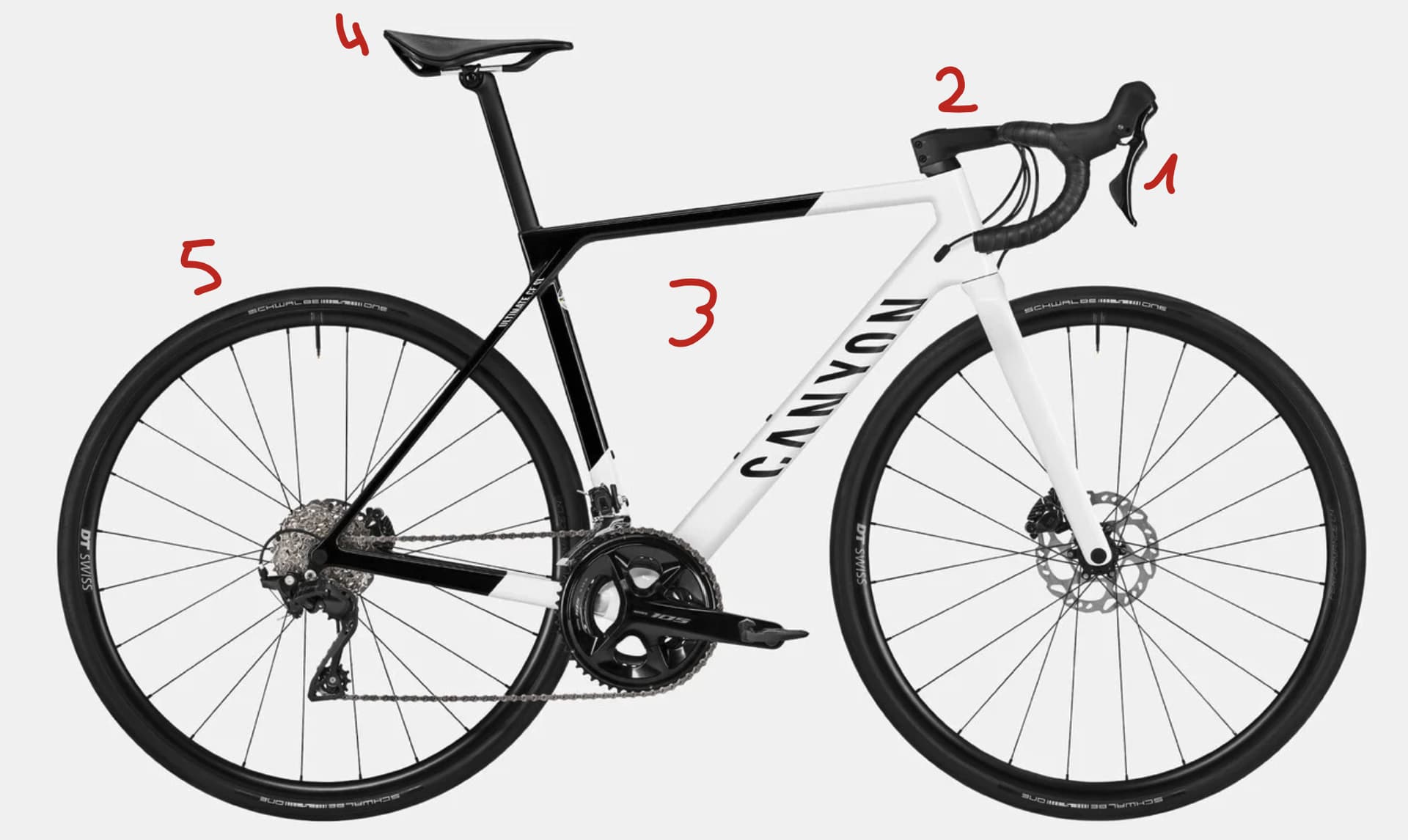
- Example: Chapter 7 of Graham’s book discusses how to memorize the key points of an article. This advice consists of 5 steps. I have attached this advice to different parts of a race bike.
- Pick a location to store information for the article
- handle bars
- image: a road map with red circle around key locations on the map
- Visualize the key points of the article by creating an image for each point
- gps attached to stem
- image: polaroid pictures attached to the gps
- Review the images
- frame
- image: a friend named An secures the frame with a chain and key (Anki reviewing software)
- Attach each image to a location
- seat
- image: polaroid pictures are pinned to locations on the map
- Review the locations and their images
- wheel
- image: similar as point 3 but at the wheel
- Pick a location to store information for the article
- Example: Chapter 7 of Graham’s book discusses how to memorize the key points of an article. This advice consists of 5 steps. I have attached this advice to different parts of a race bike.
- Even simple objects can serve as powerful locations. It also takes less time to create than a more elaborate memory palace, but stores less information.
- This is in line with the previous example of the bike to attach just a couple of simple key points.
- Some examples of simple objects I’ve used so far:
- Race bike
- Tent
- Oldtimer Porche
- Motorcycle with sidecar
- Even pictures of unknown rooms or front porches have proven successful and fast in storing information. This was quite a nice surprise and might allow me to quickly create new locations to store information. Although I still need to experience how well this scales if I have a lot of pictures of buildings or rooms I do not know from personal experience and that they might be confused more often.
- Reviewing anytime, anywhere. It is such a wonderful experience to be able to review on the go when commuting, in the fitness, when walking… so many opportunities of review just by having all the information in your mental notepad. This gives so much freedom in learning and making sure learned material is retained. I will however need a more structured approach to really move to long-term learning with reviewing at even longer intervals of 3 months - 1 year…
Next
-
More memory palaces. I only have 170 documented locations at the moment. I still have a backlog of undocumented locations, but this currently is a slow process. I notice I’m already paying a lot more attention to my surroundings than I used to.
- Solutions
- dedicated time every Sunday to document a memory palace of at least 25 locations
- add one virtual palace every week of at least 25 locations
- Solutions
-
Further experiment with the Body System to store conversational information
- I’m currently attaching things a person says to me to specific body parts of the person itself. This isn’t currently working that well at the moment. I think I need to put more effort in the visualization process and the reviewing during the day.
-
Apply mnemonics to study for the DP-600 Microsoft Fabric Analytics certification
- This will be a real first test for me to apply mnemonics to a specific learning project.
- There’s 2 types of structures that can be followed to attach information
- The course structure is broken down into 3 hierarchies Microsoft Certified: Fabric Analytics Engineer Associate - Certifications | Microsoft Learn
- 5 main domains
- multiple subdomains
- each subdomain consisting of subsections
- However the study guide follows a bit of a different breakdown also consisting of 3 hierarchies but with different divisions Study guide for Exam DP-600: Implementing Analytics Solutions Using Microsoft Fabric | Microsoft Learn
- 4 main domains
- multiple subdomains
- core skills in each subdomain
- The course structure is broken down into 3 hierarchies Microsoft Certified: Fabric Analytics Engineer Associate - Certifications | Microsoft Learn
- To facilitate the learning process I will start with the course structure. The structure of the study guide might however be useful to store skills in a more generic separate long term memory palace.
-
Incorporate weekly words and images training from Memory League
Future
This is just a list of things I want to keep in mind but will not act upon just now:
- Attaching symbol’s to rooms to categorize content. The following post How many memory palace do we need? - #6 by Erol talks about attaching an image to the door of a room, this is an idea I like as soon as I need to remember more complex content.
- I really want to improve my ability to remember day-to-day random information, but realize this might still be a bit ambitious. Although I will keep trying on a daily base to retain information I’ll still have to think about useful strategies.
- This day-to-day information can be broken down to at least the following categories
- People
- Tasks and projects
- Current affairs (news)
- Random bits of knowledge
- Episodic information / events
- …
- This day-to-day information can be broken down to at least the following categories
- I like to idea of experimenting with a dedicated memory palace for each day of the week. This might be useful for task management or for maintaining ad hoc information of that day without having to put mental effort into deciding upon a memory palace on the fly. By having 7 different memory palaces I can reduce ghosting since there’s enough time between reusing the palace.