I’ve delved into countless captivating stories on this forum, finding inspiration in how people approach their memory enhancement journeys. In this short span of time, the insights I’ve gained have already proven invaluable, even though a lot of the information I encounter stretches beyond my current skill set.
I however don’t try to be intimidated too much. As Gall’s law states:
“A complex system that works is invariably found to have evolved from a simple system that worked. The inverse proposition also appears to be true: a complex system designed from scratch never works and cannot be made to work. You have to start over, beginning with a simple system.”
My path forward involves discovering what works best for me, exercising patience throughout the process. This thread serves as both a public record of my journey and a means of holding myself accountable. While I won’t write every day, I’ll capture key moments during my progress.
Motivation Behind the Journey
My quest begins from scratch, fueled by frustration over forgetting so much. It’s disconcerting to converse with others who seem to know more about my life than I do. Beyond improving my autobiographical memory, I recognize the broader applications of mnemonic techniques—from project management and knowledge acquisition to interpersonal relations.
First feelings from a week of mnemonics
Shifting from lack of encoding to deliberate focus: My memory challenges don’t solely stem from recall issues; they often arise due to insufficient encoding. Creating vivid mental images makes encoding engaging and effective. Despite occasional setbacks, especially when converting everyday conversations to visual imagery or memory palaces, this approach has yielded quick wins.
I’m feeling incredibly motivated. I really believe in the power these methods can have and am enjoying the learning and the helpful community.
Current approach
I am currently:
immersing myself in the domain of mnemonics
by reading books like
Memory Craft (Lynne Kelly)
Moonwalking with Einstein (Joshua Foer)
How to develop a brilliant memory week by week (Dominic O’Brien)
trying to apply mnemonics in my day-to-day activities
summarizing main topics of a “current affairs” podcast I listen to daily
I am using the same memory palace over and over again. I have noticed a bit ghosting due to reuse since the podcast discusses current affairs on a daily base with quite some overlap in topics across days which can cause confusion during recall, but I don’t really mind. I just see it as an easy training of encoding auditory information in a memory palace and is something I can train during my commute.
Storing my projects with associated tasks in a memory palace. My company works in sprint of 2 weeks where we prioritize tasks we want to finish within this timespan, so the amount of loci needed is very small, so this feels like low-hanging fruit.
I actively construct memory palaces whenever an opportunity arises. I’ve compiled a list of potential real-life locations to serve as memory palaces. During my commute or other reflective moments, I mentally walk through these spaces and assign labels to specific locations for future use. Currently, I find it easier to use smaller, “isolated” rooms as a memory palace on its own, reducing the decision-making friction associated with selecting a complete building.
I’m working on enhancing my interpersonal skills. Specifically, I’ve been linking the information people share about their personal lives or upcoming events to mental images of the individuals themselves. My hope is that when I encounter these people again, these vivid images and associated stories will be triggered, allowing me to engage in more meaningful future conversations.
Improvements or Challenges
Speed challenges in linking verbal information to images: I’m grappling with the pace required to associate spoken words in day-to-day contexts from which topics can be quite varied with mental visuals.
Allocating ad hoc information to memory palaces: Using a memory palace to store diverse information encountered during daily interactions presents difficulties. Keeping track of already-used locations and preventing information loss remains a challenge. For example when I want to store information about a new topic, I’m unsure if I can put it at location 3 or if location 3 was already used. Perhaps this might just mean that location 3 just wasn’t encoded that well or that I should provide myself a marker for the last stored location.
Unstructured approach: Currently, my approach is somewhat unstructured, but I’m content with that. As someone who occasionally falls into the trap of overthinking and premature optimization, I’m simply experimenting whenever I notice an opportunity.
Feeling overwhelmed: I find myself in a phase of slight overwhelm due to the multitude of domains and opportunities related to memory techniques. I haven’t prioritised specific domains yet and am missing direction.
Memory palace decision paralysis: Choosing the right memory palace presents challenges. Oddly enough, I feel emotionally attached to some palaces, resisting their use for certain purposes—even though this attachment is irrational. I’ve settled on using my office building for project-related information. For book-related information I considered a virtual library memory palace. There are some great virtual library tours e.g. The London Library | Virtual tour generated by Panotour However, virtual libraries can have a less straightforward structure as opposed to homes, adding complexity. The advantage of a real personal memory palace lies in its accessibility—no need for upfront learning about an unfamiliar location.
Next step
Choosing a knowledge domain to apply mnemonics: I’m contemplating applying mnemonics more rigorously within a specific area of knowledge. Politics seems like an intriguing choice due to the upcoming elections and legislation. It provides a structured framework for remembering people, programs, parties, and historical context. However, I realize that politics doesn’t have an immediate impact on my work or personal life. I plan to make a decision this week to avoid procrastination.
Expand my mnemonics toolkit: While I’ve been relying heavily on memory palaces, I recognize the need to diversify my mnemonic techniques. Dominic O’Brien’s book could be a valuable resource for exploring a wider range of techniques beyond memory palaces.
Build more memory palaces.
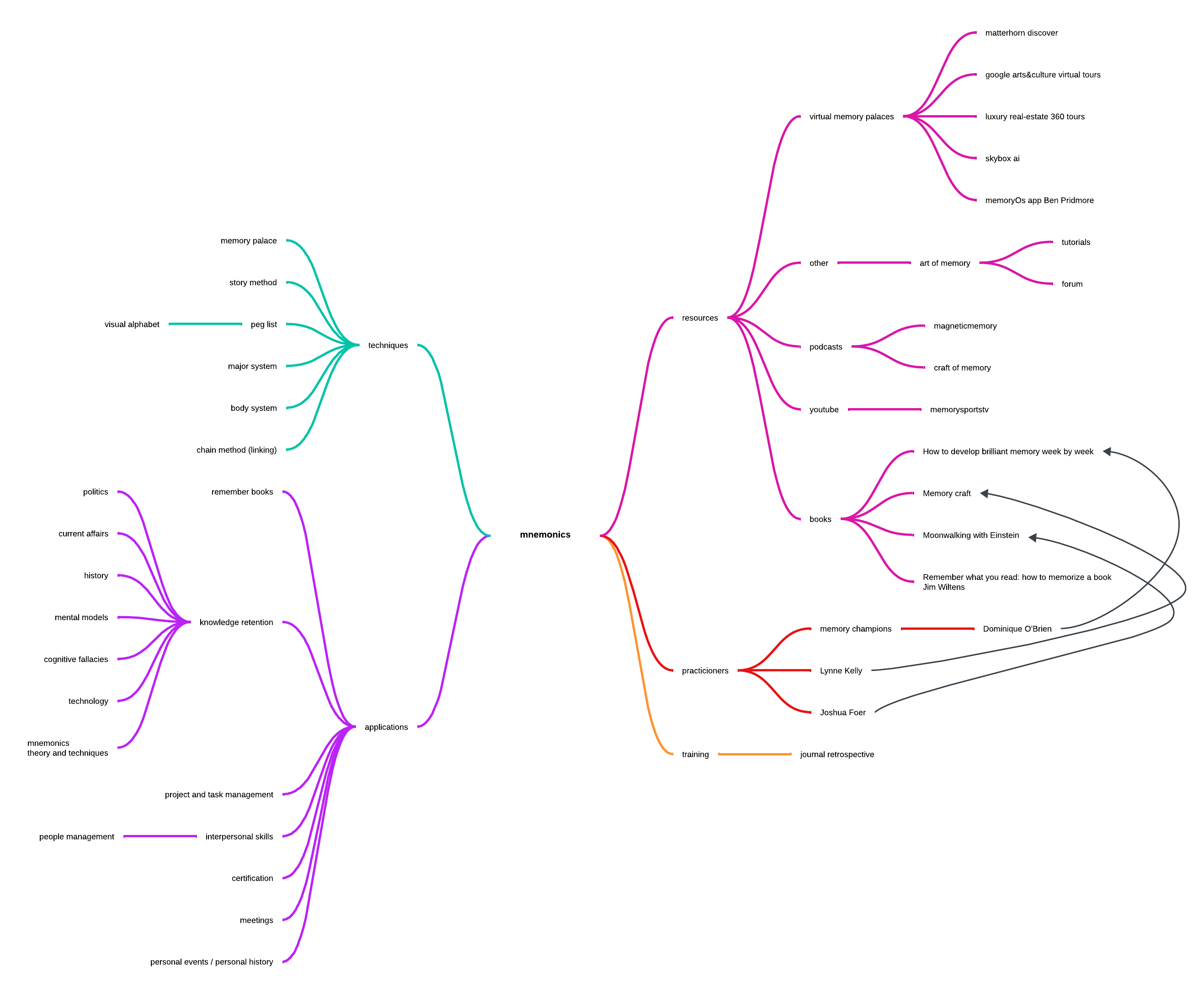
Below a visual overview of some domains to serve as a reference for future efforts.
So, in some ways I am very much a novice to this forum, so take my perspective with a grain of salt.
My sense, is that for rapid ad hoc encoding, it is critical to have everything except the [Learning item] variable, pre-established. This way, you are essentially embedding each learning item in a rich set of pre-existing neural associations, like a piece of drifting pollen getting caught in an intricate spider’s web. Thus having a favorite memory palace of X locations optimized for speed, that allows you to rapidly capture ad hoc information has been quite useful to me. Then later on, you can pass them on to other memory palaces, and make more slow and deliberate decisions regarding what is the optimal way to categorize this, which items are redundant, what is the optimal sequencing, etc.
In some sense, this ties into Daniel Kahneman’s principle of “Thinking Fast and Slow”, and I think it is fundamentally very useful to allow yourself that deliberate time to figure out which pieces of information are redundant, or need to be re-categorized, but those are the kinds of decisions that will significantly hamper your ability to encode on the fly.
So I favor this bimodal approach, where you have a palace and strategy for rapid-encoding, and then a strategy for slower deliberate encoding at the end of each day / week.
Thanks so much for your insights! The spider web metaphor really resonated with me
I’m finding the method of encoding transient, ad hoc information into memory palaces a bit challenging at the moment. To keep things manageable, I’ve shifted my focus to really solidifying the visualization process itself and the story method and incrementally try to expirement with more techniques.
I will provide a more detailed account on my progress later this week.
Your Complete Guide to Building a Memory Palace by Graham Best
I recommend this book to any beginner, it has helped me a lot because it breaks down the process of building your first memory palace in easy to follow steps and starts with the fundamentals of the visualization process. Every chapter consists of an exercise that helps you solidify the learned concepts to different domains e.g. to do lists, grocery list, public speaking…
Concepts
Picture associations: Connecting pictures together to one. This is the foundation of a lot of the mnemonic techniques e.g. peg systems and memory palace
Picturing non-picture words by soundalike words or similar words in meaning e.g. time => clock
The book moves on to the concept of memory palaces itself and its application to different domains.
My Progress
I’ve changed my strategy a bit compared to last time. I initially wanted to broaden my focus to a wide set of mnemonics strategies, but noticed I was lacking in quite some fundamental skills and feeling overwhelmed. So I have shifted to a more focused approach with just a handful of techniques, mostly focusing on the process of visualization itself. Taking time to really make sure I vividly imagine scenes in my mind and trying to convert words to images as much as possible.
I have mostly been applying mnemonics in the context of remembering the content of Graham’s book. Some insights I’ve obtained by applying mnemonics in this context are:
Rhyming peg system is a simple system to quickly attach information to images. It has helped me to memorize the chapters of a book, but I also see its value in quickly remembering ad hoc information.
This Rhyming peg system works by attaching numbers to a word that rhymes e.g.
one → sun
two → shoe
three → tree
…
This has proven quite a simple yet powerful toolkit that makes attaching my images to a sequence quite easy. I create a new image based on the peg and the key topic of the chapter
Example: Chapter 3 of Graham’s book discusses remembering names with an exercise to remember the name of the 7 dwarfs of snow white. So I visualized a tree with the dwarfs hanging on the branches with big nametags across their shirt.
Embedded pegs: I attached “objects/palaces” to these pegs if I wanted to provide more context or key points for the chapter
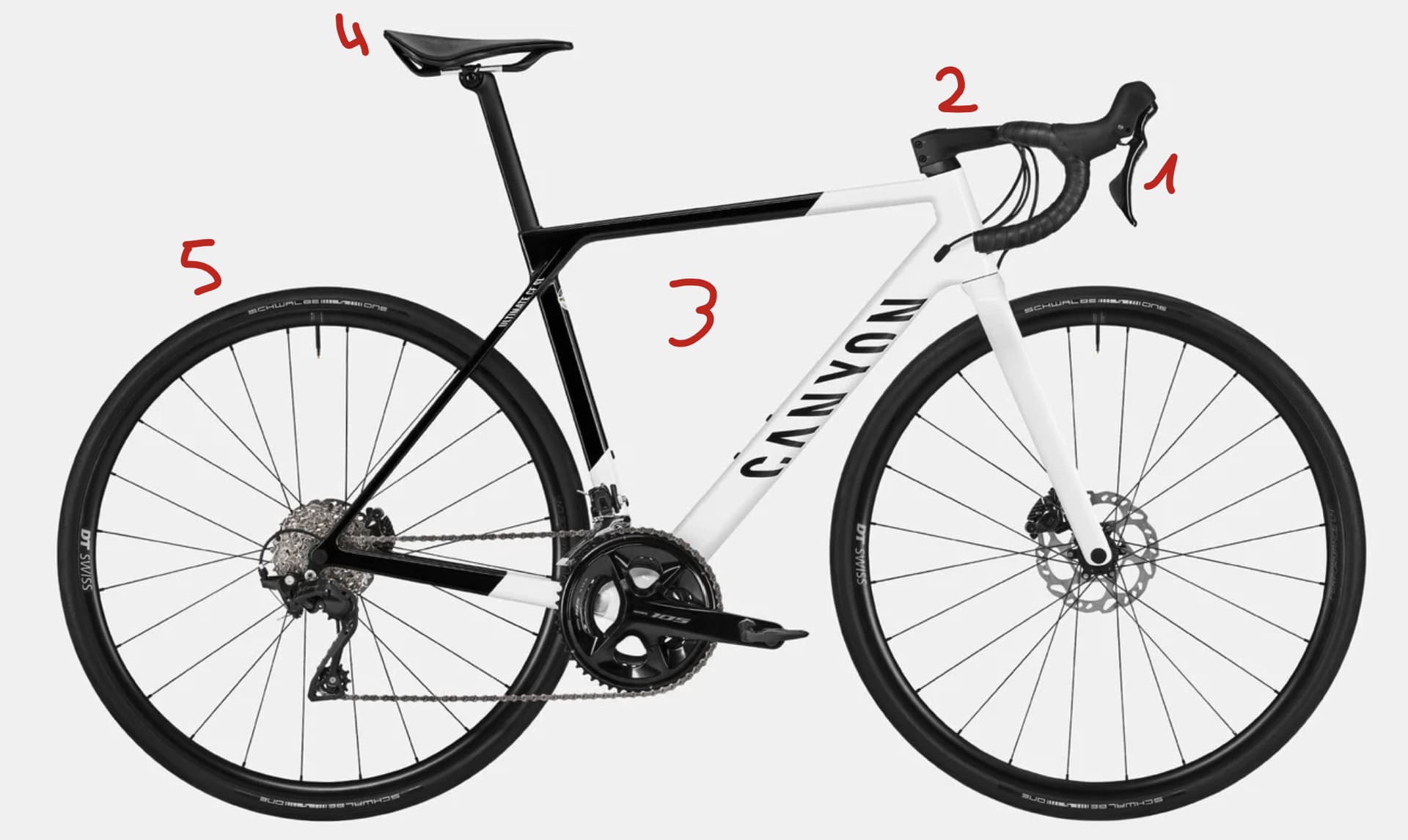
Example: Chapter 7 of Graham’s book discusses how to memorize the key points of an article. This advice consists of 5 steps. I have attached this advice to different parts of a race bike.
Pick a location to store information for the article
handle bars
image: a road map with red circle around key locations on the map
Visualize the key points of the article by creating an image for each point
gps attached to stem
image: polaroid pictures attached to the gps
Review the images
frame
image: a friend named An secures the frame with a chain and key (Anki reviewing software)
Attach each image to a location
seat
image: polaroid pictures are pinned to locations on the map
Even simple objects can serve as powerful locations. It also takes less time to create than a more elaborate memory palace, but stores less information.
This is in line with the previous example of the bike to attach just a couple of simple key points.
Some examples of simple objects I’ve used so far:
Race bike
Tent
Oldtimer Porche
Motorcycle with sidecar
Even pictures of unknown rooms or front porches have proven successful and fast in storing information. This was quite a nice surprise and might allow me to quickly create new locations to store information. Although I still need to experience how well this scales if I have a lot of pictures of buildings or rooms I do not know from personal experience and that they might be confused more often.
Reviewing anytime, anywhere. It is such a wonderful experience to be able to review on the go when commuting, in the fitness, when walking… so many opportunities of review just by having all the information in your mental notepad. This gives so much freedom in learning and making sure learned material is retained. I will however need a more structured approach to really move to long-term learning with reviewing at even longer intervals of 3 months - 1 year…
Next
More memory palaces. I only have 170 documented locations at the moment. I still have a backlog of undocumented locations, but this currently is a slow process. I notice I’m already paying a lot more attention to my surroundings than I used to.
Solutions
dedicated time every Sunday to document a memory palace of at least 25 locations
add one virtual palace every week of at least 25 locations
Further experiment with the Body System to store conversational information
I’m currently attaching things a person says to me to specific body parts of the person itself. This isn’t currently working that well at the moment. I think I need to put more effort in the visualization process and the reviewing during the day.
Apply mnemonics to study for the DP-600 Microsoft Fabric Analytics certification
This will be a real first test for me to apply mnemonics to a specific learning project.
There’s 2 types of structures that can be followed to attach information
To facilitate the learning process I will start with the course structure. The structure of the study guide might however be useful to store skills in a more generic separate long term memory palace.
Incorporate weekly words and images training from Memory League
Future
This is just a list of things I want to keep in mind but will not act upon just now:
Attaching symbol’s to rooms to categorize content. The following post How many memory palace do we need? - #6 by Erol talks about attaching an image to the door of a room, this is an idea I like as soon as I need to remember more complex content.
I really want to improve my ability to remember day-to-day random information, but realize this might still be a bit ambitious. Although I will keep trying on a daily base to retain information I’ll still have to think about useful strategies.
This day-to-day information can be broken down to at least the following categories
People
Tasks and projects
Current affairs (news)
Random bits of knowledge
Episodic information / events
…
I like to idea of experimenting with a dedicated memory palace for each day of the week. This might be useful for task management or for maintaining ad hoc information of that day without having to put mental effort into deciding upon a memory palace on the fly. By having 7 different memory palaces I can reduce ghosting since there’s enough time between reusing the palace.