Hey guys, have found this video from a learning expert,

I do think he has a point about remembering things in order is not equal to understanding of them. However, maybe I am wrong. Therefore would be nice to know what you think!
Hey guys, have found this video from a learning expert,
I do think he has a point about remembering things in order is not equal to understanding of them. However, maybe I am wrong. Therefore would be nice to know what you think!
Your statement lacks context to have much meaning in my opinion. It is not clear what things you are referring to.
Some thoughts on the video
He makes some good points in my opinion and he has great presentation skills. However, I have some problems with some of the things he says.
single digit multiplication
Here he creates a false dichotomy. He compares using mnemonics to learn fact such as 7 * 8 = 56 and using pattern understanding for that. I learned these facts by oral repetition in elementary school. Neither patterns nor mnemonics are typically used as far as I know for learning this.
Learning all Chinese emperors is not useful, but learning Chinese geography is
He makes a case that learning all Chinese emperors in sequence with dates and all is not useful , but learning Chinese geography is. This seems like more of a personal preference than anything else. If you are set on learning Chinese history, having this information using mnemonics would not be so hard and would give you a framework to attach more historical information to.
To much focus on memory palace
He seems to equate mnemonics with using the memory palace and thus comes to the conclusion that mnemonics has limitations like “you can only put so much in it before you start overwriting old information for the sake of new information” (sort of paraphrased what he said). He doesn’t mention for example that you can learn foreign vocabulary very fast using methods like associating words with what they sound like in your own language.
Falsely equating mnemonics with short term memorization
He is using multiple fallacies (anybody know the proper names?) that are basically:
mnemonics are often used for short term memorisation (in memory competitions), therefore they are not good for long term memorization. How something is used doesn’t say anything about how they shouldn’t be used.
mnemonics are actually also used for long term memorization (so he kind of uses an argument based on an untrue fact as a result of framing mnemonics as used in memory competitions only). He also kind of contradicts himself when says that using mnemonics for learning the periodic table seems like a good idea to him.
False depiction of school system
He creates this ideal world wherein students learn things for the long run and only should be using mnemonics for emergency exams (like when you really have to pass an exam and don’t have much time for learning). I can tell from experience that even at university level students care about passing exams first and foremost; keeping the information for the long term is not always the main priority. Another thing is that lot’s of information you learn in high school for example will be forgotten in only a couple years after graduation. Joshua Foer gave a presentation in Holland wherein he stressed that spaced repetition was severely lacking as an integral part of the school system; so you learn some things once and then you will forget it in a predictable fashion.
Thanks for bringing this video up. It was nice to watch it and have a way to share some thoughts on it.
I like it that he has researched enough to know the Major System and the PAO and that he chose to mention them on the video.
At first, he was just pointing out the difference between remembering and understanding. According to him, the latter is better for content that is “structured,” which I believe to be his way of referring to conceptual knowledge. When he says that memorization only helps with isolated bits of information, he’s saying that the memory palace only helps with factual knowledge. What he misses, however, is that conceptual knowledge is based on factual knowledge. For instance, you need to remember the terminology in order to understand a theory.
About long-term memorization, he’s very incorrect. For instance, he could google about memory athletes who have memorized thousands of digits of mathematical constants, like Pi, Euler’s number, square root of two, etc. These athletes didn’t spend just one day to break those records. If you want to remember your memory palace in the long-term, just apply active recall and spaced repetition, possibly by using anki.
Also, there are some types of conceptual knowledge that are worth memorizing. The memory palace isn’t just a sequence of loci: there are rooms too. You may very well use different areas to encode different types of information; in other words, you can apply the memory palace to categories and classifications, which are conceptual knowledge.
His comments on the multiplication table makes me think he disconsidered the possibility that the person may both memorize AND understand. You don’t need to choose only one thing. For instance, understanding that 4x7=7x4 allows you to memorize just half the images, so understanding often helps memorization.
His comments on Chinese emperors shows that he hasn’t considered the possibility of memorizing as a way of creating new hooks for future understanding. As I said previously, conceptual knowledge is dependent on factual knowledge, so if you don’t know emperor X, you will have trouble understanding what he did because your working memory will be trying to analyze both X and his relationship to other things. When you have memorized previously, you can automatically recall things like his name, the time, and maybe one point or two about what he did. This gives you hooks to associate new knowledge, allowing you to understand faster and more easily.
To conclude, I like it that he mentioned the forum, giving people a way to learn mnemonics. Maybe he’s even gonna see this thread? It would be fun to talk to him here. Don’t worry, Dr. Benjamin, we won’t get mad just because you criticized the memory palace  .
.
Also, I just found out you used to be a Theravada monk, @Santipalo . I hope you’re managing to live well and comfortably after leaving the monastic life. Much metta to you!
My experience… in 2015 I was studying English on my own… then I saw about memory techniques… per day, I read 20 words of English and at the end of the day I had only 3 memorized on average… knowing memory techniques. . from 20 it was 19 or 20 when I consulted the meaning… what I learned during 1 month with techniques, it took more than 8 months to memorize without techniques… I don’t see any difference between a memory athlete or a teacher with knowledge of techniques … both are good… the one with the former memory athlete, Ron White very good… the one with Anthony Mietivier, great and complete…
Very interesting topic! In my experience there are indeed arguments for memory techniques, but also against them when it comes to learning.
As @Mike4 already mentioned, memorizing facts can create a lot of hooks for further learning. When you already have a list of Chinese emperors in your mind, you will recognize them. Then you will think something like: ‘Oh, I know this one! He ruled in that period of time, just after that other emperor who did this and that.’
It’s similar to cars. When you get to know a certain model by heart, all of a sudden you will recognize it in traffic everywhere.
I’m also a bit puzzled why so many people claim that memorization decreases understanding. Yes, you can argue that using memory techniques takes away time that you could use to deepen understanding. But it can also be the other way around. Using the techniques greatly reduces the time you need to memorize something, hence you have a lot more time to master the understanding! That includes studying internal structures.
On the other hand you often don’t know what’s important when learning something new. In this case trying to memorize everything isn’t adviceable. The things you actually need can get lost in all the details, kind of. Hope you know what I mean. Or even worse, you memorize the wrong things. Hence it’s good to have a certain level of understanding before applying memory techniques. You should at least know what’s important enough to go into long term memory.
Another potential pitfall: When connecting facts to a memory palace, there will probably be less connections between the facts. For example you can place the Chinese emperors in a memory palace and recall them in order. No problem. But when you take the palace away after a while, it will be a lot harder to remember which emperor succeeded another one. There are no links between them. Well, at least without further learning, see the example above (‘Oh, I know this one! He ruled in that period of time, just after that other emperor …')
So what arguments are stronger, pro or contra? In my opinion it depends on how you use memory techniques. But I think with the right strategies they can be a new milestone in learning and(!) understanding.
I commented on the video. Nice on him to make it, and he appears interested. Anyway, two things which I found incredibly frustrating.
For Short-Term only. The techniques work long-term, if you review. He looks at what we do in competitions and considers it to be short term use only. This may be true in the sense that I cannot remember a deck of cards which I memorized yesterday, however, if I reviewed this would be extremely easy. It works for long-term, incredibly well if you use it for long-term. When I memorize a speech for work, I will review and it comes out smooth.
Memorization ≠ Understanding
He makes the assumption that we are just memorizing rather than understanding the information. I have never seen any memory athlete endorse this. It sure is easier to remember something you understand. My recommendation is to read and understand before you even encode. If you want to apply it to a chapter, give it a good read, understand it and then put it in a memory palace for the chapter.
Speak for yourself lol
Thank you guys for commenting.
For myself, I found it difficult to understand the dichotomy of understanding vs remembering.
I will give an example from my boring accountancy studies where I have used my approximate understanding, imagination and loci.
Let’s say I am reading about what is the concept of accruals. it is something like that:
Accrual accounting is an accounting method in which payments and expenses are credited and debited when earned or incurred.
Then there are many details and nuances.
So I make a rough estimation of what that concept could mean, from my yet not complete understanding convert it into a scene/character and place it somewhere in my rented apartment. Then lately I could make a better metaphor or add some details.
For example, a character from the Simpsons named Abu who is the Indian shop owner is in my toilet demanding a payment without accepting any credit card, when I have used the toilet. Saying that I have to pay when it smells not when it gets flashed.
Here I just tried to understand the concept by making an analogy. So am I understanding or memorizing?
Did I create a fake structure that will obstruct my understanding of the concepts and the relation between them?
How do I know when I am memorizing, and when I am understanding?
Is it possible that memorizing and understanding are the wrong categories to use?
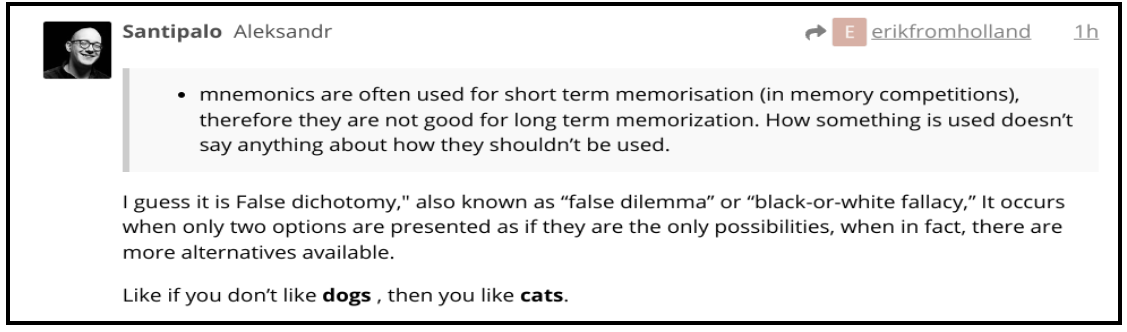
- mnemonics are often used for short term memorisation (in memory competitions), therefore they are not good for long term memorization. How something is used doesn’t say anything about how they shouldn’t be used.
I guess it is False dichotomy," also known as “false dilemma” or “black-or-white fallacy,” It occurs when only two options are presented as if they are the only possibilities, when in fact, there are more alternatives available.
Like if you don’t like dogs , then you like cats.
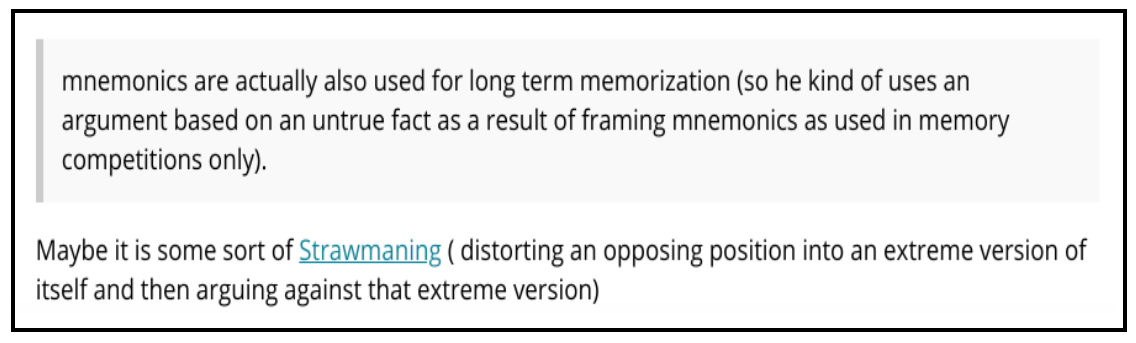
mnemonics are actually also used for long term memorization (so he kind of uses an argument based on an untrue fact as a result of framing mnemonics as used in memory competitions only).
Maybe it is some sort of Strawmaning ( distorting an opposing position into an extreme version of itself and then arguing against that extreme version)
Examples:
Thank you,
Well, it was a bizarre experience, and then it was very difficult to come back after it. Mainly because of indoctrination, but who knows.
I made an account just to say this:
Understanding and Memorizing are the same thing.
What we think of as understanding is just memory that connects better with other facts or reality.
Mnemonics work even if they don’t connect well with other facts or reality. That is the problem.
Could you elaborate on this?
In superficial understanding, memory functions in a straightforward A → B manner. However, with deep understanding, the approach involves memorizing that A possesses certain properties and also memorizing the effects of these properties. This process involves synthesizing the meaningful impact of these properties when combined. This allows for the derivation of outcomes beyond simply B, based on this dual-layered memory. Generally, when we say we’ve truly understood something, it refers to possessing this type of complex, interconnected memory that not only acknowledges the properties and their effects but also how these elements interplay with broader knowledge which is effectively also memory.
Thank you for your effort to explain!
Mnemonics work even if they don’t connect well with other facts or reality. That is the problem.
Do you mean that I can connect the wrong things, without knowing what is true, just by pure imagination. That’s why it is a problem?
In superficial understanding, memory functions in a straightforward A → B manner. However, with deep understanding, the approach involves memorizing that A possesses certain properties and also memorizing the effects of these properties. This process involves synthesizing the meaningful impact of these properties when combined. This allows for the derivation of outcomes beyond simply B, based on this dual-layered memory. Generally, when we say we’ve truly understood something, it refers to possessing this type of complex, interconnected memory that not only acknowledges the properties and their effects but also how these elements interplay with broader knowledge which is effectively also memory.
I will try to explain my understanding, are you saying that at the first stages when I memorise an object lets say an Elephant I am just knowing the label, but on the advance level I am capable to deduct that elephant has big ears, particular colour and behaviour?
After first reading your comment I was like “that makes no sense”, but after a couple of seconds I was like “yes, but …”. So here is what I can make of this. It is possible that he has, perhaps as a result of his educational training (hope that is properly phrased  ), this notion that learning strategies are generally good for either the short term or the long term. When you combine this notion with the obvious fact that memory competitions tend to focus on short term memorization it will lead to the idea that the methods used in those competitions must likely be “only” effective for short term memorization. It is however not a false dichotomy, because that is a logical error like with your dogs and cats example. It is simply an untrue fact that leads to an untrue conclusion, but it’s not the logic that is the problem.
Because we can’t know what he thinks are the underlying related facts, we can’t also not know what logic he has used to come to his conclusions. It is still possible that as I suggested he made the error of thinking that because something is used a certain way, it must not be used in another way.
Well, I tried my best
People have asked me to interview him based on this video, but I can’t quite discern what we would talk about.
As @Bigdonnyv points out, his special focus on memory athletes doesn’t quite stack up.
I’m not 100% sure and certainly not making an accusation. But it reminds me of special pleading:
In other words, it’s like he’s saying “because there’s this special group who loves memory techniques, x is the result.”
I feel Scott Young gets it a bit better in Ultralearning. Basically there he says, there are people who are into memory techniques and some of them are really into them (not an exact quote).
He leaves it at that before moving on to describe his personal preference for developing long term understanding and what amounts to semantic recall of specific words and phrases – both of which matter in different ways, in different contexts. Sometimes they might even be equally weighted in certain contexts, but ye olde art of combinatoria had the goal of being able to express concepts accurately in a variety of ways, never getting particularly hung up in the surface structure of words when the goal is to transmit the deep structure of meaning.
People use mnemonics and people criticize. Welcome to rete omnium gentium, the biggest utopia for critics yet!
I think that would be a great idea for you to talk to him. At least for the pure experience.
Very interesting take on the matter.
This also relates in an interesting way to the human intelligence vs artificial intelligence comparison. Many people suggest that computers don’t really understand things, but we do. I am inclined to think that we generally don’t understand what understanding is supposed to mean.