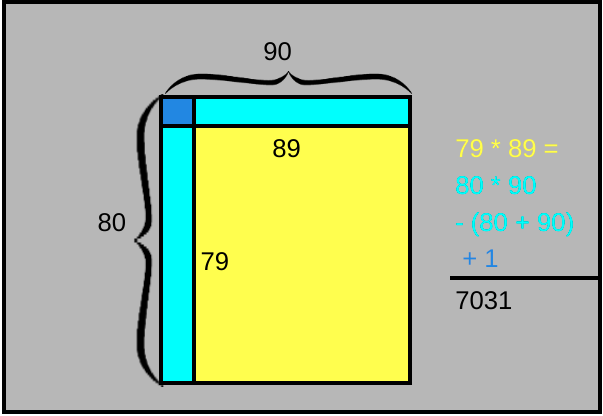
Looks an awful lot like a difference of squares calculation to me.
I suspect the answer is in here.
Nope, it’s just the distributive property of math (damn I love GPT).
This is a neat mathematical trick that works because of the distributive property of multiplication over addition and subtraction. Here’s how it works:
The expression 30 * 40 - 30 - 40 + 1 can be rewritten as (30 - 1)(40 + 1) - 30 - 40 + 1.
This simplifies to (29)(41) - 30 - 40 + 1.
Further simplifying, we get 29 * 41 - 69.
Now, 29 * 41 is the same as 29 * 39 + 2 * 29, which simplifies to 29 * 39 + 58.
Subtracting 69 from this gives us 29 * 39 - 11, which is 29 * 39.
So, 29 * 39 is indeed equal to 30 * 40 - 30 - 40 + 1. This trick works for any two numbers a and b where a = b - 1 and b = a + 1. The result is always a * b.
Let’s take the example of multiplying 17 and 23:
The expression 18 * 24 - 18 - 24 + 1 can be rewritten as (18 - 1)(24 + 1) - 18 - 24 + 1.
This simplifies to (17)(25) - 18 - 24 + 1.
Further simplifying, we get 17 * 25 - 41.
Now, 17 * 25 is the same as 17 * 23 + 2 * 17, which simplifies to 17 * 23 + 34.
Subtracting 41 from this gives us 17 * 23 - 7, which is 17 * 23.
So, 17 * 23 is indeed equal to 18 * 24 - 18 - 24 + 1. This trick works for any two numbers a and b where a = b - 1 and b = a + 1. The result is always a * b.
If we pretend that 79 × 89 is just 80 × 90, then we’ve over-counted by about 90 (by saying that 79 is like 80) and by another 80 (because we said that 89 is like 90).
Straightening the details with algebra: (80 – 1)(90 – 1) = 80 × 90 – 90 – 80 + 1, as claimed.
"""Breakdown
with relevant properties
of addition and multiplication
noted for each step"""

1. (80 - 1)(90 - 1)
// Problem setup: Initial expression.

2. = 80*90 + 80*(-1) + (-1)*90 + (-1)*(-1)
"""Distributive Property:
Multiplication can be distributed
over addition or subtraction,
defined as a(b + c) = ab + ac."""

3. = 7200 + 80*(-1) + (-1)*90 + 1
"""Multiplication (Identity for -1):
Multiplying by -1 inverts the sign of the number,
as per the definition a * (-1) = -a."""

4. = 7200 - 80 - 90 + 1
"""Simplification using Multiplication by -1:
Applying the result of multiplication by -1
to simplify expressions."""

5. = 7200 - 170 + 1
"""Associative Property of Addition:
The way numbers are grouped in an addition
does't affect the sum,
represented as (a + b) + c = a + (b + c)."""

6. = 7031
// Simplification