I want to memorize whole trigonometry formulas can any one help me on how I can achieve that.
2 Likes
Here is a website
You’ll find a whole section about trigonometry 
Have fun !
1 Like
What is exactly you need to memorise?
Like if you can, if you can’t then don’t, but if you can, please show all the formulas that you need to memorise and another thing, do you need to memorise steps, or uses or ideas, or something else, also that please, post it if possible. This can all be taking care of with a good use of pegs and the loci method.
1 Like
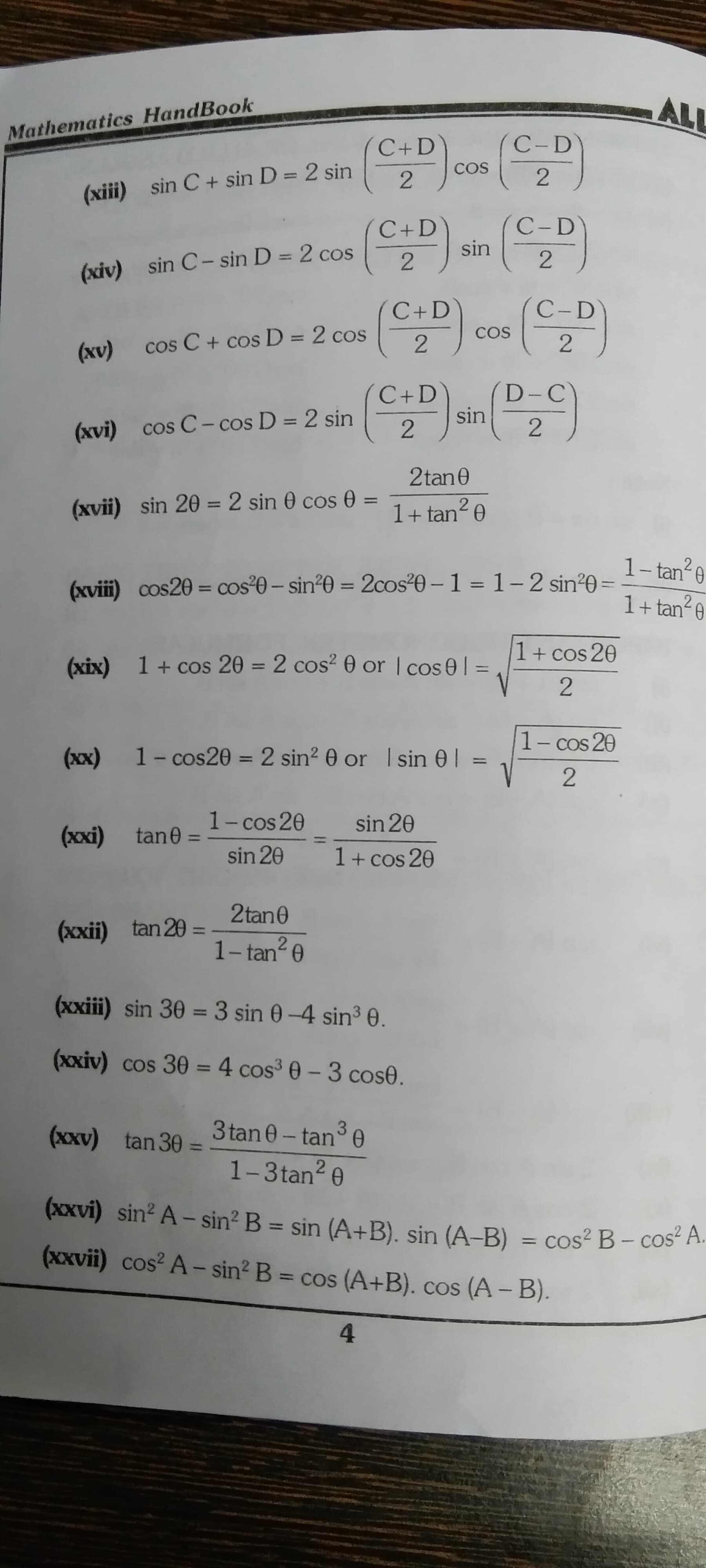
I just want to memorize all these formulas and I want they clicked me at the instant when I want.(there are more formulas also)
2 Likes
Memorizing trigonometric identities:
Method for memorization of formulae:
Identify the formulae and chunk the formula into patterns
Make a story of with mnemonic images of the chunks.
Place within a mental location.
Let’s memorize the fisrt formula of this image “Sum to product”, which is the reduced version of the first two of your photo:
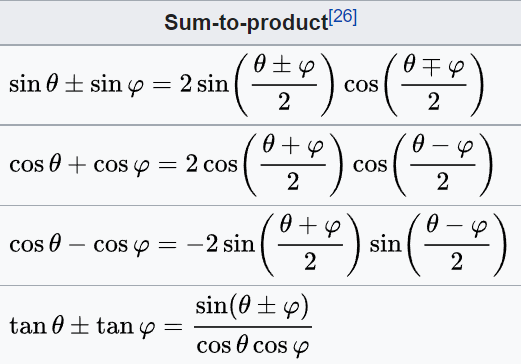
Steps:
- Identify the formulae and chunk the formulae into patterns
- There are four formulae then we’ll use four locations.
- All the operations on these formulas: addition, subtraction, multiplication and division. If you look at the formulas, do you think we really need mnemonic for the operations? I think not. We know two things, the left represents a sum and the right a product, so let’s be smart.
- The trigonometric functions used: sin, cos, and tan, let’s say a woman, two girls and a nun.
- We also have a -2 and a 2 repeating a lot, then if 2 = cup, then -2 = cup with a spoon inside.
- We also see patterns, the half of the addition of two angles and the half of the subtraction of two angles. If the angles are balls, then half means the half of a ball, but if we’re adding and subtracting then it’s easy what we can do.
- Make a story of with mnemonic images of the chunks.
-
First formula (it’s two formulae, but we won’t repeat):
Sinθ±Sinα =2 sin((θ±α)/2) cos((θ∓α)/2)
Left part:
“A woman holds a tennis ball and a basketball together around a + sign”
Right part:
Another woman drops a hold (2sin), then she fuses a half tennis ball and a half basketball ((θ+α)/2), the two girls wave to the woman and then cut in half a basketball and a tennis ball (cos〖((θ∓α)/2))〗.
On the ground you see two sticks and a cross (representing the other version of the formula)
- Place within a mental location.
Alternative method (simpler and better,with less identification and more a mnemonic first approach):
-
Make a mnemonic per side of the equation or formula, but out a temporal mnemonic that only works for your formula.
-
Create a story with the two.
You say a phrase out of the parts of the equation:
Sinθ±Sinα =2 sin((θ±α)/2) cos((θ∓α)/2)
Left side: Sino and Sina are two women girl each holding a distinct object.
Right side: Sino mixed the objects in a bowel, a man (cos) comes and separate the objects.How to remember when it’s: -, -, +?
Well, you can do the story again, Sino and Sina drop their objects instead, Sino separates the objects out of the bowel and the man Coso does add mix them again instead. Imagine.
-
Place in mental location (so you memorize).
1 Like
Before using any mnemonics, I’d first take a look at the formulas to find any patterns. Take a look at the formulas and see whether they can just make sense to you.
What happens when C and D are equal? Almost equal? Very small? One close to zero and the other something bigger? Use graphing software to try out some of these if that helps you visualize them.
Can you start with one formula and derive any others from that? For example, your first two formulas are identical (as Boris already suggested) except that one has a negative value. Well, sine is an odd function, and cosine is an even function (if you don’t know that that means then please learn it before doing anything else on this topic because you’d be missing the basics!) and it should be obvious why the second is true based on the first (or vice versa).
This will help you understand the formulas, and you’ll find the topic much easier. One very important point is this: the better you understand mathematics, the less of it you need to memorize. In fact, for my degree, we had to memorize lots of proofs, the purpose being that it would be a much easier task for someone who had understood the topic, compared with someone who did not, even if they would use the best mnemonic techniques available.
Secondly, do you really need to memorize all of these? I have a mathematics degree and never had to use most of these. Maybe your course just really likes making your memorize formulas though.
Thirdly, for anything not covered by the points above, I’d recommend using spaced repetition software (or maybe literally paper flashcards if that makes the maths easier to write?) and only resort to blind mnemonics for any formulas that don’t easily stick using that.
Good luck!
4 Likes