The Big List: Location Ideas & Inspiration for Memory Palace Places

Welcome to brunch!
Today we’re serving Bottomless Memory Palaces!

So,
Grab a pen and paper and set a timer for 180 seconds (3 minutes) (..maybe while you wait for the microwave to finish… 15 minutes if you use the Oven).

Instructions:

  1. Look at the list

  2. Scribble (and don’t stop scribbling!) ideas for personal memory palace locations until you hear beep sounds because the life support is kicking in and you’re at the hospital! Congratulations! But KEEP YOUR HAND MOVING.

Add inspiration. Add ideas.

Reply if inspiration struck you and you’re covered in ideas (or bruises)–And add to this list. It’s a community list now. Don’t pee in the water.

unnecessary backstory

I spent two hours non-stop scribbling as many personal ideas for memory palaces as I could muster out of my life and experiences. I got pages of them.

Thought I’d share the love.

These aren’t the palaces, these are broad categories I used and saw in many of my scribbles that inspired yet more scribbles.

If you’ve never done this exercise…!!
Well, Gee Willikers! Grab a gosh darned pen! Onyourmark-getsetGO

  • Homes
  • Friends
  • Work
  • Family
  • Vacations
  • Parks
  • Memories / Favorite Places
  • Childhood
  • Adulthood
  • Emotional
  • Horrible / Terrifying / Mortifying / Disgusting
  • Heavenly
  • Blackout Spots
  • Offices
  • Churches
  • Travel
  • Statues
  • Graves / Funerals
  • Netflix/Movies/Shows/Movie Scenes
  • Theatres
  • Music Scores & Compositions
  • Digital/Virtual/Games
  • Board Games
  • Devices
  • Objects/Items
  • Favorite Pictures/Art
  • Book Covers / Literature Art
  • Posters
  • Animals / Pets
  • Writing / Literature / Poems / Words / Cards
  • Shapes, Courtyards
  • Sequences, Designs, and Patterns
  • Blueprints
  • Furniture
  • Dolls / Stuffed Animals / Puppets
  • Kids Shows
  • Adult Shows
  • Westerns / Sci Fi’s / Genres
  • Illusions
  • Seasons
  • Holidays
  • Mundane and mundanities
8 Likes

Nice list! I had built one some months ago, so let me share it here too:

• House tours

• Grocery Stores

• Pharmacies

• Laundry Shops

• Gas Stations

• Bakeries

• Banks

• Veterinary

• Restaurant

• PUB

• Drive-through

• Hardware & Electronic equipment stores

• Clothing & accessories stores

• Office supplies

• Baby care supplies

• Hair salon / barber shops

• Pet supplies stores

• Florists

• Jewelry shops

• Antique shops

• Toy stores

• Perfume shops

• Gyms

• Dental Clinic

• Circus

• Police station

• Film sets

• Cemeteries

• Spacecrafts

• Car dealership

• Sports facility

• Playground

• Barns

• Cinemas

• Scout camps

• Luxurious mansions

• Museums

• Schools / Universities

• Hotels

• Libraries

• Amusement parks

• Zoos

• Malls

• Airports

• Subway / train stations

• Parks

• Offices

• Cruise ships

• Harbors

• Hospitals

• Castles

• Military bases

• Theaters

• Retail Stores

• Tribunals

• Chambers of Congress (House of representatives and The Senate)

• Presidential palaces (White house, Moscow Kremlin, 24 Sussex Drive, Palace of Turkish President etc.)

• Embassies / consulates

• Factories

• Warehouses

• Churches

• Laboratories

• Towers (Eiffel Tower / Tower of Pisa / Clock Tower)

• Water parks

• Penitentiaries

• Astronomical observatories

• Spaceports

Edit:
I just noticed that ChatGPT would be awesome for this purpose.

3 Likes

Are these suggestions of places one can use as memory palaces?

Sis chatgtp generate these ideas for you?

No, it didn’t. I brainstormed those ideas by myself. I only mentioned ChatGPT because I think it could recommend other nice places to use.

2 Likes

Here’s a MASSIVE list of place nouns that could work really well, especially if you’ve got a thing for fantasy settings:

https://www.reddit.com/r/DnDBehindTheScreen/s/tPwsNofoOU

Also, some quick googling of “list of place words” brings up a ton of results. Here’s a pretty good one:

3 Likes

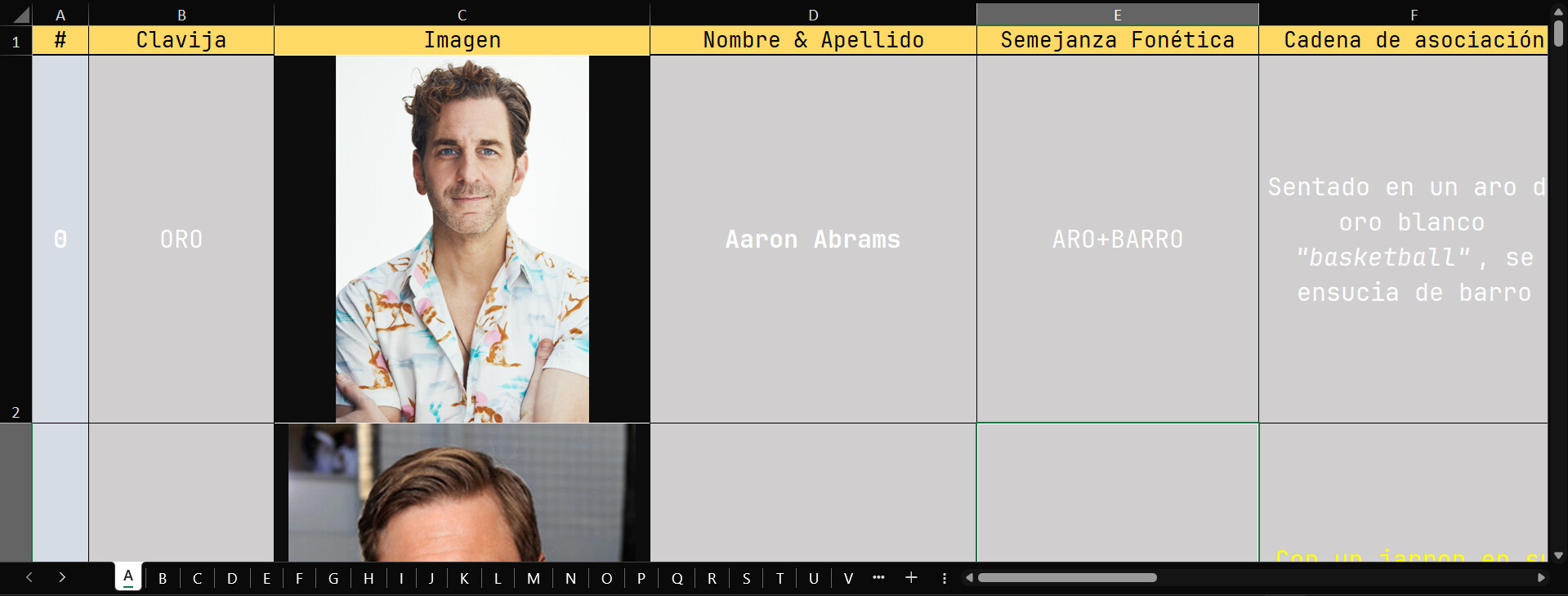
I use large alphabetical and numerical lists of names… I gradually add characters to the list and distribute them in places I go or in the video games I use to build massive palaces “construction video games”.

My list of names is a bit big, the list I show there are only actors, but I have lists of other categories of characters.

I also have lists of objects that would be used as places, but each list of objects is in a separate category.

2 Likes

I’ve found with MPs in my life, I’ve never spent enough time in them, apart from my house, to have a clear visual memory of that space. I’ve thought about, returning to somewhere like a gallery day after day to stare motionless at the architecture, but they’d probably think I’m casing the joint and ask me to leave :upside_down_face:

Don’t just go to the place but create stories with characters that you know and that you have an idea of them, for example Napoleon Bonaparte was very ambitious, to give an example, although you can add more details to the character, the idea that you have of him is essential for the scene and so you don’t just observe the place, but you fill it with life, you can also use objects for each corner of the place as if they were vertices.

Use old and common memory technique books, so you have many more ideas of how to do things and how you would do it… Everything progresses in a progressive way, don’t want to eat everything in one bite.

1 Like

I think I’m fine coming up with memorable visuals to imprint on a chosen MP; just wondering about the quality of a memorised MP. If my memory is hazy, and recall little more than white plastered surfaces from room to room, is that enough as a starting point

That’s a really great list in that Reddit thread.

Thanks for sharing!

1 Like

May I enquire if the ‘persons’ in the list are used as a ‘body palace’?

Apologies if I misread things.

No, what you do is move the character around all the loci, creating a story with them, to learn about a topic in depth.

For example, if you have a place or space such as a room with 24 loci (objects in the place such as chairs, windows, etc.) each, you can use a character who moves around the place as if it were a theater and learn the subject using characters, as if it were a theater show.

I am working on a book to show functional techniques for studying; I am not really interested in competitions.

1 Like

That’s seems very cool!

So say,you have a room populated with loci and data attached to them,and then a you take a character,moving it around the palace, interacting with these loci.

I can see it will help in solidifying the information to loci.The ‘creating a story to learn a topic in depth’ part is a little unclear to me.

I would love to learn more since I’m a student studying humanities,and analytical and critical thinking based questions are a staple in the term end exams in the uni.

Well, let’s say you watch a movie. In that movie, a series of events occur, but don’t forget that these events are different from each other. For example:

The goddess Circe meets Glaucus, a fisherman on a boat. She is the one who turns Glaucus into a sea god. Glaucus falls in love with Scylla. Circe becomes jealous and turns Scylla into a beast, etc.

You know what happened before and after, but add to this that you have a series of loci and a theme you want to understand. You can create a story in a series of places that will help you understand the theme. If it’s simple, a few will be enough. If the theme is more complex, there should be more loci.

In the previous example, I used a mythological story, but it can also be done with math and other sciences. You break down what you want to understand and work on it. Sometimes, after all that, you can create a single image to represent it, since you can define it in your own words. I’ve had it happen that I can’t say anything about a concept, but after I do this, I can define it in a simple or complex way, but the complexity depends on your command of your own language.

If the topic is something I understand and can use a few words to identify it, well, I usually use a mix of loci and layers. For example, I only place the first image of the scene in the loci. I can add plot components to the created image, for example:

The PDCA method (Plan, Do, Check, Act) and I translate it to a monk, who takes on a task that he decides to improve (the concept is based on continuous improvement). It could be karate. He plants a tree near a lake, which he checks and cares for every day. He eventually reaps the rewards and plants another tree.

Well, I can use metaphorical imagery, such as a series of techniques for spelling words. I also use these with layers if it’s a word-by-word speech. This is easy for me if I use layers. However, if it’s with loci, it’s more complex, in my opinion, since I have to create too many places. The only bad thing about layers is that you have to repeat the process from the beginning.

1 Like

Thanks, that helped a lot!

I think I get it now — so it’s like building a movie, and each locus is a still frame from that movie, right?And then you have a character who moves through all these loci, interacting with the scenes there.

I even tried it for history (Political Theory vs Ideology) and made a story with two characters moving through a classroom.

Does that sound like what you meant?

Create a list of characters, with objects, actions, and professions (such as boxing, painting, etc.), and design them in an extraordinary way to enhance memorization.

Number the character’s characteristics, from hair to toes, to help organize the information. This numbering is done only once, for example: 1. Hair, 2. Eyes, 3. Ears, etc.

You can use the left and right sides of the character to incorporate opposing concepts. For example, in the right ear of the character, you could have an angel representing honor, and in the left ear, a demon representing dishonor.

Next, take a theme and associate it with that character. In other words, you will describe the theme using the character and add objects that represent it. Each character can have up to 30 objects.

For example: Hermes has an owl on his right shoulder, symbolizing reflection; he rides a lion, representing egoism, etc. This technique can be applied to any concept, adjusting the objects to a visible size, since the goal is to focus on each body part. Animals can also be used.

Asking questions related to the concepts also works very well. This allows you to think logically about the concept and expand your reasoning, stimulating not just creativity, but also logic and critical thinking.

Remember, the character can move from one area to another, allowing you to connect ideas or concepts. If he visits a space where another idea exists, it may be something that, at first glance, doesn’t seem related.

For example, I’ll use Hermes to explain the concept of an algorithm.

Algorithm: A set of ordered, finite instructions or steps that solve a specific problem.

Hermes takes a piece of seaweed and, using a cookbook, follows the steps until he creates an exquisite dish. He eats it because he’s hungry.

In this way, the concept itself is understood. Using sensory images (that stimulate the senses) rather than just abstract ones also helps activate logic.

Yes, the concept is more complex and depends on other concepts. I created a statue with several objects representing each keyword, crafting a metaphorical story and explaining it in my own words.

Once you have this, you can compare and distinguish other concepts in different places. Just like in a theater, you can understand a broad concept in one place, decorated with objects specifically designed for that concept or series of concepts.

Remember to prepare the images first. Today, there’s a vast source of places, so you can search for surprising images online to complement your ideas.

Another example, to represent honor and dishonor:

Example 1: A girl with red hair on the left side and white on the other (dishonor = red and honor = white).
Example 2: Her left hand is burned for committing atrocious acts, and her right hand is washed for her kindness.

Yes, you create statues of this type, but don’t use them in other concepts unless you move them from one room to another, unless it’s to be used in a speech that you won’t use more than once.

Reviewing is important. I usually do it, and every time I do, I try to explain the concept differently; this helps with lateral thinking.

When in doubt and can’t break down the concept, use the AI ​​and ask it to create a series of important keywords for the topic, and based on that, create images… this is definitely the best.

1 Like

Thanks! I will implement this for my studies.

1 Like