No problem.
And also, as I am Brazilian, I have to translate to interact in this forum, and some of the times the translations are not good enough, generating a misunderstanding.
I sort of have the idea that we are talking past one another regarding the 7x7 grid that you proposed. The memory game always has an even number (multitude of 2) of cards because every card is one half of a pair. I believe you thought of a 7x7 grid because it is symmetrical and thus easy to visualize for the reader. But I also imagined that you overlooked the fact that 7x7 = 49 and thus this grid cannot possibly be used in a memory game.
You reacted to my question about this grid, but your answer kind of leaves me guessing if you understood the problem.
But I’m super interested in your answer.
I have a tendency to delete my contribution to a thread if the person asking for a contribution does not react to it within a reasonable amount of time.
I no longer have my first reaction, but I did save my “concrete mathematics analysis” of the memory game problem. So here it is:
A concrete mathematics perspective on the memory game
Perhaps of some relevance to this problem is that I used to study discrete mathematics as a hobby a long time ago. A lot of problems in the books I had were similar to this memory game problem. The proper method to solve these problems is always to first find out how you can describe it in the most simple way. It seems obvious that the only information you need is the locations of (x-1) pairs (x being the total number of pairs) because the pair that you are not memorising automatically follows from the information you did memorise. So in a 2 x 2 grid you would only need to memorise the locations of 1 pair and in a 10 x 10 grid you need to memorise the locations of 49 pairs.
You don’t have to memorise the order of the pairs meaning that for example you don’t have to memorise that the first pair can be found on location 3 and 19 and the second pair on 7 and 45. This means that you only have to code where the 2nd cards are for every first card position.
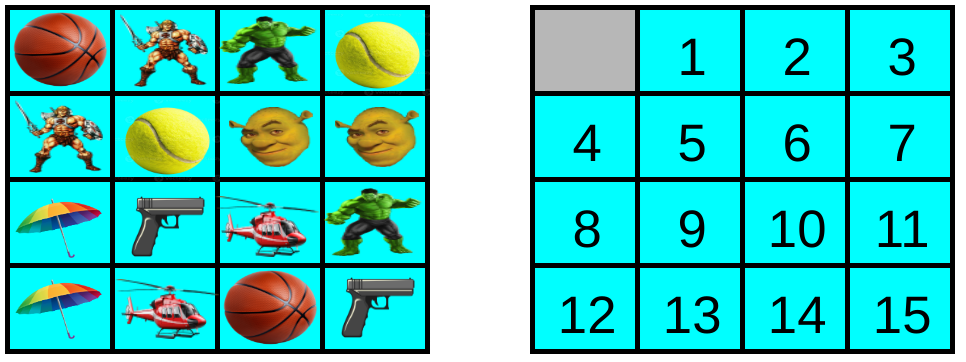
So let’s look at the below 4 x 4 grid.
So the first object we encounter if we use the left-right and up-down protocol is a basketball. The 2nd basketball can be found in location 14 . The 2nd He-man is in location 4. We thus end up with the following number sequence of just 7 numbers: 14-4-11-5-7-12-15. The position of the 1st and 2nd helicopter automatically follows from these 7 numbers.
Every number in the above sequence is an element of the range 1  15. So if we create an image collection of 15 x 15 (=225) images, we can code every variation as a sequence of only 4 images; we can choose to include the last pair (the helicopter), because memorising just 15 as opposed to 15 and 13 (the 2nd helicopter) makes no difference for us in this case.
We can also choose to code the positions of the 2nd image relative to the first image. This would not make a difference for the basketball, but 2nd He-man would now be represented by number 3 (3 places away from 1st He-man). We can also ignore images once they are coded, so that means for example that the 2nd tennis ball is the next image if we ignore 2nd He-man. So the location of the 2nd tennis ball can now be represented by number 1. If we code in this way we get: 14-3-8-1-1-3-3. Notice that the 2nd number can never be higher than 13 and the 3th number can never be higher than 11 and so on. This means that there are 15 x 13 x 11 x … = 2.027.025 possible variations to memorise. There is a possible way to benefit from the fact that the number of variations drops the more pairs you have memorised. There are only 7 x 5 x 3 = 105 possible variations for the last 3 pairs (the actual last pair doesn’t have to be coded as explained above). So that means that every possible variation of these 3 pairs can be associated with just one of the 225 images you already created for the above described more simple version of representation. So we would need 14-3 = 1 image, 8-1 = 1 image and 1-3-3 = 1 image and that means that with a collection of 225 images we can represent every variation of this 4 * 4 grid with just 3 images.