Technique for Math

Hey,

I started working on a way to remember math formulas and definitions since i will be starting a degree in physics which is quite technical. This utilizes the method of loci and some major system so that each file has one or more pictures associated with it. I am still developing the system but am looking for some input on what people think. This is what I have come up with so far, any suggestions or comments would be greatly appreciated. Thanks.

What I have so far.

  • addition Cross or Intersection sign

− subtraction 2x4( piece of wood)

× multiplication Jolly Roger flag (usually variables next to each other imply multiplication)

÷ division Seesaw for small division and the golden gate bridge for larger division

± plus or minus Pogo Stick

< less than Pacman (looks like his mouth)

greater than Mrs.Pacman (looks like her mouth)

≠ not equal Train Tracks

= equal Gymnastics Parallel Bars

| | absolute value Left is Telephone pole, Right Flag pole

( ) parentheses Left is boomerang, Right is banana

an a to the nth Carrot with major system picture for n. Last parenthesis is connected with
respective major system picture.

a^2 a squared Picture Frame

a^3 a cubed Ice Cube

√ square root Tree (Kind of root in treetop) End is the stump of tree

X variable Animated character who’s name starts with that letter.

b1 Subset/Base Sub Sandwich or major system number on the feet of the variable character

π pi (3.14) Pie

a:b ratio Radio (sounds similar)

What I need help with

≤ smaller or equal

≥ bigger or equal

° degree

mod remainder calculation

∞ infinity

x! factorial

f (x) function of x

(f ∘g) function composition

∆ delta

∑ sigma

e Euler’s number

brackets

{ } set

∈ element of

lim limit Speed Limit sign with C on the sign using major system\

y ’ derivative

∫ integral

δ delta function

ε epsilon

8 Likes

HI,

I know what you are going through. For calc three and differential equations, I had to have formulas memorized for the test.

here is what I can come up with;

≤ smaller or equal a small mouse drinking tea(Teaqual)

≥ bigger or equal a elephant drinking tea

° degree Thermometer

mod remainder calculation What??

∞ infinity Fin from adventure time (inFINity)

x! factorial chest with ballons( X marks the spot which has a chest and ! makes me think of a party)

f (x) function of x I don’t know if you have an alphabet system but I would use my picture for f caging() my image for x

(f ∘g) function composition I would use my alphabet system again here but g would be inside f like i would see a jeep (g) inside jeff’s butt!! Crazy but hey it works. you put g into f

∆ delta triforce ( makes me think of link from zelda)

∑ sigma cigar

e Euler’s number A tea cup in oil

brackets rackets(tenis)

{ } set birds

∈ element of elmo playing with tent

lim limit Speed Limit sign with C on the sign using major system\

y ’ derivative dirt

∫ integral snake

δ delta function someone hanging ( like a hangman)

ε epsilon someone slips on a banana

Let me know what you think

Is it worth making a system for studying advanced math?

Don’t some of the formulas become very complex and then its hard to follow a system to break the formula down into components and combine it?

1 Like

Thanks r 30 for the valuable information. I’m studying my first year in physics, and I have prospective memory complications ( remembering to remember), and when I visited a neural phycologist she introduced me to the memory palace technique. So now my plan is to use the method of loci to drastically reduce or perhaps even eliminate prospective memeory by simply remembering everything and using a plug and play system in tests. I must admit that the hardest part of using mnemonics in calculus is the repetition of symbols in a given equation. It’s simple enough to create an image for each element on its own, but creative a story that were each repeating symbol actually makes sense has proven quiet challenging. I played a lot of computer games during high school, so I have a ton of Refferences and loci with the world’s of the games I played, and I can easily visit them via saved games on my computer at home.

But I’ve found a problem with this. I used a scene to remember all the steps one should go through when contracting a graph. But honestly it came to the test, i forgot that had created this story in that scene, and simply walked right past it ( burning trees with faces in them) as if they were merely decor of the original game scene that no one pays attention to in the game. This makes me worry that my largest database of loci Refferences may not be an effective source because of my past experience in playing the game and only focusing on interactive objects instead of meditating on every single object in the scene.

Any advice appreciated. We shoudl keep this forum nice and busy, the 3 physics mnemonists :stuck_out_tongue:
Any help

Hello, GRiifen,

I’m glad that there is people out there who are also interested in memorizing math and physics. Ok, I try to give you some advice on the problems you wrote about:

I must admit that the hardest part of using mnemonics in calculus is the repetition of symbols in a given equation. It's simple enough to create an image for each element on its own, but creative a story that were each repeating symbol actually makes sense has proven quiet challenging.
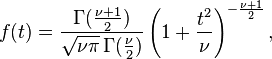
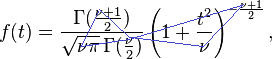
You could find all instances of letter/operation that is repeating in that equation and connect them with lines. student_t_distribution.png student_t_distribution_v-triangled.png

If there are more than 3 symbols you can form shapes, for example here I formed 2 triangles. The angle dots of the shape connect different loci (put v into 5 different loci). Then you just need to recall the exact positions of these loci, the shapes are going to help you do that.
EDIT: You can also visualize the image you have for the repeating symbol “v” walking through all these loci in order. You could even numerize them 1,2,3,4,5 using your peg list.

But I've found a problem with this. I used a scene to remember all the steps one should go through when contracting a graph. But honestly it came to the test, i forgot that had created this story in that scene, and simply walked right past it ( burning trees with faces in them) as if they were merely decor of the original game scene that no one pays attention to in the game. This makes me worry that my largest database of loci Refferences may not be an effective source because of my past experience in playing the game and only focusing on interactive objects instead of meditating on every single object in the scene.
Yes, there are some objects that naturally draw your attention, they make better loci. If you use loci are not so notable, then you just have to revise them more times, each time you walk past them you train yourself to turn your attention to them.

It also helps if you just don’t recall info by randomly walking around in your palace, but you have specific routes, a journey. Then the chance to just walk past some loci is minimized, because you know which locus comes after the current one
(I also pointed out in my previous comment that recalling the symbols of equation should be done in order).

4 Likes

Thanks for the quick reply r30.

With regards to the shapes, i think it’s a good idea. Just with regards to remembering the shape, would you say that changing your type of view of the room would help. Our very day lobes are based on first person perception, but when I think of connecting repeating events which form a shape, the first thought that comes to mind is to view the shape from a birds eye view. Two reasons: a change on perspective means one more notable difference that can help oneself remember the loci. The second would be that if I overlap the room with connecting lines, and say the equation is quite long and complex, from a first person perspective it will land up looking messy. What are your thoughts on this? If I think about it, the only danger that comes up would be forgetting to go to a birds eye view, but I can also just put a poster next to the wall on the way out that I will remind myself to look at, which will just contain a check list if different perspectives that the room has.

I those I suppose it’s just a matter of practice and learning more about how you remember some things better than others. It’s just such a pity we weren’t driven by this when we were in primary school.

I finished reading moon walking with Einstein two days back, and this afternoon I plan on doing a search for the Latin book on mnemonics so I can start reading it ASAP. Has anyone read the book/ knows where to find it?

I’ve used the bird’s view on some occasions also. You are correct when you say that changing our point of view allows to add extra images to the same loci you have already used (read the second answer to this FAQ).

In case of equation it can be a little tricky (I haven’t tried it myself), because the loci often go from up->down (they are on the same plane) and viewing them from up you can’t see the whole equation at the same time (upper loci hide the ones that are beneath). Then you should rotate the loci of the equation when going birdsview (you’ll still have different background, which allows you to add extra info).OR you just don’t put the loci on the same plane.

1 Like

What is the title?

I started to use items in the NES Castlevania games as operators. After a bit of thinking I decided that visual shape is the best association. So knife became a minus, cross boomerang became a plus, the orb is then a dot product and the cross is the cross product. When it’s hard to find an item, that looks quite like the given symbol, I use metaphors. Coma is a cooked pork, hinting at the short break. Watch (which stops time) is a period, hinting at the long break.
I’ve remembered only 9 definitions and one lemma as of now. Store them in the TF2 map with no numerical order, I’ll add it if I see any need in it.

Hi Guitargod10940,

I’m also a physics student. I just did an analysis on my equation and definition memorizing techniques and here is what I have learned so far:

General tips about studing:

  1. Make sure you memorize most important equations and definitions absolutely correctly (here's why).
  2. Eq-s and def-s can be more easily remembered and understood if you put them in use. That would be solving some exercises or proving some theorems using the pre-memorized eq-s/def-s.
  3. Also: Write the eq-s down. Using your muscle-memory benefits (and you'll have to write them down at exam anyway).
  4. Equation isn't random:
    • It is derived from another eq-s.
    • It is logical. If you magnify/reduce the input of a variable, the outcome is magnified/reduced in logical rate. Your gut feeling tells that it was P=U*I, not P=U/I (the greater the current is the more power it has, not less power)

Other tips:

  1. Divide the eq into smaller parts/chunks. Good separators are operations. For example, let's try to memorize Maxwell-Boltzmann gas distribution function :

    maxwell-boltzmann.png

    There were three things multiplied:

    1. massive two pockeTs
      • m/ sth
      • 2pikT
      And these two are cubed (could visualize them in cube) and then taken square root (cube under roots of a tree).
    2. 4piv2 (4pi is famous (from 'the area of sphere' formula). Could imagine a) square-shaped speedomeeter that measures the speed of a rolling sphere or b) forbidden speeding square (below I depicted it as a child's sandbox with race cars))
    3. e power sth
      • (mv2)/2 (kinetic energy)...
      • ..continuing -kT again (it was in the beginning too, also it means entropy S=kT)
    Note that I usually first try to recall the letters, then the operations they were placed under. Operations kind of just make sense later. And all these things together give you probability density function of gas particle speeds. Now this is a thing you just have to understand, mnemonics won't be much of a use here (besides memorizing that it is a probability density function, not the probability itself).
  2. Additional steps 2 and 3 (using loci):

  3. Using multiple loci per equation: If you want you can place these chunks you get into different loci.
    1. It's good if the loci are organized in the way that they mimick the shape of the equation. Otherway your brain gets confused, since your loci don't resemble the equation you'll be seeing in your book.
    2. Make sure you are able to recall all these loci. I have used some movie scenes that I hadn't had reviewed before starting to memorize an equation. I had trouble already recalling the loci, and then there was no way of recalling the equation.
    Now the loci tell you:
    1. How many parts (chunks) there were.
    2. How the chunks were placed.
    3. Give you overall glimpse what chunks were and what they consisted of.
    And you use images (massive two pockets etc), stories they're vowen into (look the very last tip) and logic to recall every chunk in detail.
  4. Placing the equations (like in this Physics Equation video): Similar equations can be placed near each other. For example one is above another - that makes them easily comparable. Then you use one to recall other - first recall the parts that they both have, and then the parts that were different.
  5. Use spatial revision for the equation many times before going to exam.
  6. 4.2 Always recall the symbols of the equation in the same order. It's also beneficial to spell the equation out while recalling it by writing it down, then it will be in your visual memory, vocal memory and muscle memory. I even sometimes tend to touch the loci of the symbols with my fingers, they are like little dolls in a dollhouse.
I'm giving you all these tips, because memorizing eq-s and definitions correctly and at the same time understanding them and being able to use them is one of the hardest things I've encountered in menmonics (when compared to memorizing other subjects).

More interesting tips:

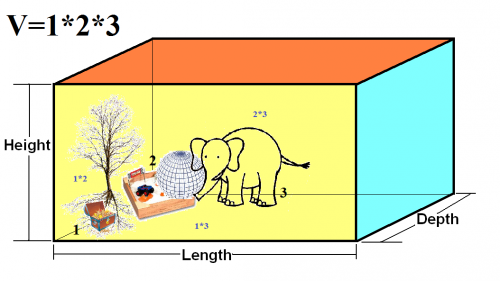
  1. Logical and mathematical statements represented intuitively. It discusses how to create "psychologically best kind of image" for every operation. For example, 'cube' is a good image for memorizing/understanding that something was cubed. And if three things (tree-, sphere- and elephant chunk) are multiplied, then in turn they also form their own chunk - we can visualize them inside a cuboid (each thing has its own edge, and their product equals with the amount of unit cubes (total volume) in that cuboid). cuboid.png Note that you can also use different faces of the cuboid to visualize the products of different pair of factors (for example if W=U*I*t, then U*I=P (power), and you can place your image of 'power' to the corresponding face).
  2. My webpage for math. There is a very simple example. However, this is not the optimal way to memorize the equation (it uses separate locus for each character!). Also, the loci are from movie scene (my personal preference) and uses persons as loci (which I don't recommend to do).
  3. About similar equations: Behind->Front technique for organizing similar equations (as I mentioned in point 3). I also recommended writing all eq-s down. Then going from Up->Down is good. Not only for similar equations, but for learning theorems also: theorem that you have placed down on your paper can be proved using the definitions and statements of theorems you have placed above, because you've already proven them (proved to be very efficient when I studied for my Algebra exam, had to be able to prove 73 theorems and remember ca 120 definitions).
  4. Creating a story between symbols in your equation. We already made some mnemonic images (massive two pockets, cube, tree-roots, speedometer, e...). Now to ease the recall we could connect the images into story: Massive two pockets are embedded into a cube, hidden below a tree (let the pockets be filled with gold, so it's a treasure chest). But a glass-sphere is accelerating on a speeding-square (sandbox), until it has reached the velocity needed to crash down the tree. Who was accelerating the sphere? An elephant (e) who wants the forbidden treasure for himself. That elephant knew two things: sphere had to reach a certain kinetic energy to bring down the tree, and the mess the crashing tree caused only certifies the fact that 'the entropy of a closed system only increases'. You can pin some images to the loci you're using (e.g. elephant is tamping cracks into its locus, or the first locus becomes leafy all around (there is a tree growing there)).

Ideas removed from old post:
Other tips:

  1. It’s more important to memorize the letters, not the operations *(use separate loci for letters) Recalling the letters is harder than recalling the operations. If you can recall some of the letters then recalling the operations they were under or between is quite easy. Of course, sometimes memorizing some operations is also good, if you have like sin(a+b) = sin(a)cos(b) + cos(a)sin(b) (the operations are repeating and in confusing order).
    *Separate loci for chunks, if you wish. But memorizing the operations that are illogical/always forgetting makes sense.
    2.1 Don’t use loci that tend to “fuse into one (object)”. That would be e.g. the four corners of a door. Take separate object as a locus for each letter (your brain thinks of it like this: Ahaa, here is a separate new object, that means here must be a separate new letter/operation (since in the equation they aren’t somehow connected, they are separate objects)).
    **Kind of preference thing. Some mnemonists use corners and walls and whichever small loci, and still are able to recall all images they placed there (here are some tips about it). Also, using separate object for each letter/operation is a huge waste, and can be even slow/confusing. Use loci for chunks.
  2. Similar equations should be placed behind/in front of each other. One of them would be above the other, located behind the other (behind because then it gives depth, and 3D structure is what our brain likes more than 2D structure. Then they also have order (since we usually move from left to right, front to behind in our palaces, not from up to down)). Then you can see them both at the same time and use the similarities in your advantage (e.g. they both have some same symbols, then you just need to remember the symbols for one eq and use the same loci of these symbols for the other equation too. Or the symbols can just be similar in some way (not always visually similar, but in meaning)). You can recall both of these eq-s from this point of view.
    ***No need to think about in such complicated way.
    More interesting tips:
  3. Creating a story between symbols in your equation. Can be useful, because stories are linear and you’ll be recalling the symbols always in the same order. However, I tend to use transformation method (transforming locus (object) into the symbol you placed there), but this means I have a pre-memorized image for every letter/physical magnitude. Find out yourself which of them is better for you. They can also be used simultaneously (makes the associations double-strong).
    ****In the example I used all possible linking devices (story method, and interactions/transformations between locus and its image). If you have time be creative and use whichever of them to ease your recall.
10 Likes

Hello! It’s been 6 years since last message. You folks sure have some formulas that you’ve learned back then, but barely if ever used till this day. I’m wondering, how good do you remember them today?

If you still can remember them, then I think someone might want to write an answer on this also very popular question.¹ This would be an amazing answer, because the general opinion in there it seems is that there’s no way not to forget math you’ve learned but barely if ever applied.

1: Forum does not allow links, so: mathoverflow net/questions/143309/how-do-you-not-forget-old-math

1 Like

Here’s a link: