Any suggestions on how one might go about teaching a 6 year-old a 3 x 3 Rubik Cube’s solution. I am not looking for speed here but rather a method that provides consistency. I guess in short what I am asking (as I know that algorithms must be learnt to solve the cube) is how do you teach a 6 year-old to ‘memorize’ the steps or algorithms necessary to solve a ‘scrambled’ cube?
- Memorise order of steps:
You can imagine what elements of each step looks like and connect them with some linking method, story method for example.
Here is a story, that I created for this beginner’s method:
https://youtu.be/E7-0GYMCwyQ
- Daisy -daisy -summer
- Cross -petals fell to the ground -autumn
- White layer - snow layer - winter
- Edges - tulips - spring
- Yellow cross - dandelion - summer
- Yellow corners permutation - yellow leaves fly from one place to another - autumn
6.1. Yellow corners orientation - yellow leaves layer - autumn - Edges permutation - maybe dandelion leaves sorted in jars for medical use - winter
(On this step edge permutation is only thing left to do. So no need to memorise this step)
The story itself:
“A daisy grew on a field, then its petals fell to the ground. Snow fell on them. On the same place tulips were planted, then dandelion was planted. Strong wind blew yellow leaves on them and then all became covered with leaves.”
Maybe it is good to show pictures of the story to the child or even ask child to draw the pictures himself.
I think best way is to ask child what do steps looks like to him and then create story from his images.
- Memorise how to solve each step:
If you teach a method with long algorithms, you can create an image for each move and create a story for each algorithm.
But I teach method with one short algorithm, that should be repeated many times.
This algorithm is "R U R’ U’ ". This algorithm is for shuffling elements near right hand.
For step 3 “snow should fall down”, so you found white pieces(“snow clouds”) in top layer(“sky”) and repeat R U R’ U’ (“shuffle clouds”) until white piece is pointing down and colors match with edges (“until snow lay correctly”)
For step 4 “you should plant tulips”, so you do R U R’ U’ (“dig=shuffle snow to create hole for tulip”) and then put white piece down like in step 3(“plant snow with tulip the same way you put snow from clouds”)
If child don’t understand some process you should create another explaining story.
For step 1 you can imagine that Rubik’s cube with 3 layers is “a house with 3 floors”. White piece on a side is “living on 1st or 2nd or 3rd floor”. Goal is to put all 4 edge pieces on the top face(“on the roof”). 2nd floor is better, so you firstly put pieces on 2nd floor and then to the roof.
Just stories doesn’t include all needed information. While using these stories you should show on the cube what is correct and what isn’t.
I haven’t explained full method, but hope you get the idea.
Yinghao Wang from china teaches 4 year children to solve Rubik’s cube under in 10 seconds. Some of his little students in 7 years age sometimes defeat world champions and this is unbelievable!
I wonder what methods of teaching dose he use.
A very strong and respected chess trainer GM Jacob Aagard told his daughter children aren’t allowed to play chess until they are 4 years old and then she was very eager to start playing on her 4th birthday.
This leads me to believe age 4 is around the development stage children can potentially handle learning skills like chess or rubik’s cube.
2 Likes
Thank you for your detailed reply. I particularly like the story method you have given in your response. If I’m understanding you correctly, are you saying at some stage in the 3 x 3 cube’s solution a series of RUR(Prime)U(Prime) will solve for all six sides of the cube though? If that is indeed the case, what is the stage of the solution. There are a multitude of youtube videos available on solving the 3 x 3, could you suggest the best one for the purpose of a six-year old wanting to learn the secrets of the cubes solution for me. Many thanks again!
Yes, series of RUR’U’ and L’U’LU(the same moves but with left hand) solves each step of Rubik’s cube solution excluding the first step.
I think the best tutorials I have watched are:
- Full R U R’U’ method https://youtu.be/E7-0GYMCwyQ ,
- and a short tutorial about slightly better method
https://youtu.be/7Ron6MN45LY
2 Likes
My story-line is as follows:
- Build a Daisy and drop Daisy petals to bottom to make a “White Cross”
- A Snowstorm completes the “White Side”
- Plant “Colourful Tulips” in second layer
- Build a Yellow Dandilion (yellow cross)
- Positioning corners. I have Geoff Hurst only man to score a hat-trick in a Soccer World Cup Final (taking corner kicks - first from RHS x 3, thereafter a whole cube rotation to the left, and then from the LHS x 3) - RHS are RUR’U’ x 3 and LHS are L’U’LU x 3 But important not to forget cubes rotation between the two series of algorithms
- Twist last layer corners. Right Hand is waving to me from the ‘completed white side’ which is placed on top. You now rotate using RUR’U’ algorithm. Note load yellow corner pieces to be rotated by turning only the bottom layer. Perform RUR’U’ algorithm as many times as needed to get yellow corner pieces to face down.
- Position last layer edges. Here I picture a ‘digital alarm clock’ showing the time 11:55 to remind me that the series of alternating algorithms are:
1 x RUR’U’
1 x L’U’LU
5 x RUR’U’
5 x L’U’LU
Step 7 above is the longest set of algorithms and is where things are prone to going wrong. I think I need to buy my grandson a better quality 3 x 3 cube because he has a cheap generic Chinese version. The people given their demonstrations of cube solving are using “Rolls-Royce” models of cubes, obviously a huge price difference but you get what you pay for ‘magnets’ and all! The important thing is the storyline to remember the sequence of steps to solve the 3 x 3. I know this method is not the most efficient having seen Chinese youtuber wiz-kids solve the cube extremely quickly but obviously they are “Speed-Cubers” that have learnt countless patterns and know exactly what the shortest paths are to solutions in break-neck time! I’ll leave those heuristics for the experts. My goal is to teach my 6 year-old grandson and he seems to be cottoning onto the RUR’U’ L’U’LU method of algorithms quite well.
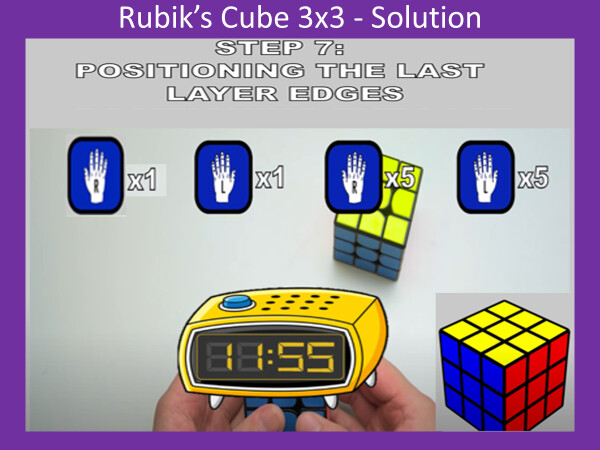
Great story! I like “alarm clock 11:55”.
If you think, that the step 7 will cause mistakes, you can make it much shorter:
- 5 x RUR’U’ equals to 1 x URU’R’ so
instead of
1 x RUR’U’
1 x L’U’LU
5 x RUR’U’
5 x L’U’LU
You can do
1 x RUR’U’
1 x L’U’LU
1 x URU’R’
1 x U’L’UL - Another option is
R2U RUR’U’ R’U’R’UR’
It should be performed from different angle. - M2 U M’ U2 M U M2
- F2 U’ M’ U2 M U F2 (From different angle again)
- You can see other options here https://speedcubedb.com/a/3x3/PLL/Ua/0
All best 3x3 cubes are Chinese too.
And price difference isn’t always huge. Best cube isn’t always expensive. Some record holders have huge puzzle collection but use cube “Meilong 3m” for 4 dollars or cube “RS3M2020” for 9 dollars to set their records on competition. But of course these cubes have magnets and were bought from speedcube shops.
Good luck with Rubik’s cubes to your grandson!
2 Likes
Do the 5 x L’U’LU maybe have a shorter version too? If they do, I can rather teach the further shorter algorithms to solve in Step 7, the final step of rotating the top layer edge pieces.
Given that 5 x RUR’U’ equals 1 x URU’R’ there has to be a shorter version for the 5 x L’U’LU too? I’m guessing??
Yes,
5 x L’U’LU equals to 1 x U’L’UL
I already wrote that full algorithm will be
1 x RUR’U’
1 x L’U’LU
1 x URU’R’
1 x U’L’UL
1 Like
Thank you so much!
1 Like
Very lazy question, but does that run into parity problems (Like, the blindfold methods often do)?
I see some great ideas here already. One other thing to consider is the Roux method, which I think requires a smaller amount of memorised algorithms. I learned the usual layer-by-layer method years ago and tried switching to Roux a year ago, and it’s fun, although I don’t think I’m faster since I don’t really practice (maybe 45-60 seconds with layer-by-layer, and around a minute for Roux).
When doing layer-by-layer, I did come up with a mnemonic system for learning algorithms: each face move translates to a digit, then putting 7 before a digit means to turn anti-clockwise, putting 8 before means turning twice, then 9 and 0 signify slice and wide moves. I had some other method to indicate cube rotations. This would turn each algorithm into a sequence of digits which I could memorise with the Major system. But it became a real chore for me, and didn’t help with speed since you want to build cube algorithms into muscle memory without having to think about them.
Another possibility is to use the blindfolded methods. I use the most beginnerish Old Pochmann method which is really only 3 algorithms: one for edge swaps, one for corner swaps, one to fix parity errors. During the solve, you just have to memorise one sequence of letters for the order of edge swaps and another for corner swaps, then intuitively figure out how to setup (move the target piece to a “buffer slot” position) and restore (undo the setup moves). I use a memory palace for the piece letters: edge pieces go in the sitting room, corner pieces in the bedroom.
1 Like
There are additional U moves between RUR’U’, so there is not parity.
Method without additional moves would have parity.
Yes, Roux and Old Pochmann are options too. But they require more intuitive understanding in some steps.
I believe Old Pochmann is fastest method by learning time. But if and only if a student understands setup moves easily.
Actually only 2 algorithms. The algorithm for corner swaps can also fix parity errors.
But for this to work you need to memorise 2 edges swapped.
And in non-blindfolded solve with Old Pochmann parity is fixed automatically.
1 Like
Thank you for the system to turn moves into digits! I believe some day i will force mnemonics and muscle memory to work together.
2 Likes
This topic was also recently discussed over on Cubers Reddit. u/olimo has been teaching her 4 year old daughter how to solve, so it’s certainly doable for a 6 year old.
https://www.reddit.com/r/Cubers/comments/zaf7nr/how_do_you_teach_beginners_to_cube/
https://www.reddit.com/r/Cubers/comments/xepxvg/some_notes_on_teaching_my_4yo_daughter_to_solve/
I particularly like the Merry-Go Round (horizontal plane) and Ferris Wheel (vertical plane) metaphors. All is progressing well with my grandson’s 3 x 3 cube’s solution. The point made in the information you provided about a 4 year-old not being concerned with how long it takes to solve the cube, just as long as it can be solved is as relevant to a 6 year-old too it would seem. Thanks for sharing the information Bjorn.