I have started teaching my 11-year-old daughter some mnemonic techniques, starting with numbers. So far, I have taught her the number shape system and the number rhyme system for numbers 0 to 10.
However, I would like to teach her mnemonics for numbers 0 to 100. I personally use the major system, but I’m not sure if it’s suitable for her age. Therefore, I’m open to suggestions for the easiest number system to teach her.
I have heard of the PAO technique and the shaper system technique, but I’m not sure which one to start with. I want to make sure it’s a technique that she can easily learn and understand.
What are your thoughts? Which mnemonic technique do you recommend for teaching numbers 0 to 100 to an 11-year-old? Have you tried any other techniques that have worked well for you or your children?
I appreciate any suggestions or advice you have to offer. Thanks in advance for your help!
What would she use it for? This affects which technique you might prioritize. You can always extend a 2-digit object system to a 2-digit PAO system or similar.
The most important practical system for most people is perhaps the memory palace and its use for quickly storing small sequences of information, like a shopping list.
I know your question is mainly about numbers, but it may be tough to find fun applications for a kid to use an advanced number system with. Not to mention the time investment needed to get to a point of easy utility with a two-digit PAO system, especially if you aren’t very familiar with the technique yourself yet. There isn’t much need for kids to memorize 16 digit credit card numbers or licence plates quite yet, usually. Unless they are REALLY into numbers and have expressed that interest unprompted, I’d advise focusing more on general utility techniques that are more widely applicable first.
I’ve got two kids, age 7 and 10, and starting last spring we explored the story link method by making up stories for small lists when we went to the grocery store. “an EGG cracks open and SPAGHETTI pours out, twisting and knotting around a BROCCOLI guy who gets trapped and calls for help, a SOAP BOTTLE rescues it by squirting soap that dissolves the spaghetti, and then giant soap bubble traps a TOILET PAPER ROLL that floats away and then pops and unravels all over a… etc.”
We also used the soundalike method to learn the 50 states in alphabetical order. They were unfamiliar with many of the state names so had to rely on soundalike for ones like “Kansas” (a can of sauce) or “Delaware” (a man in a suit made of deli meat… a deli wearing man.) That was almost a year ago, and they can still rip through the states today. They really liked that and it got them to think a little bit about how you can take an abstract unfamiliar thing and make it visually memorable for you.
They also had some fun with learning the Major System 0-9 sounds and storing the imagery in a basic memory palace created from the layout of their room. The number stuff is less practical early on and is a little bit esoteric at first though, so I didn’t push it too much…
I’d recommend finding something they’re really interested in and showing them how to use story link and soundalike methods to memorize something related. Maybe it’s the order of the planets and their major moons. Or the release order of the last 20 Disney animated movies. Or the top 10 most popular dog breeds. Something they’d be into and doesn’t just feel like more homework. Introduce the idea of thinking about HOW you’d turn something boring or abstract into something fun and memorable.
Whatever you go with, just make sure they’re enjoying it!
If your daughter can learn the first 1-50 Peg Words which are all intuitive in nature (in other words they don’t rely on any encoding system), I would suggest she uses a similar system to what I am teaching my grandson who is aged 7.
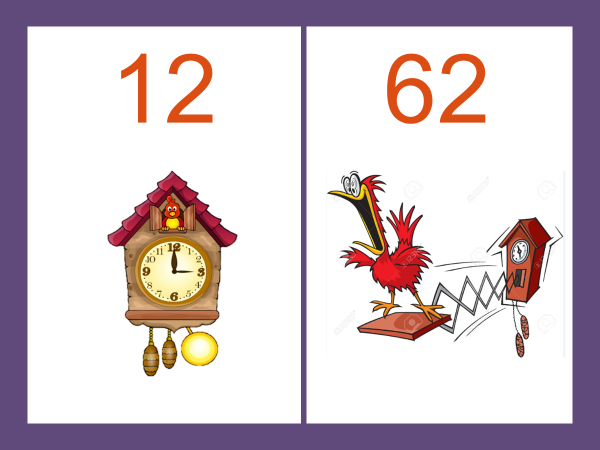
For example 12 = Clock (as there are 12 numbers on a face of a clock)
To get to 62 = 12 + 50 = Cuckoo (intuitively a Cuckoo could go hand-in-hand with a clock as an association). I posted a couple of days ago on this topic on the forum but the post didn’t get too strong a response so I jettisoned discussing it any further as I thought perhaps it’s of little interest to the folk out there that are using the more sophisticated systems like: Major System or Dominic System or PAO etc.? My idea though, is that mnemonics should be for everyone young and old and for all different levels of abilities. I would think as soon as a child can master the number system 1 - 10 that mnemonics could be taught to them. Some Nursery Rhymes do exactly that: "One-Two… Buckle your Shoe, Three-Four…Knock at the Door, Five-Six pick up Sticks etc. The principles behind mnemonics at whatever level remain the same, namely: use concrete images, make the images colourful, add movement to your images, exaggerate your images, invoke as many senses in your images as are possible, make your images humorous etc.
See the picture below for the #12 and #62 which I call the “Intuitive Peg System” that I am teaching my grandson to store things in chronological order:
Oh I see what you mean. Yes I would agree, building vocabulary is probably a better skills-set for an 11 year-old as opposed to learning 100 digits of Pi. I don’t compete but I understand you have various disciplines within the Memory Championships, words being one such category.
@fred2, I think @Bigdonnyv is talking less about building vocabulary and more about learning to quickly take an abstract thing like a word and turn it into a memorable representative image. By practicing it with words, you could apply it to other concepts.
It’s great to hear that you are teaching your daughter mnemonic techniques at a young age. Mnemonic techniques can be very helpful for memory retention and recall.
When it comes to choosing a mnemonic system for numbers, there are several options to consider, including the Major system, the PAO system, and the shape system. Each system has its own strengths and weaknesses, and the best one for your daughter will depend on her learning style and preferences.
The Major system is a popular and effective method for encoding numbers as consonants, which can then be used to create words and phrases. However, it may be more challenging for an 11-year-old to learn and understand, as it involves more abstract concepts and memorization of phonetic sounds.
The PAO system involves creating a person, action, and object for each number from 0 to 99. This can be a fun and creative way to associate numbers with memorable images, but it may also be more time-consuming to learn and practice.
The shape system is a simpler technique that involves associating each number with a specific shape. This can be a great option for younger learners, as it is easy to visualize and remember. You can create your own shapes or use existing ones, such as geometric shapes or animals.
Ultimately, the best technique for your daughter will depend on her individual learning style and preferences. You may want to try out a few different techniques and see which one she responds to the best. Additionally, it’s important to keep the learning process fun and engaging to maintain her interest and motivation.