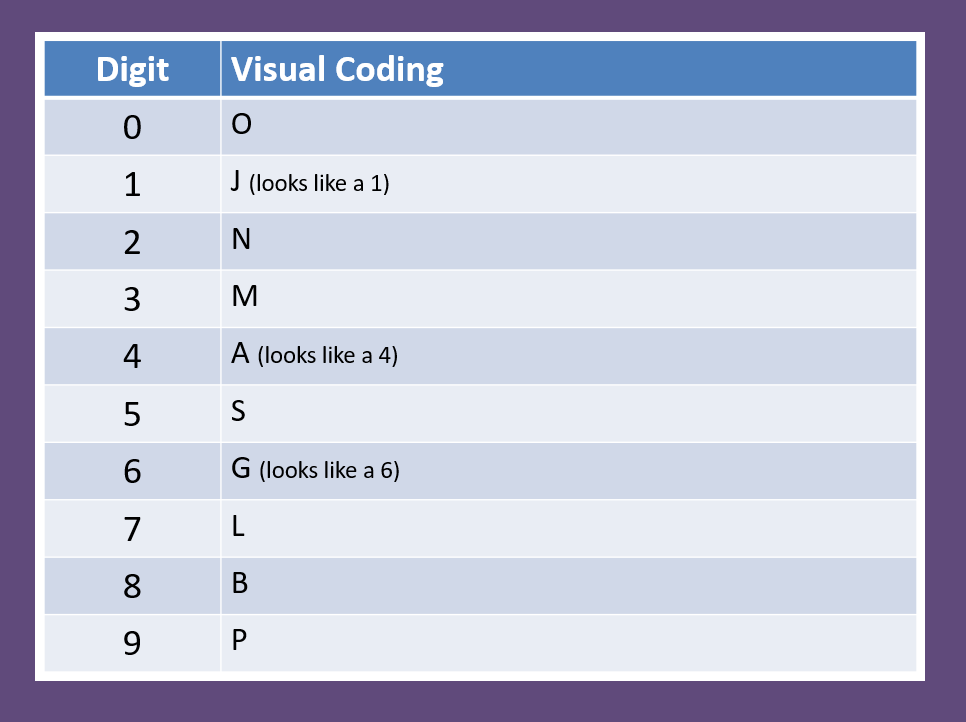
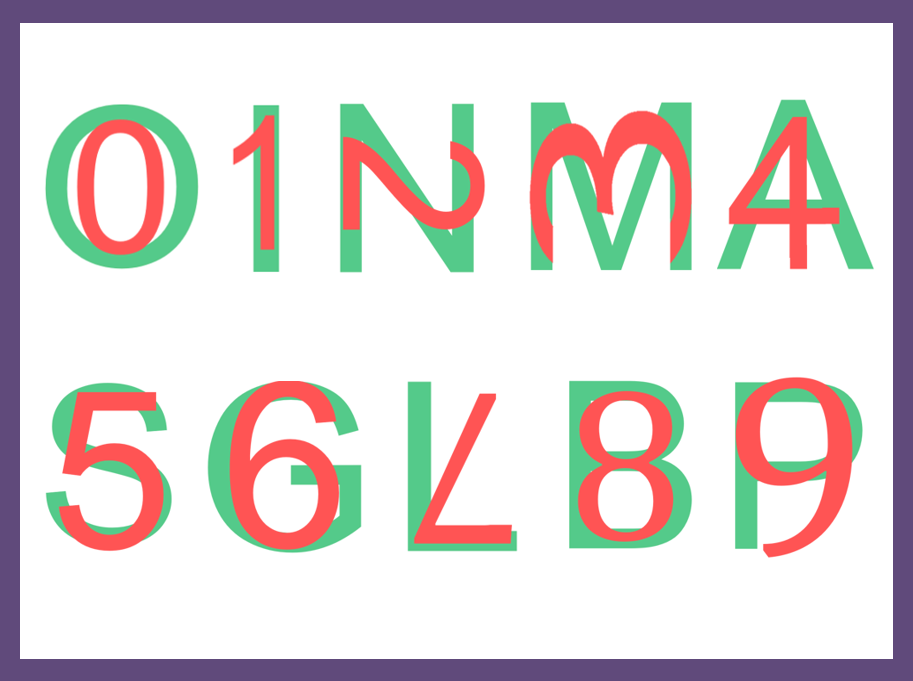
I have decided to formulate a new set of characters for my PAO based on the following coding:
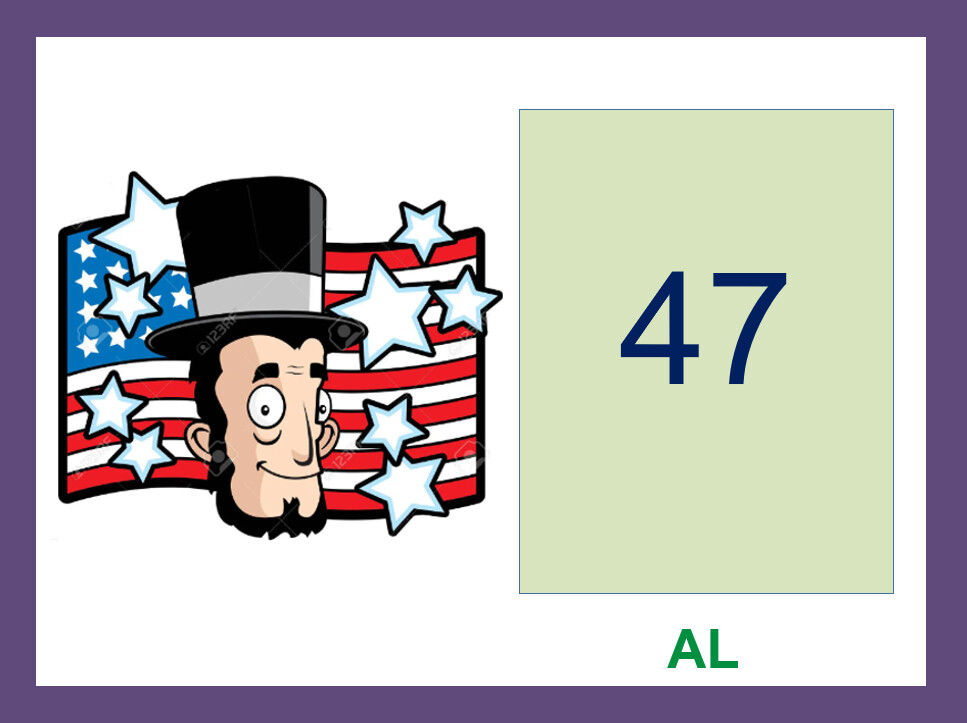
I am now stuck for a suitable action and object for my #47 which gives the initials AL = Abraham Lincoln. Any suggestions out there?
I have decided to formulate a new set of characters for my PAO based on the following coding:
I am now stuck for a suitable action and object for my #47 which gives the initials AL = Abraham Lincoln. Any suggestions out there?
@fred2, Ol’ Abe wasn’t big into extreme actions. Reading at the fireplace, enacting laws, giving speeches…
How about using his namesake children’s toy, the Lincoln logs? For an action, you have piling up stuff in a stack and the object is the wooden log or log cabin.
Doug
I am 80% complete with my cast of characters using the above mentioned ‘visual coding technique’. I list below the characters I have thus far found and would welcome any other inputs from forum members to complete the missing ones. Note: I have used the search engine to Search for notable people via their initials at:
People by Initials but that hasn’t helped me get any closer to the missing names I’m needing. Thus far I have:
| 0 | 0 | Ozzie | Osbourne | |
|---|---|---|---|---|
| 0 | 1 | O | J Simpson | |
| 0 | 2 | Olivia | Newton-John | |
| 0 | 3 | Old | Maid | |
| 0 | 4 | O | Ats | |
| 0 | 5 | Ortho | Surgeon | |
| 0 | 6 | Organ | Grinder | |
| 0 | 7 | 007 | ||
| 0 | 8 | Otto | Bismarck | |
| 0 | 9 | Oscar | Pistorius | |
| 1 | 0 | Jackie | Onasis | |
| — | — | — | — | |
| 1 | 1 | Janet | Jackson | |
| 1 | 2 | Jack | Nicholsen | |
| 1 | 3 | John | Mcenroe | |
| 1 | 4 | Jennifer | Arniston | |
| 1 | 5 | Jerry | Springer | |
| 1 | 6 | Judy | Garland | |
| 1 | 7 | John | Lennon | |
| 1 | 8 | Justin | Bieber | |
| 1 | 9 | Jade | Pinkett-Smith | |
| 2 | 0 | Nigel | Owens | |
| 2 | 1 | Norah | Jones | |
| 2 | 2 | Nick | Nolte | |
| 2 | 3 | Nelson | Mandela | |
| 2 | 4 | Neil | Armstrong | |
| 2 | 5 | Nicole | Scherzinger | |
| 2 | 6 | Natalie | Glebova | |
| 2 | 7 | |||
| 2 | 8 | Napoleon | Bonaparte | |
| 2 | 9 | Nelson | Piquet | |
| 3 | 0 | Michelle | Obama | |
| — | — | — | — | |
| 3 | 1 | Michael | Jackson | |
| 3 | 2 | Martina | Navratilova | |
| 3 | 3 | Mickey | Mouse | |
| 3 | 4 | Mohammed | Ali | |
| 3 | 5 | Marge | Simpson | |
| 3 | 6 | Mel | Gibson | |
| 3 | 7 | Monica | Lewinsky | |
| 3 | 8 | Mel | B | |
| 3 | 9 | Mary | Poppins | |
| 4 | 0 | Annie | Oakley | |
| 4 | 1 | Al | Johnson | |
| — | — | — | — | — |
| 4 | 2 | Amanda | Nunes | |
| 4 | 3 | Arthur | Murray | |
| 4 | 4 | Archie | Andrews | |
| 4 | 5 | Arnold | Schwatzenegger | |
| 4 | 6 | Ali | G | |
| 4 | 7 | Abraham | Lincoln | |
| 4 | 8 | Anne | Bolelyn | |
| 4 | 9 | |||
| 5 | 0 | Scarlett | O’Hara | |
| — | — | — | — | |
| 5 | 1 | Steve | Jobs | |
| 5 | 2 | Stevie | Nicks | |
| 5 | 3 | Steve | Martin | |
| 5 | 4 | Steve | Austin | |
| 5 | 5 | Sylvester | Stallone | |
| 5 | 6 | Speedy | Gonzales | |
| 5 | 7 | Sonny | Liston | |
| 5 | 8 | Sleeping | Beauty | |
| 5 | 9 | |||
| 6 | 0 | George | Orwell | |
| 6 | 1 | |||
| 6 | 2 | Greg | Norman | |
| 6 | 3 | |||
| 6 | 4 | Georgio | Armani | |
| 6 | 5 | Gerda | Steyn | |
| 6 | 6 | Galileo | Galilei | |
| 6 | 7 | |||
| — | — | — | — | |
| 6 | 8 | Gary | Bailey | |
| 6 | 9 | Gary | Player | |
| 7 | 0 | |||
| 7 | 1 | |||
| 7 | 2 | |||
| 7 | 3 | |||
| 7 | 4 | Louis | Armstrong | |
| 7 | 5 | Lisa | Simpson | |
| 7 | 6 | |||
| 7 | 7 | Lucky | Luke | |
| 7 | 8 | |||
| 7 | 9 | Luciano | Pavarotti | |
| 8 | 0 | Barack | Obama | |
| 8 | 1 | Billy | Joel | |
| 8 | 2 | Bridget | Nielsen | |
| 8 | 3 | Bob | Marley | |
| 8 | 4 | Buzz | Aldrin | |
| 8 | 5 | Bart | Simpson | |
| 8 | 6 | Bear | Grylls | |
| 8 | 7 | Bruce | Lee | |
| 8 | 8 | Bugs | Bunny | |
| 8 | 9 | |||
| 9 | 0 | |||
| 9 | 1 | |||
| 9 | 2 | |||
| 9 | 3 | Paul | McCartney | |
| 9 | 4 | Pamela | Anderson | |
| 9 | 5 | Patrick | Swayze | |
| 9 | 6 | |||
| 9 | 7 | |||
| 9 | 8 | |||
| 9 | 9 | Peppa | Pig |
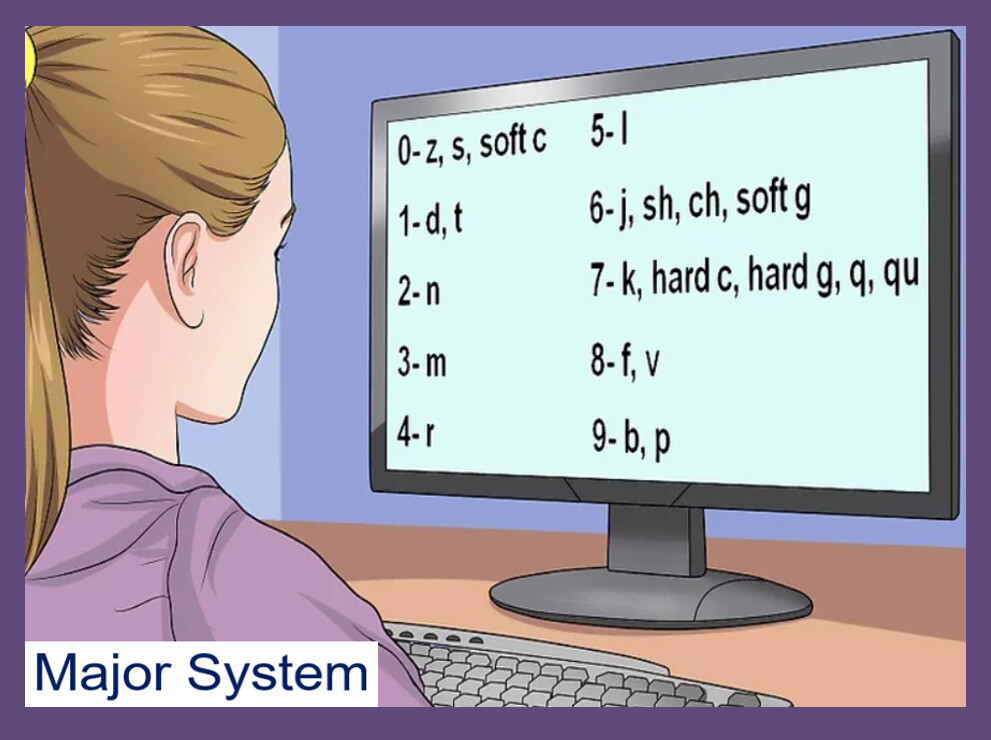
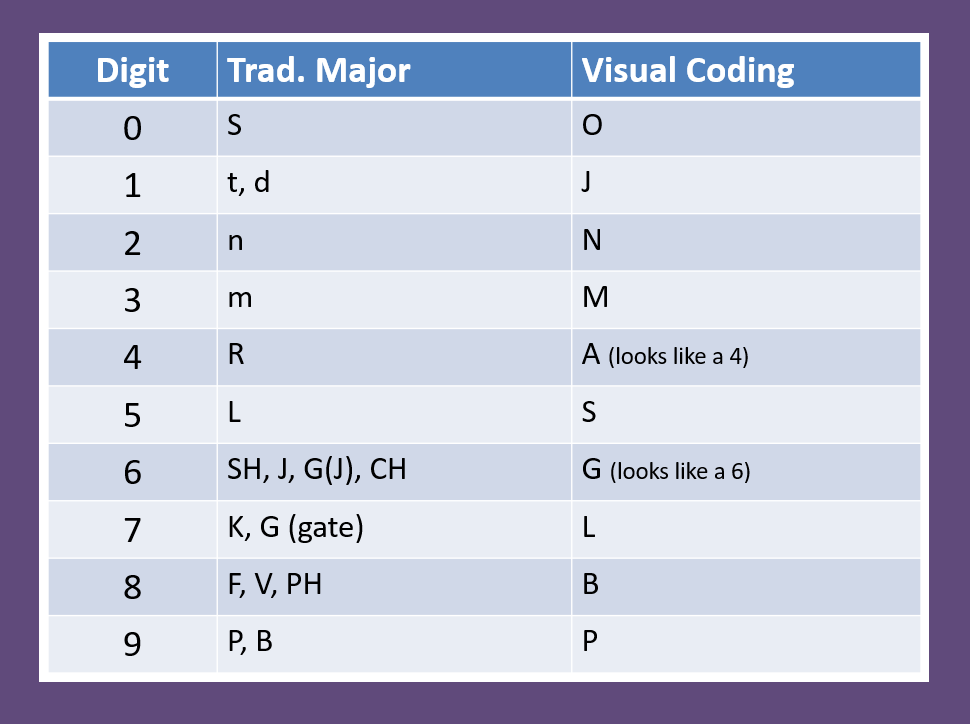
Any help would be really appreciated. To recap the code of numbers to letters is:
@fred2, I’ll do a few lookups for you in my Major System Toolkit. Did you get it when it was free?
96 (PG) - Peter Gabriel, Paul Gauguin, Porter Wagner,
97 (PL) - Paris Hilton, Peggy Lipton, Peter Lorre, Paul Lynde,
98 (PB) - Paula Abdul, Pearl Bailey, P. T. Barnum, Pat Benatar, Pat Boone, Peter Boyle, Pierce Brosnan, Pieter Brueghel the Elder
If those work out for you and I’ve got the conversions right, let me know and give me a few more combinations with the conversion letters since they aren’t Major.
Doug
This exercise isn’t as straight-forward as I first thought it to be. To answer your question I do recollect downloading free material from your Github on your Major System Toolkit. Congratulations on publishing it into a book. The problem I have in using the source for names and surnames on the “Famous People by Initials” Website is that it is populated by so many people I don’t know and yet again, famous people that should stand out for me, don’t necessarily appear on the list. A case in point was #59 or (SP) in the “Visual Code” I am now creating for my PAO system. How I could forget Shaun Pollock our once time National Cricket Captain is beyond me? Thanks for your contribution given. Paula Abdul would be #94 under my new favoured Visual Coding method and not #98 as you have shown? I’ll keep plugging away for names, eventually I’ll get there!
This exercise isn’t as straight-forward as I first thought it to be. To answer you question I do recollect downloading free material from your Github on your Major System Toolkit. Congratulations on publishing it into a book. The problem I have in using the source for names and surnames on the “Famous People by Initials” Website is that it is populated by so many people I don’t know and yet again, famous people that should stand out for me, don’t necessarily appear on the list. A case in point was #59 or (SP) in the “Visual Code” I am now creating for my PAO system. How could I forget Shaun Pollock our once time National Cricket Captain is beyond me? Thanks for your contribution given. Paula Abdul would be #94 under my new favoured Visual Coding method and not #98 as you have shown? I’ll keep plugging away for names, eventually I’ll get there!
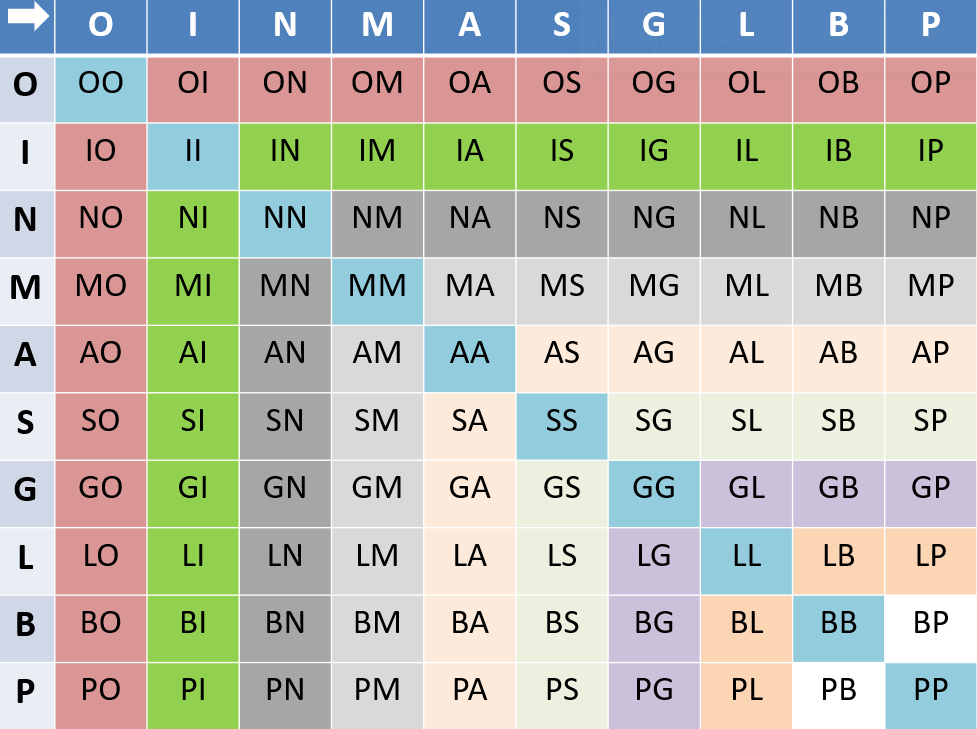
I have decided that an I = 1 will work better than a J = 1 in the original code I suggested. Therefore it’s back to the drawing board on this exercise for me. My new updated template for numbers 00 - 99 is even closer to @erikfromholland suggested coding system. Now to find those characters for any double-digit number containing a 1.
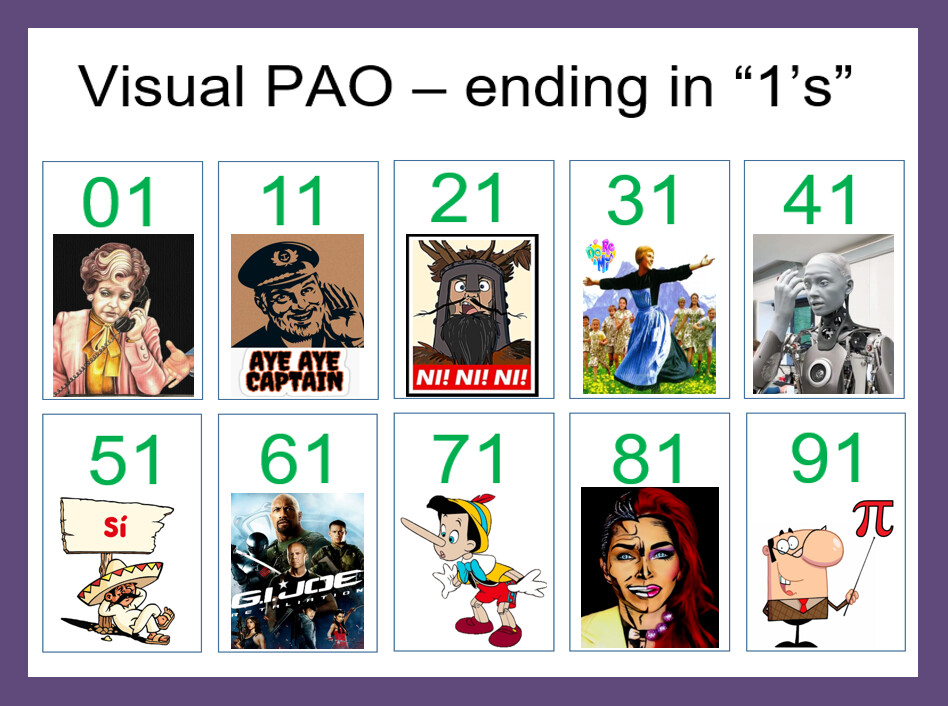
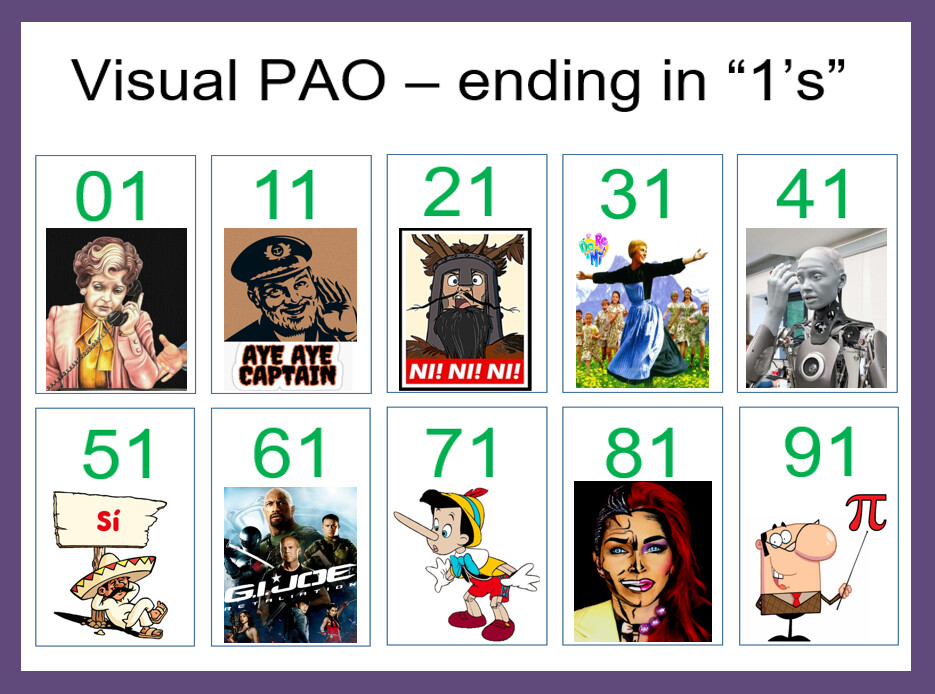
Some new characters staring me right in the face for the double-digit numbers ending in “1’s” can be read straight off the diagram as words:
01 = Oh I know (OI) (Sybil in Faulty Towers)
11 = Eye Eye Captain! (II)
21 = NI (Knights saying NI - Monty Python)
31 = MI - Julie Andrews (Do, Rey, Me) “Sound of Music”
41 = AI = Artificial Intelligence (Sophia - AI Robot)
51 = SI = Manuel - Faulty Towers (Si Si Si - Mr. Faulty)
61 = GI = GI Jane/Joe
71 = Lee Iacocca
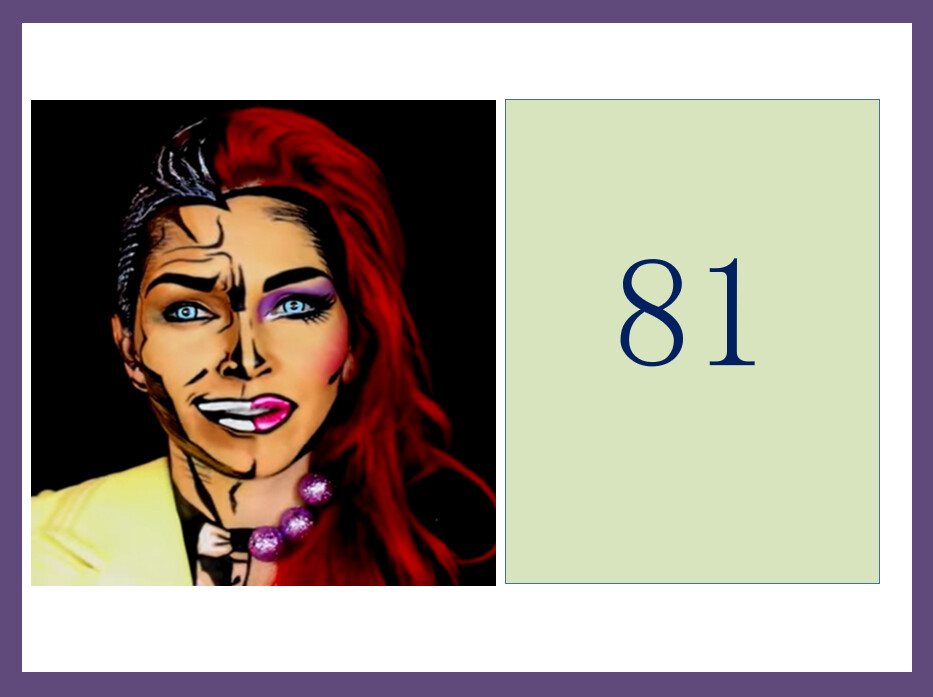
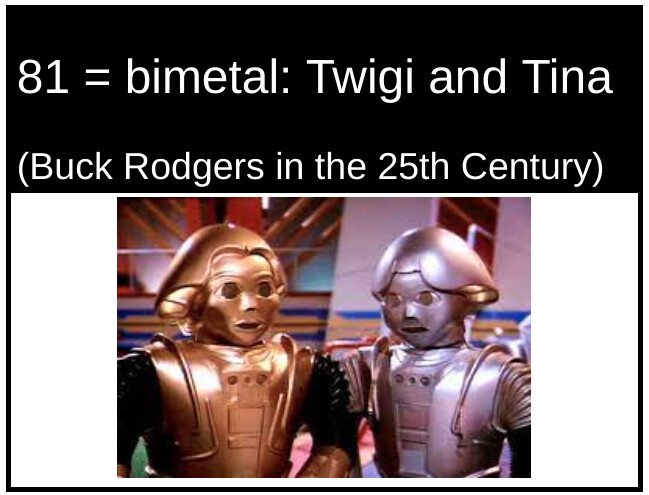
81 = BI (Bi-sexual)
91 = PI (Maths Geometry Teacher) PI = 3,14…
Still busy working out the double-digits from 10 - 19 but it shouldn’t be too difficult! I find as much as I may have wanted to have used a different image for #21 the Knights of NI from Monty Pythons Holy Grail movie was the first one ‘implanted’ in my memory from a previous post by @erikfromholland. The Knights of NI are going nowhere thanks to that ‘ridiculous’ Monty Python video clip that comes to the fore every time I see a #21 now. LOL!
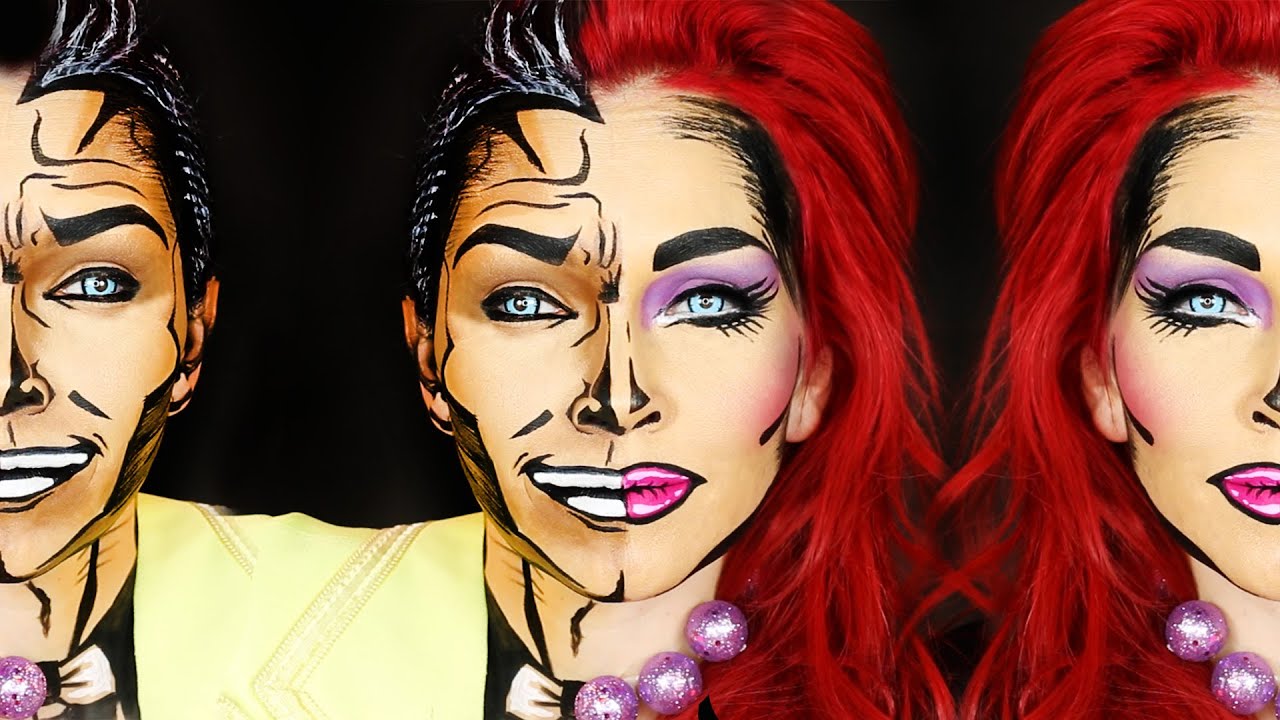
My #81 = BI (half-man/ half-woman) uses the following slide:
Amazingly not a cartoon at all, see videoclip on You Tube below by Kandee Johnson:
One possibility to encode my cast of characters in the visual PAO for playing cards would be as follows:
10’s = Spades (1 point)
20’s = Hearts (2 sides)
30’s = Clubs (3 balls)
40’s = Diamonds (4 points)
Could use rhyming images for Queens and Kings and Jacks could take take the images of the professions of people using the “tools” or “suits”. For example, Jack of Spades = a Gardener (uses a Spade), Jack of Hearts = Heart Surgeon (uses Hearts), Jack of Clubs = a Caveman (uses a Club) and Jack of Diamonds = Jeweler (uses Diamonds) to make Jewelry.
Fred, this is a cool project and I enjoy watching your curiosity and reflection unfold as you explore all these different ideas. I’m gonna be critical here, but I don’t want you to think I’m discouraging your process or minimizing the effort and accomplishment of trying new things. Think of this as the thoughts of a skeptical student who heard about a new approach, but wants some more info before they dive into learning it.
I want to see how this system will work for you in practice. When your list is complete, learn it, use it and tell us how it goes. I want to see if the learning experience is easy or if it is a huge grind to get fluent with your list. I want to see what kind of times you can get, if it’s faster and easier to work with than other systems you’ve tried in the past. I want to see comparison data from actual memorization attempts you’ve done and hear your impressions on what really worked in practice.
My immediate reaction is that combining several different ways of translating your number pairs would make it really hard to keep things straight when learning the list. (Some pairs translate as initials of people, some as initials of things that you then link to people, some to actual phonetic names, some words that link to people, some quotes, some even abstract connections like Pi to a teacher, some use long vowel sounds, some short…) The best systems typically are consistent and provide the simplest way to encode and decode as possible with the least number of variations to keep track of.
When you’re flowing along during memorization, it’s very taxing on the focus and speed to have to constantly be thinking about exceptions and trying to recall which numbers followed which rules. As with any system, over time recognizing these exceptions will become instinctual, but I’d be interested to see how long it takes to get fluent in those variations vs. a more structured translation approach.
You’re touting the ease at which the numbers can be read by just looking at their shapes as a big advantage over other systems, but with only 10 number/letter associations to learn, after a pretty short while almost any system can become second nature to read, especially if you can find an easy way to link the numbers to the sounds or letters they represent. For example, you use S for 5 because of the similar shape. I use L for 5, the traditional Major association, and had no problem quickly associating it because I connected the top straight lines across and down as a sideways L shape. I can literally read the L in the shape of the 5. 7 for K is no problem either, in a more abstract way, the 7 looks like a sharp edge and K makes a very sharp sound.
My point is that very quickly, one can become fluent in seeing a single number and reading it as a letter or a sound, so changing the letter assignments doesn’t provide the big advantage. The advantage of “easier” to read number associations may save yourself a few days maybe even a week’s worth of effort in learning the sounds, but if two people both develop fluency in their 10 number-letter conversions, the playing field is level very quickly and there needs to be a demonstrated advantage in all of the other aspects of the system to make it worth it. Where the real gains can come is in the rules for assigning meaning to those number combos. If the structure is too loose and arbitrary, it will be difficult to teach, learn, and retain regardless of how quickly you can get fluent with the base conversions.
The other question I have is will your use of O, I, and A as your number choices confuse and/or limit you if you use a phonetic structure like the Major System to build other elements or for other applications? By removing 3 out of the 5 vowels from your options to fill in words, your choices are now very narrow, and I could see it getting confusing if you mix and match systems where just for people those vowels matter but for other things they might not…
Think about future-proofing as well. If you want to move beyond a 2-digit into a 3-digit system, will the approach translate? Will you need to completely change the number-letter associations? Will you be able to generate 1000 images from those phonetics or rules of construction? This is a legitimate consideration if people are looking at a 2-digit system as an intermediate step, but eventually want to advance. If the 2-digit system can directly translate into the 3, then there is no worry about having to learn a completely new approach or unlearn the habits of the old system.
It’s one thing to update and change and tweak and theorize about systems, but I want to see you apply it and test it. A few hours of testing is worth days and days of theorizing, as it can help identify the strengths and weaknesses of an approach very quickly. A system can look revolutionary on paper and just not click well in practice, or a can be confirmed and improved upon much easier with actual data to draw on. I want to see you run with this and see where it goes. Don’t leave it as an uncooked recipe. Bake the cake and see what it tastes like!
It would be awesome if you started a thread in the Training Journal section to document what you discover about your attempts to learn and apply this approach. I would love to follow along with your exploration of this system and see how you deal with some of these challenges!
Firstly, no offense taken by anything you’ve said which is as always well-thought out. I certainly in no ways take umbrage to any criticism that is constructively levelled by anyone on this forum which is the very reason I choose to put my current ‘pet project’ of the “Visual Coding System” up here on the forum for others to comment upon in the first place. At the outset, I would like to set out a few caveats that in all probability I should have done in earlier posts:
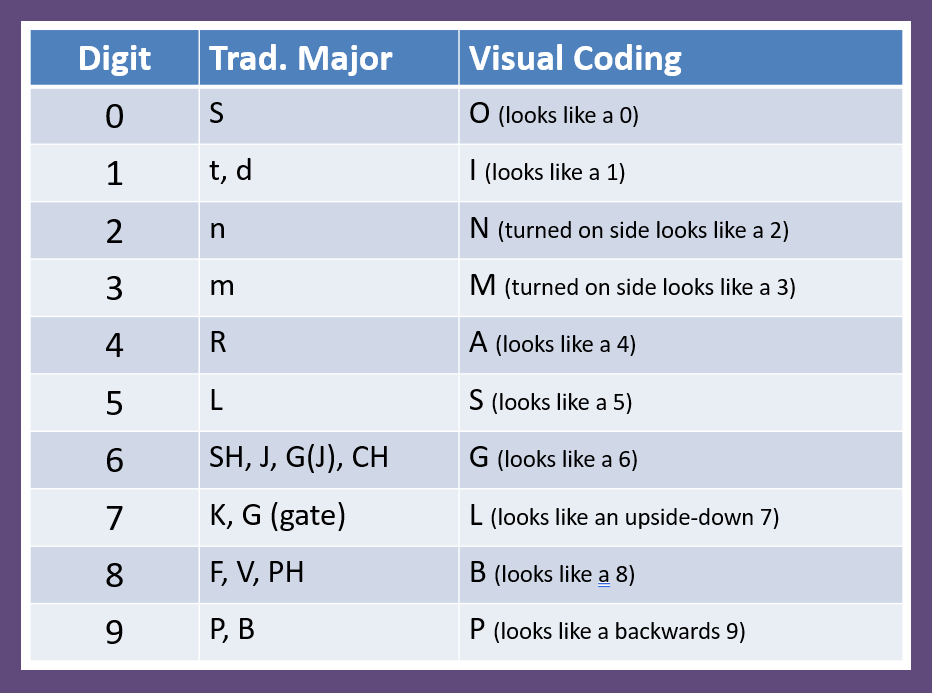
The sole reason of putting out the advocated “Visual Coded PAO System” is for memory hobbyists or enthusiasts to consider approaching things from a different angle and what I consider in many respects to be a better angle, in converting a two-digit system into a set of 100 paired two-letter combinations (although I respect many on this forum may differ with my opinion?) Thus similar to a F1 racing car designer, I have proverbially speaking not put myself into the drivers cockpit in testing my hypothesize, nor is there anytime likely in the future that I intend doing so. I am merely proposing a system that others may want to tinker with to see if it serves their purposes any better in devising a two-digit PAO system. I thus leave the proverbial testing of the F1 racing car (analogy for the ‘visual system of encoding’) to those forum members that are far more fleet-footed than I am to test at their own peril (or otherwise)? The embellishments and improvements that I am suggesting to the traditional major encoding system is limited solely to a two-digit PAO as previously stated. To sum up again, in a form of a table, my proposed embellished “Visual Encoding System” consists of only 10 letters ascribed to each number as highlighted in the table below:
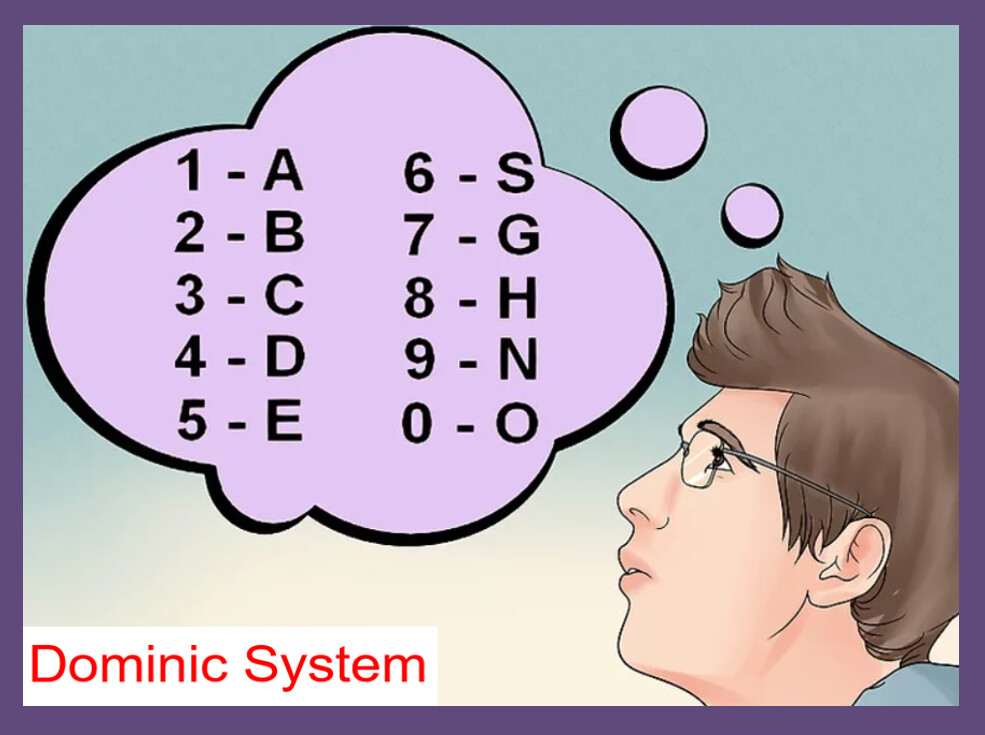
My suggested reason for the superiority of the ‘visual encoding system’ as compared to the ‘traditional major encoding system’ in learning it, is its intuitive manner in which numbers can directly be translated into single letters and visa-versa. Some may argue that having more than one letter that each number translates into is advantageous for building up a bigger set of words than would otherwise be the case with the proposed ‘visual coding system’. Certainly for a 3-digit PAO System, I would agree with this contention. But in devising a 2-digit PAO System, it should be noted that Dominic O’Brien’s System of coding given below also has this “one-letter to one-number correspondence” advantage over the traditional major system that offers more than one letter for each number in many instances, which may lead a novice to some confusion? O’Brien’s coded system given below in table form is as follows:
Note that Dominic O’Brien devised his system to encode sequences of numbers and playing cards in winning the World Memory Championships eight times. Dominic’s system has letters corresponding to each suit of a standard deck of playing cards too, being: H = Hearts, C = Clubs, D = Diamonds and S = Spades.
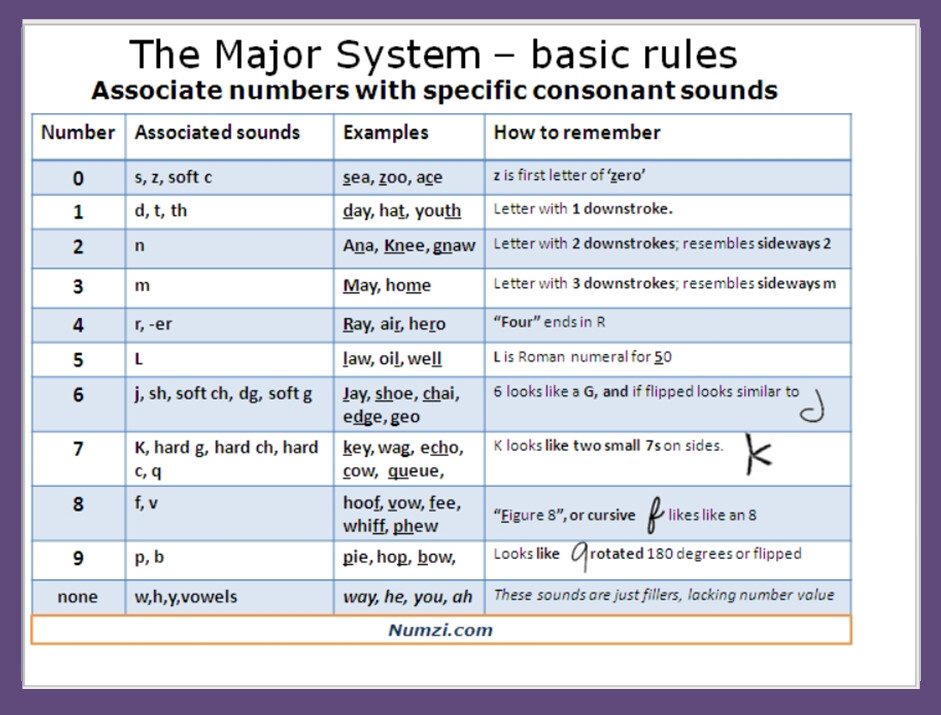
Compare the above mentioned Dominic System and Visual Encoding System to the more traditional approach followed by the advocates of the Major System given in the table below highlights the point I am making about ‘multiple-outs’ for certain number to letter encoding. For example #6 in traditional major system encoding yields: j, sh, ch and a soft g (as in George):
Those familiar with the traditional major system will also be familiar with the following rules to remember which letter or sometimes letters (to be read as ‘phonetic sounds’) corresponds to each single digit number from 0- 9:
The most notable difference between the “traditional major system” and the “Visual Encoding System”, is that similar to the Dominic System, The “Visual Encoding System” is non-phonetic in nature, thus no need for the auditory decipherment of going through letters and mumbling: per or ber for ‘9’s’, or ner for 2’s etc.
As already stated therefore, being able to literally read off and decipher ‘numbers to letters’ and ‘letters to numbers’ from the way the letters and numbers logically link to one another and not needing to vocalize words to decipher them into numbers and not having multiple options but restricting the number to letter encoding to single options only, is to my mind a far easier and simple way to approach things? But I concede if one wants to go bigger in terms of a 000 - 999 then arguably, the major system out-trumps all other systems alluded to. Thus I do take your criticism into account here but point out that the “Visual Encoding System” was a Mini-Minor bought and sold as a Mini-Minor and not expected to be converted into a Ferrari!
To your point about rules, the rule for all my two-digit numbers ending in “1” is simply read them, thus:
01 = O I know!
11 = Aye Aye Captain
21 = NI (Knights of NI)
31 = MI (Do, Rey, Mi)
41 = AI (Robot = Artificial Intellegence)
51 = SI (Spanish for yes)
61 = GI (GI Joe)
71 = LI (Lie - Pinocchio - Lie)
81 = BI (Bisexual)
91 = PI (Maths Teacher)
I can honestly say that when I watched today’s rugby match Cheetahs vs The Bulls, when I saw the shirt #15 of the Cheetahs’ full-back, I immediately encoded it to the corresponding person in my “Visual Encoded System’s” PAO - which happens to be: Ian Smith (IS) former Prime Minister of Rhodesia (now Zimbabwe).
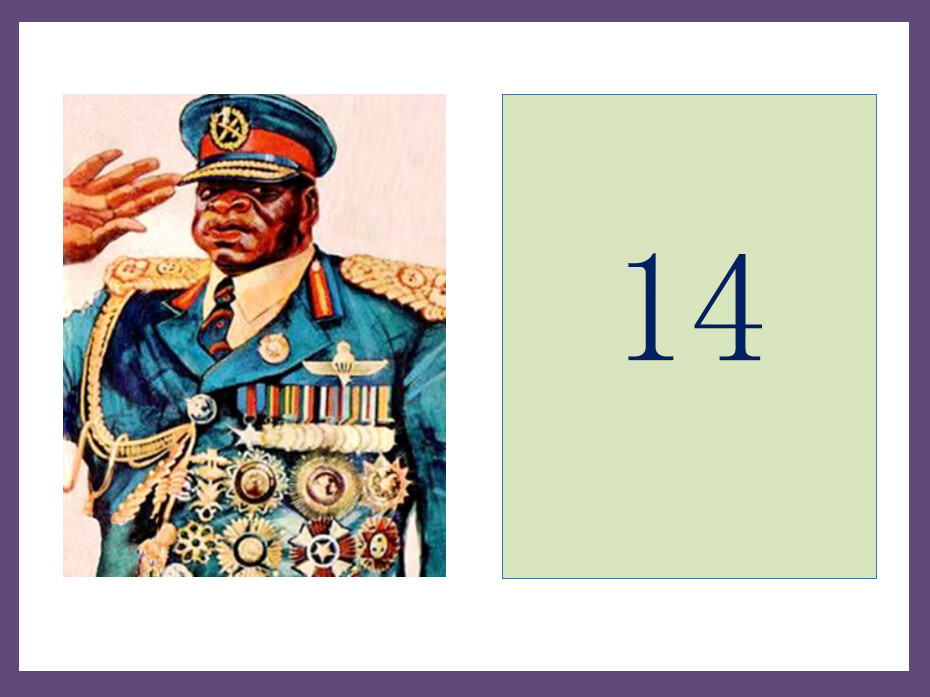
Your point you make however that “changing letter assignments doesn’t provide a big advantage” however can’t go unchallenged. For me at least seeing a #15 immediately makes me see “Ian Smith”. There is no AE= Albert Einstein (encoding as needed to be done in Dominic System). Lesser still, no #15 = TL (in Major System) = Tommy Lee. It just ‘intuitively’ cuts out the step in both those systems? I am fully aware that my proposed system is using 3 vowels out of 5 but my PAO doesn’t rely on building Actions and Objects from letters or vowels of any kind. So for example, in the “Visual Encoding System” #14 translates into Idi Amin (Person)/ Pinning a Medal (Action)/ on his Tunic (Object):
Again thank you for your constructive criticism and perhaps all in good time I may eat the proverbial cake you so aptly gave as a metaphor, all in good time but I’m still in the kitchen playing with the recipe. The cake still needs to be put into the oven and baked and who knows, thereafter I may take that giant leap and test it by eating it. But intuitively (not scientifically proven/nor disproved) this whole idea of a “Visual Encoding System” sits very well with me!
@erikfromholland and @TheHumanTim and @thinkaboutthebible. I have just been ‘googling’ the theme around the concept of a “Visual Encoding System” on the internet and it appears that others before me, have actually used similar ‘number-pairings’ and ‘letter-pairings’ to those I am suggesting to be used in a VES (Visual Encoding System). I stumbled across a course on Udemy authored by Johannes Mallow and Florian Delle that uses 6 of the number-to-letter pairings that I have suggested. I believe Johannes Mallow is a “5 times German Memory Champion and multiple world record holder in memory sports” (information gleaned from Johannes Mallow’s twitter account). From the free video clips advertising their offerings, they are suggesting a set of similar single-correspondence number-to-letter pairings to those I have suggested in this link, with 6 identical ‘number to letter pairings’ to those that I’ve suggested. Interesting and this is to @TheHumanTim point, they don’t touch any of the 3 vowel letters (A, I or O) that I have suggested in my “Visual Encoding System” (VES) and given that they styled their system “The Visual Major System”, they have kept with the original Major System letters that we all know, albeit they have simplified things (which I like a lot) by only having a direct one-to-one correspondence between their numbers to letters using the Major System letters that carry values that most look like the numbers themselves. This being said, the letter arrived at from the number, acts as a prompt for the user to find all similar sounding letters as contained in the Traditional Major Phonetic Coding System that we all know. I won’t divulge their number to letter codlings, as that is their intellectual material but for those of you interested, they do load a couple of free video clips that introduce their coding system quite clearly. You can view the clips at the following link for free https://www.udemy.com/course/visual-major-system/
I am so happy that I stumbled across this link, as at least it shows that someone as reputable as Johannes Mallow has advocated a similar system to that, that I am proposing as an improvement upon the tried and tested existing “Major System”. I have copied @JohannesM on this forum in the hope that it is the same Johannes Mallow (5 times German Champion) that co-authored the Udemy course for his comment on the number-to-letter combinations that I have already proposed in my earlier posts to this link. For ease of reference my suggested coding is:
Where they differ in their system is in their coding of their numbers: 0, 1, 4 and 9. Three of which (0, 1 and 4), as you can see from my slide above, are the vowel sounds. As my system of VES was solely designed as a PAO system, as explained previously, I was not hung up about using these vowel letters, as my peg system is only 00 - 99 and the letters are solely used to generate People for my PAO. Obviously, I arrive at my Actions and Objects for each of my cast of characters independently of needing any number-to-letter coding system as both Actions and Objects are arrived at directly from my chosen cast of 100 characters themselves! @TheHumanTim you have to at least concede that there must be some merit, albeit in a limited two-digit PAO System that I am proposing, if a similar system to Visual Encoding System (VES) is being used by Johannes Mallow?
Post Scriptum: On second thoughts and to your point @TheHumanTim , I think I will build in the component of consistency by ‘limiting’ all my cast of characters to two-digit ‘first names and surnames’. That will make it easier to learn without ‘exceptions’ to the general rule. The biggest problem I will have though is with those wretched “i’s” and “o’s” though. Still as almost identical shapes in both numbers and letters, they would just be too good to change to less desirable coding images. O = 0 and I = 1, I just can’t see things any other way?