The results clearly demonstrated that those who had read on computer screens had understood less than those who read on paper. Perhaps surprisingly, this disparity was encountered with both the fiction and the factual prose.
This may interesting for anyone who tends to remember the position of words on a page:
An obvious difference between PC screens and paper is that paper is material. You can feel the weight, texture and thickness of a pamphlet or a book. You can see where it begins and ends. You can quickly leaf through the pages with your fingers.
This perceptible, direct experience gives you a mental map of the entire text. The brain has an easier task when you can touch as well as see.
Previous research has demonstrated that a mental map is particularly important if the text is long. Lengthy texts call for quicker navigation. You need to be able to leaf back and forth through different parts of the text to see, review and comprehend relationships and contexts.
I’m not a professional, I’m just heading my second competition in my life, but to be honest, there is a noticeable difference in my performance when memorizing on a computer compared to memorizing using real papers. I hate memorizing on a computer, to be honest.
I use computer for names & faces, abstract images, dates & events, but everything else is simply generated in excel sheets and printed on the real papers.
And memorizing cards on a computer? No way! I had to get used to it, because when I tried it for the first time, I could do deck in 30 seconds, but on computer it took me almost a minute and I ended up with gaps…
Yes, a problem with computer is that you scroll a page up and down and thus it has no constant point of view. In terms of mnemonics this would be “linking the text of a document together” (one big story with only adjacent paragraphs and images having location with respect to each other), but if you have a real book, it forms a “memory palace” (each page and text paragraph, image, chart has constant location). And we all know that memory palaces are more effective than linear stories.
I was a big fan of PDF files (attached sticky notes to it), but experience showed that this wasn’t good for memorization. Now I like to handle real books and make notes into it or onto paper.
Maybe there is an application for tablet that enables you to see documents as real books, and enables you to turn the pages with the digital pen?
What is the biggest difference between normal paper and computer screen ?
I was playing a game named ’ diablo 3 ’ who plays this game knows this u get tired really fast after playing this game. I could play any other game alot and still i won’t get tired. It’s actually one of the diablo 3 developers’ problem, lots of player sent to forums and said ’ we get tired a lot ’ i dunno if they have fixed or not, but i searched for that.
Diablo 3 has lots of cool effects which makes me tired a lot. After realizing that, i look for why effects making me tired. Most of research shows that light source increases alpha waves in our brain.
Light is tricky and there are a lots of variables… Did you know they can hypnotize(really hard:P) and-or manipulate you by using light ?
As a student I have to read from three different kinds of text: pdf files, photocopies, and real books. I can clearly recall much more about what I read in the real books than in the other two formats, but I can´t detect any difference between my retention from photocopies and pdf files, even when the copies do have a lot of the physical characteristics that distinguish the book from the screen. That makes me think that the important difference is something that appears in the books and not in the copies. It´s true that sometimes the copies are fragmentary, but full book copies doesn´t help my retention either. That makes me think that it´s not the physical feeling itself, but the distinctive physical feeling from different books that is not present in the copies; they all look alike and feel alike. Maybe we can think the copies as one and the same memory palace that is reused each time we read another copy.
Yeah what about reading ebooks in epub format in an epub reading app on a tablet? You have easy access to a dictionary and translator if you don’t understand a word and you can bookmark and highlight everything you think is important and review it faster.
" those who had read on computer screens had understood less than those who read on paper."
Yes, that’s probably because screens have additional distractions.
But if you are disciplined, it’s the same information essentially.
Energy-wise I prefer speed-reading on screen (by just clicking '‘page-down’) rather than in paper, where it takes more energy to flip a paper book page every few seconds.
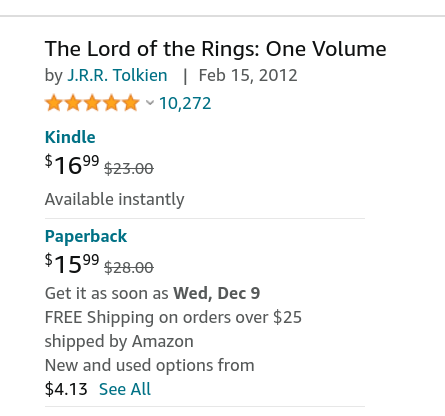
Do you prefer reading an e-book or a physical version? It might be a surprise, but for most people, old school print on paper still wins.
…
While millennials are sometimes blamed for killing industries, it’s actually younger people who appear to be popularizing print. Sixty-three percent of physical book sales in the U.K. are to people under the age of 44, while 52% of e-book sales are to those over 45, according to Nielsen.
It’s a similar picture in the U.S., where 75% of people aged 18 to 29 claimed to have read a physical book in 2017, higher than the average of 67%, according to Pew Research.
I think it doesn’t help that the price of ebooks is going up. I’ve even seen ebooks that are more expensive than the print versions.