Strategies for improved visual memory

Late last week I took several visual memory tests (related to an avocation I wish to pursue) and scored really, really poorly. I was tired, and spent some of the time I should have been working to remember the figures (more on this below) thinking about how poorly it was going. I wouldn’t describe myself as a terribly visual person, but my performance on these tests would suggest someone who is regularly unable to find his car, gets lost in new cities, can’t remember how to work through web pages he’s visited before, etc. As I said, I’m not terribly visual (good thing I’m not an architect!), but I’m not “lost” in the visual world by any stretch.

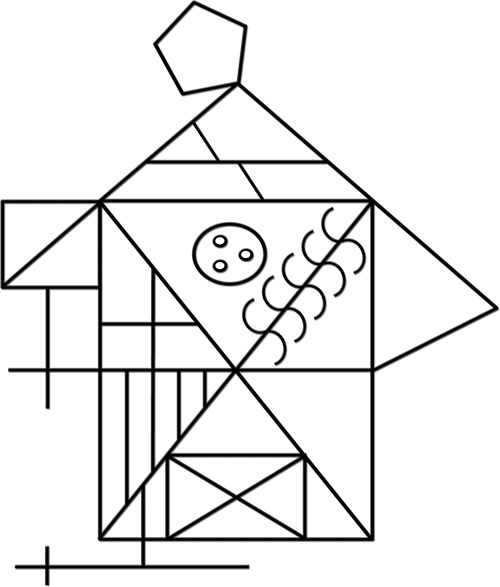
In terms of the test, one was the Rey-Osterrieth Complex Figure Test, where you get to look at a figure for a minute or two (or, in my case, you get to copy it), and then have to reproduce it (both immediately, and in ten or fifteen minutes). Here is an example of the figure:

The other test consisted of six random figures (maybe a half circle, a box on top of a circle, a triangle with lines through it…sometimes “regular” figures and sometimes not) on a page. I was given maybe 20 or 30 seconds to look at the page, and then had to reproduce it immediately, and again in ten or fifteen minutes. And I had to try to put the figures in the same position on the paper. I did very poorly!

Later on, I was tested on my ability to marry names with faces…brief videos of twelve people, who told me their names, and then where they’re from. I nailed this pretty well…because the guy whose name started with a “T” had a tie on, the woman whose name started with a “B” had short hair like a boy, etc. I was able to develop rules/strategies for remembering the names.

What I’m hoping to figure out are strategies for remembering figures and shapes…as in the tests where I did so poorly. I have read about memory palaces, but don’t see how to use one for figures and shapes (particularly one large figure, unless the figure is divided up into sections). And I don’t have an idea about a strategy similar to the one I effectively used for names/faces.

I’m going to be retested in about a month, and it’s really important (to me!) that I score something “normal”…like 40-50th percentile (maybe not even that high…just “passable”.

So, what are some strategies to use for this sort of memorization. And where can I go online (either website, or to buy something) for practice? I will be grateful for any help…I want to do better! Thank you!

What jobapplication is this?
It sounds so interesting, but i cant understand the requirements …

google image streaming, it helped me to get better at remembering stuff because you get better at creating pictures, which helps you to remember them.

This is not related to my work, but rather to a hobby that I wish to continue pursuing. In the process of proving that an earlier diagnosis of a particular condition was incorrect (it wasn’t close; that earlier diagnosis was wrong), I was tested on visual memory, and performed very poorly. As I wrote above, visual memory has not surfaced as an issue in my day to day life, and if you asked me prior to last week’s testing if I had any concerns regarding how I might perform, I would have had none. With a retest coming, I want to do what I can to practice and sharpen. Thank you.

This is not related to my work, but rather to a hobby that I wish to continue pursuing. In the process of proving that an earlier diagnosis of a particular condition was incorrect (it wasn’t close; that earlier diagnosis was wrong), I was tested on visual memory, and performed very poorly. As I wrote above, visual memory has not surfaced as an issue in my day to day life, and if you asked me prior to last week’s testing if I had any concerns regarding how I might perform, I would have had none. With a retest coming, I want to do what I can to practice and sharpen. Thank you.

I am not an expert …but relaxation exercises and just plain old visualizing … seem to do the job … at least for me .

One exercise I’ve red about is to imagine a candle and try to keep that image with your eyes closed at first for as long as you can. Then try to keep it with your eyes opened . But you will get frustrated a bit no doubt when you practice this . It takes time to develop anything … to change a habit . Some books say that for changing a habit you need up to 6 weeks .

There are 4 stages :

1.Unconscious incompetence
2.Conscious incompetence
3.Conscious competence
4.Unconscious competence

So you see … every new habit must become automatic … and you must not stop until you get to that level . It may take you a while to get good . And I think that with imagination and visual memory you can get very good if you practice . And another thing that I believe is true is … if you are a person that gets annoyed easily … or even depressed don’t do so well. People who have lots of negativity don’t have good visual memory and imagination , because imagination usually works to cure bad self image , or depression , or even obsessive compulsive disorder . In general … try to imagine things that bring you pleasure … and stay away from bad memories !!

Hope it helps !! :slight_smile:

In order to score good on a Rey-Osterrieth test, one needs to be able to remember shapes, lines and curves.
If you want to train this, try to see the shapes of all objects you encounter in life.
If you come across let’s say a lift, see the doors as rectangles, see the shapes of the gate.

Here is an example:

http://www.crusaderindustrialdoors.com/image_library/library/c/cru/crusaderindustrialdoors.com/orig_169.jpg

Can you look at the picture for some seconds, close your eyes and see all shapes?
Can you then redraw the picture from memory?
Try this.

Here is how I would memorize this picture:

My first thought is of a house.
We have a roof, which is a triangle and a square underneath.
Instead of a chimney there is a pentagon.
So from top to bottom, in terms of shapes we have 5-3-4.
Does that make sense?

Then ask yourself:
1: what is inside the triangle?
2: What is inside the square?

Answers:
1: the traingle is divided by a straight line.
2: the square is divided into 4 parts using a cross. In the top there is a circle with 3 smallers ones, etc., etc.

Try to divide the figure into knows shapes and memorize them.
IRL, do this for all objects you come across. Walk around town and memorize random shapes.
Memorize houses, trees, letter boxes, etc., etc.

Train yourself to take objects apart into shapes.

Very helpful, thank you.

A couple of follow up questions:

  • Is it correct to assume that one can have a “bad day” on a visual memory test? I was not especially well rested, and the day of testing was grueling (test after test of things like having to repeat a long list of random numbers…but backwards). Furthermore, by the time I did the retest on visual memory, I was shaken by how poorly I did on the first test.

  • As I asked above, could I possibly have tested very, very poorly on a visual memory test (like the Rey test), but not have had this issue surface in my day-to-day life? I have not had an injury/stroke, etc. And I don’t fear going to new places out of concern I won’t find my way back, I haven’t had a need to utilize special strategies to move through life, etc. Wouldn’t I have been aware of the apparent deficit that showed up on the test?

  • The recommendation to think about objects in everyday life as individual shapes is not foreign to me. I think I do that actually. And what is really interesting to me is that when I doodle (long conference call, for example), I am apt to doodle something that looks like the Rey drawing! Squares/rectangles divided into and extended by triangles. That’s my thing!

  • Away from thinking more about objects in my everyday life, are there games, practice tests, apps, etc. that folks can recommend that I work on? I really want to go into my retest (hopefully in a month) with a high degree of confidence in my ability to do reasonably well. Working through actual challenges with some success will help with this. Going in with shaky confidence, hoping that my unstructured efforts to be more visual have paid off, is something I’d like to avoid.

Thanks again.

@Kinma

Dont get this:

your example and how you would remember it makes no sense to me.
I see no correlations between those two at all.

Could you please explain this problem?
Did i miss something here?

regards

Ps.
I would try to remember the picture as it is without color, because i cant reproduce colors in my mind.

If I knew that I could perform this “hobby” just fine even without achieving greater skill in this area, I would just worry about beating the test. I would get my hands on as many of these as possible, and practice them with a timer, always writing down where you went wrong and why that might be.

For the Rey Test,

I would get my hands on as many of these as possible, and practice them with a timer, always writing down where you went wrong and why that might be, as well as writing down how well you think you did. I would also draw twenty of them in one sitting - not taking too long to think about what I was doing so they would be easy to forget - wait a few days to forget their details, and then use one these for extra practice when I ran out. I would also draw some with great thought, as if you were commissioned to draw more images for the Rey test that would look like they had been drawn by the original artist. Print a bunch of them out and study them for patterns. Look at the patterns that occur most often, such as the different ways triangles and squares are divided, and draw similar pictures using these same patterns, trying to use approximately the same number of pen-strokes that would be found in the actual images.

For the test of 6 images, there’s a much easier way.

I would choose groups of 6 loci that naturally occur together in this configuration, such as 1) the counter to the left of the stove, 2) the stove, 3) the counter to the right of the stove, 4) the cabinet below the counter to the left of the stove, 5) the oven below the stove, 6) the cabinet beneath the counter to the right of the stove.

Make objects for all of the common shape-types that can occur - a stop sign for an octagon, a dorito for an equilateral triangle, etc., and when you are shown the images, quickly imagine the objects in those configurations upon your loci, and if necessary, with chunks taken out of them at the appropriate places. Scan and review them multiple times before you aren’t allowed to look at them anymore. You could score really, really high on your test this way.

Thanks for the responses.

Best I can tell, there are not many versions (if more than one or two) the Rey Osterrieth test. Anyone know if this is correct? I’d love to have a bunch to practice with a timer. I might have to enlist my wife/daughter to devise some drawings that are similar.

As for the test of the six images, I like the last suggestion…sort of a memory palace approach. One consideration, however: the shapes are not necessarily all “regular”. They’re not all octagons, triangles, half circles, etc. They might be partially completed squares with one diagonal line, a circle on top of a rectangle, etc. So it’s remembering, in some cases, brand new figures that you may never have seen before.

Keep the ideas coming! Thanks again.

In the Rey-Osterrieth Complex Figure Test one has to look at a figure and memorize it. The figure consists of lines, shapes, curves and circles. In order to score high on this test, you have to be able to memorize these shapes.

In order to train this skill, you observe (and memorize) your surroundings. IRL. Decode the things you come across in terms of shapes and try to remember them. This is great training.

Another skill that helps in remembering things is to ask yourself questions.
This demands and makes sure you pay attention.

This is possible.

I do not know enough about the test to make big statements about this. What I do know is that the mind is very capable of creating coping strategies for any deficiencies one might have.

Train the tests with a friend or relative.
This way the other person can devise tests tailored to your specific situation.

IMO this is correct. I do not know if there is even more than one.

That is why I recommend training with real life situations.
Every day you will encounter new shapes. This will prepare you for figures you have never seen before.
By trying to memorize real life objects, this will quickly tell you where your specific deficiencies lie.