Storing information about sequential job numbers

Hello all! I’ve been lurking, and studying the art of memory on and off for years, but this is my first post, as I’m starting to get serious about applying everything to my every day life.

I’m trying to use mnemonics to remember specific information about jobs at work. I am an Auto Body Estimator, and I deal with 3 different parties for each job, who all know the jobs by different information.

The Customer: They only refer to the job by their name, and occasionally the make, model, and color of their car. They are only interested in when it will be done, and any additional damage we find on the car upon disassembly.

The Insurance Company: They refer to the job by the Insurance claim number. These numbers are usually somewhere between 8 and 16 digits, and each insurance company follows a specific format, usually a combination of numbers and letters. The insurance company is generally interested in cost of the job, labor rates, part selection (aftermarket, used, oem,) deductibles, rental coverage, and when the job will be done.

The Technicians: The workers performing the work usually only know the job by the repair order (RO) number, which as of right now, is a 4 digit number. These are sequential, so right now we are on 1559, so the next job will be 1560. The technicians are concerned with whether or not certain parts have been ordered, when they will be here, or if they are here or not. They also sometimes want to know details about what we are working on specifically on the car.

The trouble I am running into, is that A.) I don’t know how to properly organize all of this information in a simple, easy-to-navigate fashion, and B.) with sequential RO numbers, it’s proving difficult for me to create memorable images that are easily distinguishable from each other.

For example:
I use a 00-99 PAO I came up with that moderately strictly follows the major system. If I use these for my RO numbers, first of all, I only get part of the image, as they are only 4 digits. I’m thinking I should use the customers as the Person, then the Action and Objects from my PAO to complete the image, but often I don’t see the customer until they pick up the completed car.

Even then, my images start to look like this:
1441 - Josh Tearing a Rat
1442 - Tasha Tearing a Rune
1443 - Nathan Tearing a bottle of Rum
1444 - Kerry Tearing a Radar gun
1445 - Jamie Tearing a Rail
1446 - MJ Tearing a Roach
1447 - Susan Tearing a Rake
1448 - Derek Tearing a Reef (coral)
1449 - Amanda Tearing a Rib

This gets much more difficult if I use the person from my PAO because it ends up being the same person doing different actions, and trying to associate those with a customer’s car.

I’m just looking for some ideas, so if any of you have tips for me, I’d absolutely love some input.

Thanks guys!
@Zelotroper, the first step before jumping in to a mnemonic system would be to make a workable manual management spreadsheet with customer name, car info, pickup date estimate, other damage, insurance claim number, insurance info, repair number, and repair info. Or do you have that already in one central place?

This will help you organize and prioritize what needs to be converted into mnemonics and how. You have a mixed bag of datatypes and uses which is the most difficult problem to solve well. I have a method but will need to see your fields you select for memorization and some example data.

Doug

2 Likes

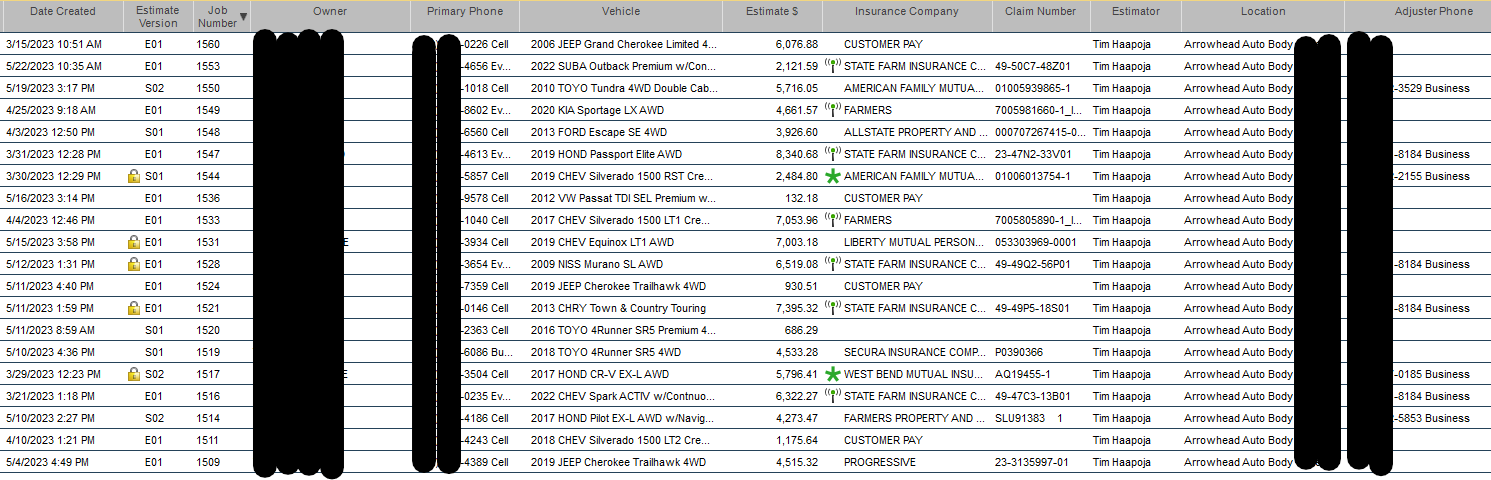
Here is the management software we use. At this level, it works like a basic spreadsheet, I’ve redacted the sensitive information.

I don’t have any reason to memorize every detail here, but my main goal is to be able to know which job someone is referring to without having to look at my computer.

For instance, walking through the shop, a tech may ask “did we get the grille for 1532?” I simply want to be able to remember which customer and vehicle that is. Or when an insurance adjuster calls and asks about “claim number yada yada yada” that I know which vehicle that is.

90% of the time, I am able to answer whatever question it is that someone is asking me, but with multiple different ways to reference a job, it’s hard to quickly know which one.

A small side goal is that I would like to be able to identify which customer is calling based on just the phone number, but of course that just comes down to memorizing all of the phone numbers as well, which very well could be impractical.

Is that helpful Doug?

1 Like

@Zelotroper, very helpful.

So let’s do some triage.
Basic info then is converting customer last name, vehicle make and model, claim number (ugly ID, do you have to know all of it or maybe just the last four characters?), and optionally the phone number (can you just use the last four numbers here also?)

Can we eliminate anything more? That’s a workable set of data to start with I think. How many new cars do you get a day? Are you able to review every day to refresh the active cars? How many active jobs do you have on the average?

Doug

1 Like

I would say I personally deal with roughly 20 active jobs on any given day. Each week I take in 6-10 more, so they are all here between 2-3 weeks.

The last four digits of the claim number should be sufficient most of the time, but in some instances, the middle digits are more important, but I can get that part figured out.

Phone number, the last 4 is probably doable, though I am currently working on a PAO system for common local area codes and exchange codes, which takes care of the first 6 digits easily making the phone number 1 quick image.

I’d say I would be more than happy if I could consistently remember:
RO number
Customer Name + Phone number
Vehicle Make & Model + Insurance claim number

Realistically, lots of the other information stores itself rather well due to the nature of the job. Even Vehicle Make and Model and the location of the damage, I can usually dig out of my brain if a customer calls 3 months later with a question.

I can definitely review daily, shouldn’t take me more than 10-15 minutes, even if I’m running through all of the images every morning.

1 Like

@Zelotroper, sounds very doable. I’ll sketch out a plan and see what you think later on tonight or tomorrow. Maybe other people would like to put some ideas out there also.
Doug

1 Like

@Zelotroper, so this is the most diifficult type of problem that I’ve seen in mnemonics. Lucky you! It involves mixed data types and multiple images. There’s a competitive version of this called Three Strikes You’re Out where memory athletes have to memorize three different pieces of data for each datatype. You can see my original post on the new type of technique for the solution to complex real world problems.

You’ll have to build up your toolkits with PA and PAO systems and get good at visualization of multiple images. I had to create lots of tools to make things easier as I made conversions and eventually published them.

Here’s the conversions that I think work:

  • Insurance claim number, use 4 selected digits for a PA image. If two letters are involved use an extended PA system of the alphabet using animals and their actions (bestiary). Alligator splashes large tail, bear eats honey, etc. One letter will invoke the creature but may break up the group into three parts where you should go PAO on it.
  • Phone number, use 4 digits for a PA image until you get good and extend it to the full number.
  • Repair number, 4 digits, use PA image.
  • Customer last name, convert to substitute words.
  • Vehicle Make & Model - convert to substitute words, possibly use an action to create damage in the appropriate area.

Now to store the info we’ll use what I call an abstract peg system which looks like a resuable “memory palace” and tie it together with a story narrative. The info must always be stored in the same area and the image will be different for every stored combination of values. Imagine some generic vehicle. Here’s the locations where I would store the same info every time:

Location Data type
Driver’s seat Customer last name
Passenger’s seat Repair number
Front and back hood Vehicle make and model
Back seat Insurance claim number
Digital panel between seats Phone number

Now let’s take an example row of data:

Data type Data
Customer last name Donaldson
Repair number 1560
Vehicle make and model Jeep Grand Cherokee
Insurance claim number 8Z01
Phone number 0226

We convert this into visual mnemonics to make the abstract peg image a concrete image.

Location Data Mnemonic
Driver’s seat Donaldson Donald Duck
Passenger’s seat 1560 Outlaw making dinner reservations on cell phone (Jewess, it’s a joke “what does a Jewish American princess make for dinner?”
Front hood Jeep Grand Cherokee Jeep, the cartoon character or Egyptian and his wooden chair that breaks when he sits in it.
Back seat 8Z01 UFO, (zebra) flying in to jail bars in the back seat, and turned into pita bread by a Saudi baker.
Digital panel between seats 0226 Swan, (wench) tempting other by flashing her knees in a ruffled skirt

Now to make the image work so it is navigable, you add some narrative logic to the pieces so that they interact with each other. If you have a good memory for odd images, which I don’t, you can reduce the story details. I need them.

The narrative story: Donald Duck is interested in eating at a seafood restaurant so tells the outlaw to do that. He pulls his gun out and says he’s eating steak. The Saudi in the back seat is making pita bread while he’s in the jail of the back seats for the steak sandwiches he thinks he’s going to get. The outlaw uses the car’s digital panel to call and finds the Tempting Swan Steakhouse nearby and goes there. The woman distracts Donald at the door and runs into an Egyptian going into the restaurant with his wooden chair which smashes on to the hood. Does the Egyptian cause damage to the car anywhere else?

Commiting something like that takes some time and I would document every single image you create, concentrate on one for a minute, review after 10 or 15 minutes and then at the first and end of your day. So, complex data equals complex imagery. There’s lots of moving parts. But it’s orderly, repeatable, and can be converted back into data through the active mnemonic images that I hope stick.

If you have any questions or run into a problem, let me know.
Doug

2 Likes

This is fantastic! I appreciate all the work you put into this, I’ll definitely be trying to apply this. Lots to learn!

1 Like