I have been toying with this idea for quite long (years), but I never got around to it because of my studies.
- Has anyone tried memorizing long texts verbatim by visualizing the words in shorthand?
Basically the idea is the same as that of a memory palace. However, since words such as sentence connectors are often hard to visualize, by replacing that word with its shorthand version, one can easily visualize the word.
I tried to pick up gregg shorthand but it was too time consuming. Recently I stumbled across this: http://home.tu-clausthal.de/~rzsjs/steno/Gregg.php It’s a text to gregg translator.
My theory was that since some words are not easily visualized, one can visualize its Gregg shorthand counterpart instead. In addition, some gregg shorthand forms are very distinctive and I was thinking perhaps it might be possible to group certain words together to form an image.
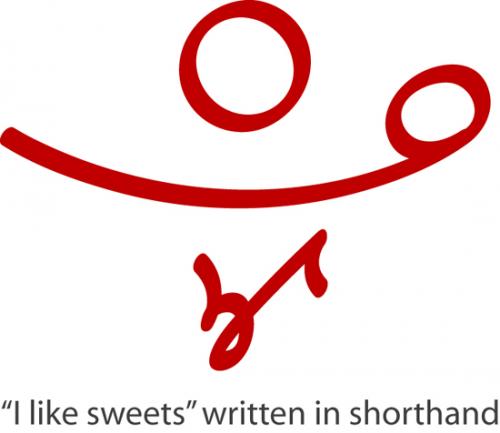
I like sweets
For example the above phrase looks like a smiley face looking down on the Gregg outline of the word ‘sweet’. In this case, a classic sweet image would serve a better purpose in the use of memorizing this phrase ‘I like sweets’
Gregg shorthand outlines get more complex with an increase in number of syllables, so perhaps attempts at memorizing text verbatim may not be possible, but it might be possible to convert the text into sentences with connectors that have easy to visualize Gregg outlines first, and then memorize using a memory palace.
Now, I know the answer to my original question is probably no but it doesn’t hurt to ask! I also hope that anyone who is adept at shorthand and familiar with mnemonic systems can aid with suggestions. I initially tried to use this system to memorize paragraphs of text for academic purposes but I got stuck at trying to pick up shorthand. I will try to pick up where I last stopped, please aid in giving me advice about how to go about doing this, and what you think about it 
In summary, I just hope this will be a useful contribution to anyone, including me, who wants to be able to use this method to study, not just to memorize shopping lists.
I have a two other questions:
2. What about the memory palace method might be useful in storing information? I once used color coding to memorize male and female French nouns (yellow and red) with the chain method but it seems to limit the imagination considerably. I read in the forum that someone imagined he was very small so his memory palace was bigger and could store more items.. which is very cool and useful! As far as I know, the only aspects of the memory palace that are useful are that loci can store items which are easily visualized, and the route you take can determine the order in which they are to be recalled. Am I missing anything?
- Has anyone else tried memorizing text verbatim before? What problems did you face other than the ones I mentioned? How far did you get and do you have any tips to share?
