Ok, so I want to polish some of this up with your guys help and perhaps make a final version to stick in the wiki. So please don’t look at this as authoritative. I’m giving my take, and looking for input. The stuff in italics is like thoughts and shortcomings that I feel need improvement etc.
At the most basic level, memory systems rely on a person:
A. Forming a strong vivid Image
B. Coming up with an association
C. Connecting the Icon to a Loci with the association
Now, there is variation on this and one could argue semantics between systems etc. I’d love to here input on how other people define the basics, but by simplifying it like this we have a way to assess for ways to improve.
So this thread deals with A. Forming a strong vivid Image. Now, I’m using the term Image loosely here because although most of the mnemonic systems I know use visual methodologies, one can really work to improve sensitivity towards all sensory inputs. I am having an issue with terminology here. I don’t want to use the terms Icon/Echo/Haptic because these really indicate the sensory memory, not ST
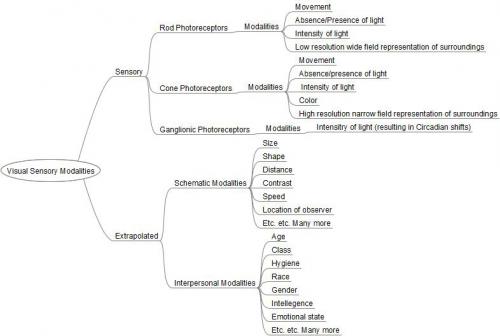
A modality is a specific aspect of an image. One can strengthen an image by focusing on bringing in all the possible modalities. Now there are two categories of modalities to consider: Sensory modalities and extrapolated modalities.
I am making new terminology here with the extrapolated modality bit. I am using these two categories because of utility, not evidence. I’d like comment on polishing this up or links to research here if anyone knows of something related. It’s the only way I can think of to explain it.
Sensory modalities are those aspects of an image which one could sense directly with the senses. The visual sensory modalities are those aspects of an image that a person directly assesses using the photoreceptors of the eye.
The visual sensory modalities are broken into three sub-categories: Rod input, Cone input, and ganglionic input.
The stimulus that a rod photoreceptor can detect are: Movement, Absence/Presence of light, Intensity of light, and low resolution wide field representation of surroundings (peripheral vision, map of surrounding).
The stimulus that Cone photoreceptor can detect are: Movement, Absence/presence of light, and Intensity of light, albeit cone photoreceptors are not as sensitive to these inputs. Cones detect color, and high resolution narrow field representation of surroundings (Tunnel vision, map of object).
The last category, Ganglionic photoreceptors (Aka non-cone non-rod photoreceptors): detect intensity of light, but the pathway results in changes to our circadian rhythms rather than direct conscious sensation.
Extrapolated modalities are not as easy to list as the sensory. Whereas with sensory, we can simply figure out all the different ways one can stimulate sensory neurons, with extrapolated modalities we are trying to identify the information that your brain has calculated and extrapolated from the sensory inputs. There are many many extrapolated modalities. Here is the beginning of a list, which hopefully we can work towards expanding later:
- Size
- Shape
- Distance
- Contrast
- Speed
- Location of the observer
As you can see, these things are not direct stimuli. Directly observed, a jet flying across the sky “seems” slow, and it certainly “seems” very small. Our brains determine however, that the jet is actually large, at a great distance, and thus moving very fast. These are very general extrapolated modalities. Lets look at some more specific examples:
- Age of a person
- Economic class of a person
- Level of hygiene
- Race
- Gender
- Level of intelligence
- Emotional state of a person
As you can see, these extrapolations are even farther away from direct sensory input than the previous and often rely on other sensory input like audio stimuli. We can assess someone age from what we see… but only with some degree of accuracy. Level of intelligence is something very difficult to test even with standardized methodologies, but it’s still an assessment we extrapolate about people after observing them. The further from direct sensory stimuli we get, the more likely we are to be wrong. For example there are definitely some transgender people out there that are nearly undetectable, and although it’s important to attempt to understand what others are feeling, we can never really know for sure.
So lets look at a map of what we’ve discussed so far.
 I’d love to get some input of course. At some point, I’m going to compile a large map of all the sensory inputs and provide links to the exact cells types. It’ll take a bit though.