I have googled quiet a bit on the solution to the Rubik’s Cube 3 x 3. It has taken me down some interesting rabbit holes, including Mathologer where the presenter goes into some elaborative mathematics of permutations of the Cube and mentions “God’s Number” which if I understood it correctly means the minimum number of turns to solve different scrambled cubes. Obviously a solved Cube with one twist would only require one twist to put it back into its “Solved State”. But what about those other scrambles? The presenter then mentions 4 Quintillion different ways the ‘tiles’ around the cube could be positioned. Now for my question aimed I guess at any “Speedcubers” out there. When these 6 second solutions to a scrambled cube is demonstated, how many different moves (in the total arsenal of the speedcuber) do they have? and secondly what mnemonics (if any) does the speedcuber use to solve the Cube? That’s the gist of my question, would love to hear from any “Cubers” on this forum.
Hello! I am speedcuber.
There many methods for solving cube in 6 seconds.
Method CFOP is the most popular one.
For speedcubers “an algorithm” is a pre-memorised sequence of moves, that solves some pieces of the Rubik’s cube.
There are 4 steps in CFOP method.
The 1st step “CROSS” is intuitive and takes 8 moves or less.
For 2nd step “F2L” you need 41 different algorithms. Each algorithm is 7 moves on average. At least 3 moves, at most 12 moves.
For 3rd step “OLL” you need 57 algorithms, 10 moves on average.
For 4th step “PLL” you need 21 algorithm, 15 moves on average.
In solve we use 4 algorithms for the 2nd step, one algorithm for the 3rd step and one for the 4th step.
8+4*7+10+15=61 moves.
So a solution with CFOP is 50-60 moves long.
And an arsenal of a CFOP speedcuber consists of 119 algorithms or more.
It is about 1500 memorised moves in muscle memory.
Usually speedcubers don’t use any mnemonics for learning algorithms.
They just give names to algorithms sometimes.
For example this situation is called “Mickey mouse”

And this is “Mickey mouse with a beard”
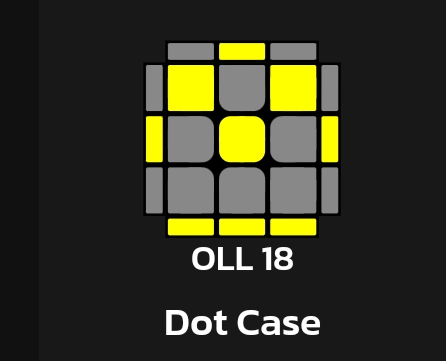
Video tutorials “How to memorise algorithms easier” say only to divide algorithms to small parts, to watch pieces’ movements and to find similarities between different algorithms. And nothing about mnemonics.
Many cubers use mnemonics for blindfolded Rubik’s cube solving although they don’t use it for learning algorithms.
Very few cubers use mnemonics to learn algorithms and solve the cube. You can turn each move into 2 digit number and memorise the number sequence.
Also you can create images for some common small sequences of moves. It can make image sequences 3 times shorter.
So if I understand you correctly, a ‘speedcuber’ using the CFOP (? does that stand for something?) is using a total of 90 learnt algorithms:
- Cross (intuitive)
- F2L (First Two Layers, I’m guessing the abbreviation means?)
- OLL (Not sure what OLL means, perhaps last-layer?)
- PLL? (It’s fascinating just how many TLA (Three Lettered Acronyms) specialists use in their areas of expertise.
But back to my observation of what you are explaining, a ‘speedcuber’ can INSPECT any scrambled cube before they commence their solving. In that inspection, supposedly they can identify patterns on the cube face (e.g. Mickey Mouse with Beard). From that they then solve the cube using the algorithms you have alluded to.
The speedcuber to my understanding is not necessary using the shortest number of steps to solve the cube (the most difficult scramble takes 20 moves to restore cube to its solved state!). The number 20 is known as “God’s Number”.
I find it fascinating that an individual can recall so many different patterns on the cube faces and that they know through their studying of countless number of patterns exactly what they must do to solve the cube. I am in awe
Mathologer says 43 Quintillion permutions of a 3 x 3 cube:
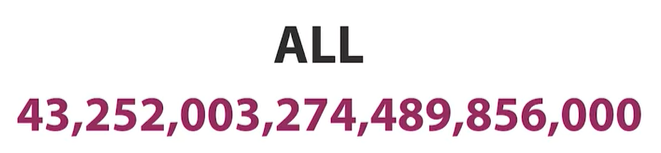
That is an immensely big number!
I am glad you like the theme 
CFOP stands for names of it steps: Cross, F2L, OLL, PLL.
57+41+21 is 119 algorithms, not 90.
F2L – First two layers ( you are correct!)
OLL – Orientation of last layer
PLL – Permutation of last layer.
Speedcubing has many acronyms:
OLS– Orientation during last slot,
VLS – Valk’s last slot,
BLE – Brooks’s last edge,
CLS corner last slot,
LSE – last several edges, L3E, L4E (for pyraminx puzzle), L6E,
L4C– last 4 corners,
OPA – oll parity avoidance,
CLL – corners of the last layer.
2 letter and 4 letter acronyms too.
WV– winter variation,
SV - summer variation (it is a part of VLS),
CP- corners permutation,
ZBLL– Zborowski Bruckhem last layer
1LLL– 1 look last layer
OLLCP – OLL+CP.
Usually speedcubers identify patterns during the solve. And they should do it very fast.
After the Cross we can see F2L patterns and choose one of them to do algorithm for.
After first F2L algorithm we can see new F2L patterns, and so on in F2L.
After F2L we can see a OLL pattern (for example Mickey mouse).
After OLL we can see a PLL pattern.
But Cross is only 8 moves or less, so speedcubers can trace pieces and predict, what F2L patterns will appear after those 8 moves. And even change cross solution accordingly if needed.
Yes, for speedsolving speedcubers don’t use the shortest solution.
But there is an FMC( Fewest moves challenge) discipline on competitions.
Competitors got the same scramble. They try to find and write down the shortest solution in an hour.
They may solve and resolve cubes as many time they want.
Some cubers always find solution around 24 moves – very close to “God’s number”.
Sometimes they found 18 move or even 16 move solution.
Yeah, 43 quintillion is a big number.
If you take 43 quintillion Rubik’s cubes to make all possible scrambles, those cubes will cover the whole Earth surface 200 times!