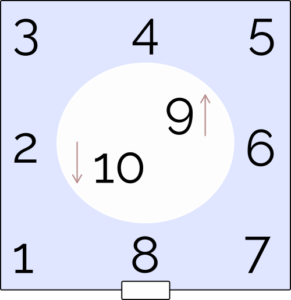
For all my Roman Rooms, I want to use the numbers 1 to 10. My goal is to assign 3 images to each number, ideally attaching each image to a different loci within the number’s area.
My question specifically concerns the floor and ceiling (numbers 9 and 10).
Since I’ll be creating multiple rooms, I’ll need to link 3 images to each floor and ceiling.
Unlike the other areas of the room, where it’s easy to find diverse loci, floors and ceilings tend to be quite similar and often lack distinctive features or furniture to serve as loci.
Do you have any advice on how to effectively use floors and ceilings for this purpose?
For the ceiling light bulbs, chandeliers, cracks in the roof and creative modern designs using triangles and ellipses are gonna do the job.
For the floor try some carpets and rugs, as varied as possible. Some bear skin in there, or a supermarket one, use a wooden floor, a ceramic floor, or even a glass floor with a nice cozy restroom downside. If you want to go wild put your room on the top of a tree house.
Just remember to match the furnitures, floor and ceiling with the main theme of the room. And add imperfections, because nothing in this world is perfect.
@SebastianO, that’s got an easy answer: use rooms with unique floors and ceilings. The reason the room pegs work is that they have interesting features to exagerate and associate to. From what I know, it’s just the way that memory works better.
Doug
Simply place imaginary loci and connect them with a story with the ones that are already there, remember to have a catalog of objects, you can look them up on the internet, since a judge’s hammer is different from a carpenter’s hammer, do this to multiply the loci of a place, connect them together and remember to review them, it won’t take long to have them like the real ones.
Are you using “Roman room” as synonymous with “memory palace,” which would typically be based on a real location you know well, or is it entirely blank and imaginary? If the latter, how are you distinguishing the rooms from one another?
I’m asking because I think that, first, you’re going to need a memorable way to distinguish the ceiling of Room #1 from the ceiling in, say, Room #8. And then comes the added challenge of dividing a blank, bare surface into multiple loci. (Personally, I think you’re making things harder for yourself by a) using an entirely imaginary space [if that’s what you’re doing] and b) trying to place three objects at each locus. But I’m mostly a traditionalist when it comes to memory palaces: use real spaces you know and don’t overcrowd them.)
Having said all that… Instead of thinking of each room containing 1-10, why not keep counting consecutively through your Roman room/house, and actually number your locations to match what you’re remembering? So Room #1 would hold 1-30, one item per location. Room #2 would then hold items 31-60. So the numbers themselves, if imagined on the floors/ceilings, would provide the locations you need on each ceiling and floor; you wouldn’t need any additional features to serve as loci. And the numbering helps guarantee that you don’t accidentally overlook something. If you don’t want to just picture a “29” floating on the ceiling, create an image for 29 using, say, the Major system, and attach your memory object to that.
I name my places in a substantive way, I place objects based on the substantive name of the place in 16 points or vertices, I can also stack, but there would be so many loci that I could not fill them, I use them for encyclopedic knowledge of a particular topic, for example a dictionary of psychology, neurosciences, etc., It could also be languages and other topics with a certain order that need many loci, I must also expand other places since a single place will not cover everything but it covers a good amount of terms.