I got my friend from the USA to send this book to me when his Mom returned to India, and I am glad to receive this book in hardcopy. As a software architect by profession, this book has become my current obsession to check my existing concepts in light of the ideas presented in this book.
The binary trees and movies having definite protagonist and antagonist connections and the fact that they are, by default, part of our existing knowledge is an eureka moment for me, and I am glad I found this book.
@joereddington, please let me know where you prefer (Amazon, Goodreads, etc) a review of this book to be posted, as I plan to write a detailed review once my reading is complete.
That’s wonderful - you were actually one of the people that motivated me to put together a Kindle version.
Amazon is probably the best place for a review, but I wouldn’t want to dictate that sort of thing. As it happens I’ve just reviewed my (excellent) electrician on three separate sites and that felt excessive…
As an experienced software developer and someone who’s fiddled around with memory techniques for a few years but never really managed to put it to good day to day use I think I’ve seen bits that will help me to finally use them it effectively.
So far I’m up to Classes in section 5.2 and really enjoying it.
In my life I’ve used the Dominic System until now. I have a question about the Major System used. I was wondering if the version in the book as used by Derren Brown is the most popular one in the world? It’s not very important but might make some examples easier to quickly pick-up.
His is actually a variation on the main one! This article outlines a lot about the major system, and mentions that Brown’s system is adjusted slightly. The ‘typical’ major system (copied verbatim from the article) is:
Digit
Consonants
Mnemonic
0
s, z, soft c
z is the first letter of zero. The other letters have a similar sound.
1
t, d
d & t have one downstroke and sound similar (some people include th here)
2
n
n looks something like 2 on its side and has 2 downstrokes
3
m
M looks like a 3 on its side and has three downstrokes
4
r
4 and R are almost mirror images of each other, R is the last letter of “fouR”
5
l
L is the Roman Numeral for 50
6
sh, soft ch, j, soft g, zh
g looks like an upside-down 6, cursive j looks kind of like a 6
7
k, hard c, hard g, hard ch, q, qu
capital K looks like two sevens stuck together
8
f, v
cursive f looks like 8, v is a vocalize f (some people include th here)
9
p, b
P looks like a mirror-image of 9. b sounds similar look like a rotated 9
Ignored
Vowel sounds, w,h,y
These sounds are ignored in the traditional Major System
Popping up to say that in case anyone ever feels like their work has been proofread enough - I’ve just done an update to fix three or four ‘it’s’ instead of ‘its’ issues that survived ten proofreads by me, two by my partner, two by my proper proofreader, three beta readers and at least four people on here who sent me other corrections.
It’s astonishing how they pop up.
Annoyingly, because the paperback version and Kindle version are currently quite far away from each other, I’ve only fixed the Kindle version. Amazon’s paperback is now a few typo’s behind. It’s one of my little jobs for the summer to bring them back together again.
…and indeed I’ve now done this. Both versions of the book are now entirely the same and I’ve changed enought minor things that I’ve tagged it as version 1.2 internally.
Well, as a former professional proofreader and editor, I wouldn’t trust AI to proofread anything. I read a self-published book not long ago where nothing was misspelled—so it would have passed any spellchecker—but there was missing, wrong, and extraneous punctuation; sentences that made no sense; and instances where wrong words were used (like “challenge” when it clearly should have been “change”).
What would it cost to hire a properly trained proofreader?
(I realize there is no specific answer to that question, but perhaps you can venture your thoughts on the subject.)
Once a friend asked me to proofread his book. I thought I would be able to do that, but it was way too difficult, so I had to back out. His writing was riddled with problems, so it was murder to even fix individual sentences. In retrospect, I’m not sure if I would have been able to proofread for George Bernard Shaw.
My hat is off to any human who can credibly proofread a whole book.
I have quite a lot of opinions on proofreading in general, but I also think that it’s worth distingishing things like proofreading from alpha readers and other types of reader - Brandon Sanderson does a really good job of this in his NYU writing course, which is free online (and is great, even if you have mixed opinions on his writing )
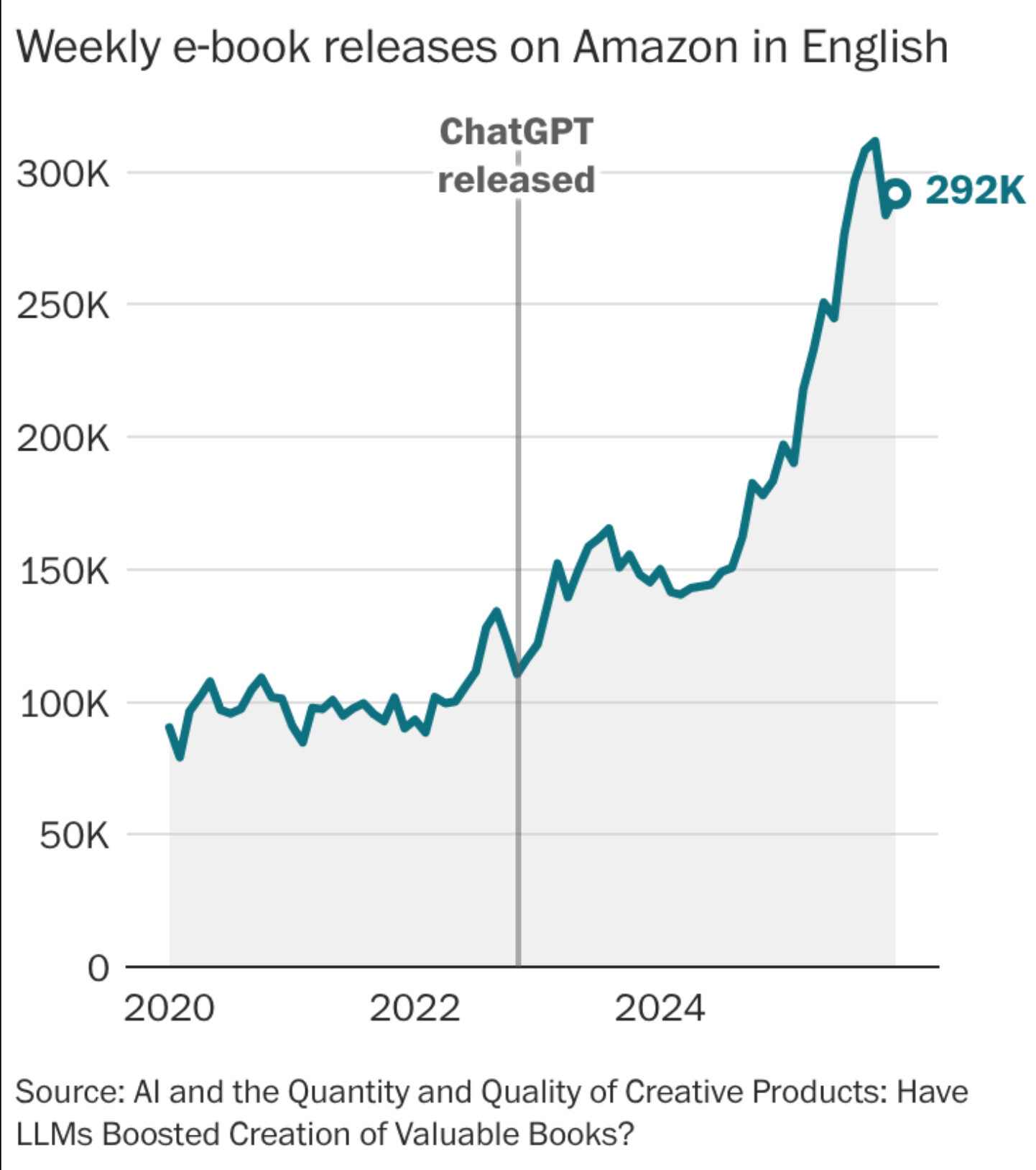
has given me pause - I strongly suspect that there will be too much spam (particularly in a marketplace like memory) to actually reach anyone with something more grounded.
I saw this coming a couple of years ago when opportunistic services started advertising “just enter a topic and receive an auto-generated book full of slop which we’ll even upload to Amazon for you”.
On the plus side, maybe, people seem to be getting extremely tired of LLM-generated content and click away as soon as they detect a whiff of it. I certainly do… I don’t even have enough time / mental space to read all the amazing human-written books on my shelf, so why would I invest time reading something the “author” probably hasn’t even read themselves?
The question is, is the number of copies you sell to people who just found them at random on Amazon significant?
I mean, even before the AI craze, I usually bought books that have been recommended to me by someone (or that I’ve heard about from someone in a podcast f. e.) and I usually read reviews beforehand, so I figure there’s not much chance to get that kind of slop.
(It’s not because I want to filter AI out, it’s just that there’s so many books and so little time…)
I’m also being silly. I didn’t write the first one expecting more than 11 copies to be sold, I wrote it because I had things I wanted to say. And I’m quite interested in finishing up the next one.
I find ebooks useful as I can carry my tablet (a little larger than iphone) or have it on the phone if the situation calls for it. Also on my tablet is my iNotes which I have many list reference material notes to refer to when needed. I highly recommend the format. I bought the book already but would rather have an ebook version - whatever type it might be. I have several formats - most of my memory books seem to be kindle oriented.