@JohnDen, classes have certainly been untouched, probably because so few people understand object oriented design well enough to convert the thinking into mnemonic structures. I grappled with the ideas and ended up calling them abstract pegs, because just like abstract classes, they can’t be used for a concrete object.
The medieval blockbook illustrations that repeat the central image of the eagle and add minor images at consistent locations have quite a few connections to other ideas we have words for now. The eagle provides the locus… but it’s not a locus really. It could be seen as an OO class. The class of John. Here’s the first object instantiation:
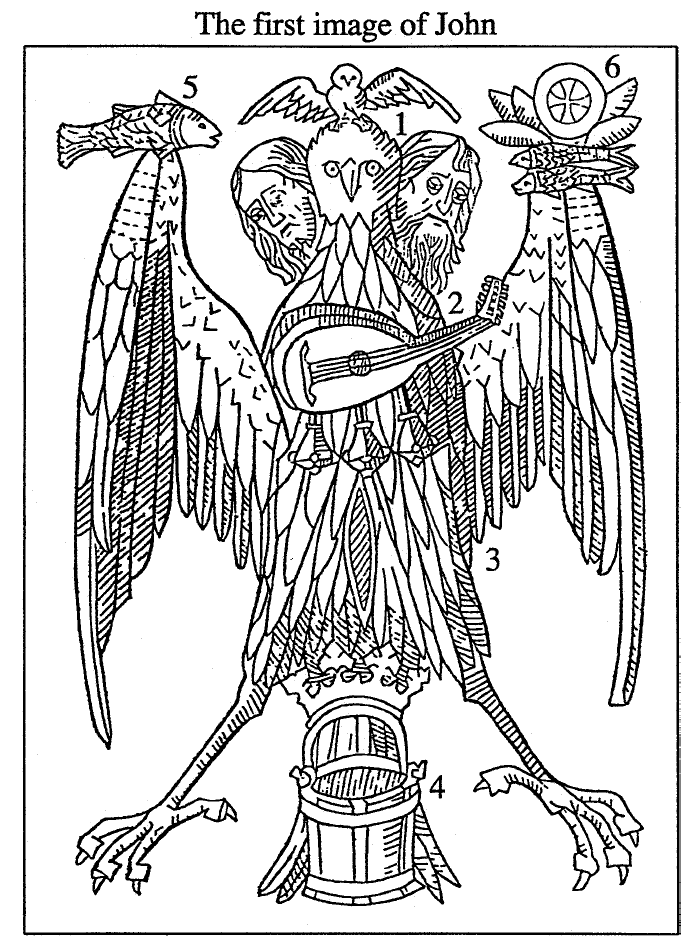
I guess it’s more of an abstract data structure that has positionally puts other images as cues to the text in consistent places. You can draw relationships to pre-OO prototypes in JavaScript or abstract data types (ADTs) in that this is a loosely typed system with constraints to a maximum of images following the rule of seven (plus or minus two) for optimum recollection.
But the designated areas on the eagle, or fields/member variables have no specific typing and would just be named head, rightWing, leftWing, etc. and the datatype would be Object. The methods would end up being the actions and any introduced items, like a rapscallion, would be considered a local variable with private visibility within the method.
I could go on but I don’t think it is really profitable. I’ve tried to work out the details in some complex problems using OO thinking with a class as the container (a book structure, a directional structure, and an anatomical structure for massage), offered here on the forum. You won’t see the word ‘class’ there but the encapsulation is strong, inheritance (adding a new position/action on the eagle) and polymorphism by interface (what groups of things are flying, burning, throwing another object?) are implementable.
I much prefer a strongly typed system and use that technique in my solutions and with the SEA-IT visual data types which would be considered the primitive variable types of visual mnemonics.
I think Joe has started some great discussions and I’m very happy to see some more in-depth cross-discipline thinking on the forum for programmers. We do have to implement the designs eventually so post what you think a good example is of your data structure. Joe elaborated in his book with many great examples although they were very British and being American, not my cup of tea. 