Interesting take.
I do not post much but it seems to me that, perhaps, just perhaps I might help here. Expand your advice with a personal example that hopefully others can use / copy.
In the early stages of using “memory palaces” it often happens that learners get bogged down with one or two (or maybe even twenty-five or twenty six) that is to say a limited number of memory palaces.
And the MrDrProfessor is right - there are dangers using the EXACT same memory palace more than once.
But beginners then think “How the hell am I going to prepare hundreds and hundreds palaces???”
I’ve even seen newbies here writing that they had run out of palaces..
Well, there is an easy way around this, - read on and find out how… I’ll give TWO different methods of developing unlimited amounts of memory palaces - all different. But based on the same sort of template;
There are many many ways to overcome this: The easiest is to have a future proofed system to construct a new memory palace at the click of the fingers.
Future proofed in that it is pre-peged and pre-ordered but the location (or time) changes.
I have seen quite a few examples of this, two that I use are:
First Method:
Crossroads Memory Palaces based on a “clock” shape:
You take any crossroads you are familiar with and superimpose a pre-prepared template which is pegged and in order.
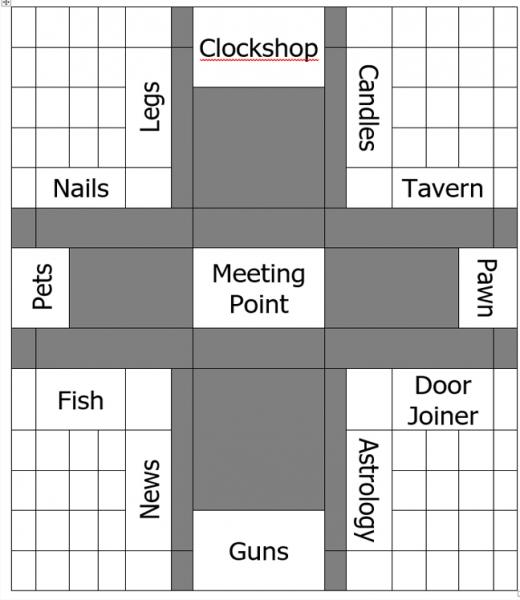
The facct is that whatever crossroads you use you can imagine being there and you know what is position one through twelve. For beginners these can be pegged of course - I used to use as an example common pegs like shapes or rhymes and have people imagine a new shop or stall selling related items in each position, then the character interact with the informationi you wish to store there… example is: Pegs of 1-12 of Candle, Swan, Pawn Brokers, Door (joiners), Astrologer, Gunshop, newspaper, fish shop (where octopuses love stealing fish number 8), pet shop - cat’s have nine lives, a nail bar for ten, dance club for 11 and a jewellers where you buy a clock for 12. This is just the first level of course.
So on the map you imagine a Candleshop at position 1, perhaps always inhabited by the same character …
Swan Pub for position 2 perhaps always with the same landlady Mrs Swan…
Here is a basic list from an old screenshot in word:
Using this ‘system’, you can choose literally any crossroads you know anywhere in the world.
Always make north 12, 6 south and the others corresponding.
I’ve use this particular method for basic lists, music theory, summaries of entire books, etc… I do not compete in memory sports - I am interested in applied memory methods…
I used to have people imagine the home they grew up in, but I’ve found it is much easier to get them to imagine a crossroads - any intersection of two roads. They can relate to that and then image the locations in seconds, and then always return there if they make a vivid association with the information they want to remember and the location they put it in.
One thing to maybe bear in mind is that the loci (shops stall or whatever) are arranged like the numbers on a clock - you stand in the centre and point - north is always twelve - her’s a combined clock and crossroads m should give people the idea, fingers crossed.
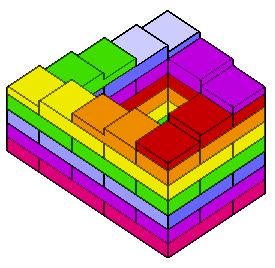
Second Method : Use of Penrose Stairs
This is another method - and a simple one for long term information as it is all pretyy much int he same place.
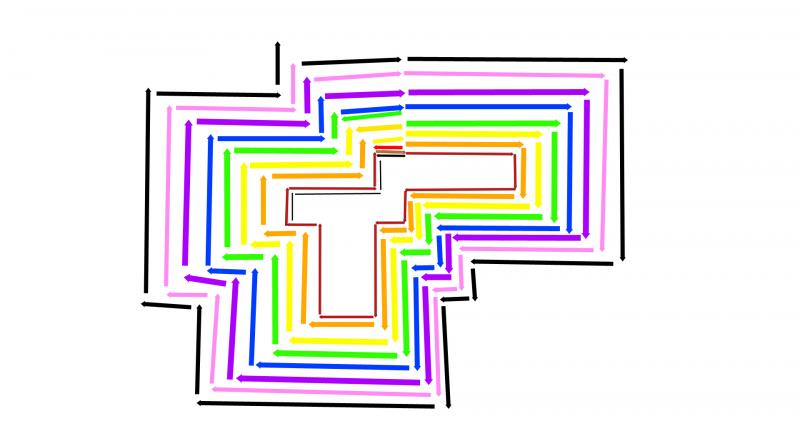
A penrose stair is a circluar route that you go back to the beginning again and keep on going and going, but you can in your head imagine things changing and going on for ever and ever… by going round and round but making each a different lap… colour… and each loci with a peg or character..
This method simply means using a known journey of a set number of memory slots or loci, and when you get to the end you imagine being a storey higher. You go around and around. I use this a great deal now. I find it combines well with the crossroads template as well, but I have used it in long journeys too, I suspect this is the best way to remember simple information with say a hundred stages - I used this for encoding the entire Grand Staff of music as a PAO… 00-99 but I used only a twelve stage walk around my home city - but it was like lap one - red (1-12), lap two orange (13-24 etc and I encoded them by colour using the old ROYGBIV
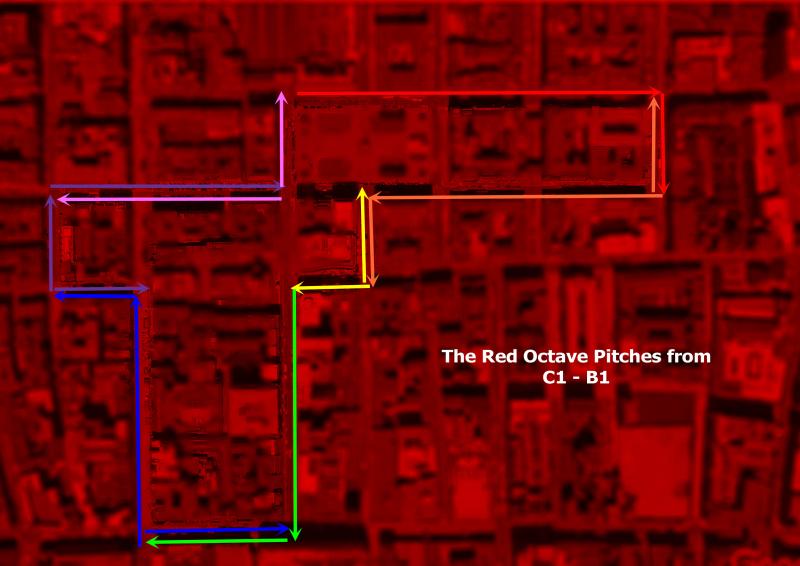
For the musical Grand Staff (and I show this only as an example - you can use this for anything). I used Google Earth to reinforce my own memory:
Chose a route from my city I know and can imagine walking:
Chose the route in various angles:
Then pegged it with that route in my head
And then made it colour coded each lap:
example:
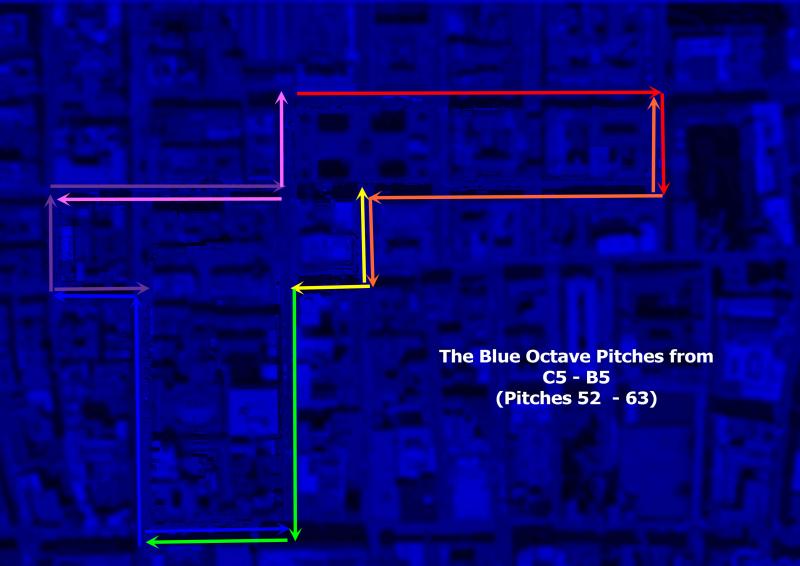
And here’s one of the fifth lap (blue - red orange yellow gren BLUE)
Each loci (here a street bathed in a colour) was unique and had a PERSON, with an ACTION and an OBJECT, A NUMBER and a SYMBOL.
The whole route can be imagined as a long winding journey in laps, I foudn this sort of thing helped:
I understand why Alex Mullin might say what he says but he’s an memory athlete and trying to do things quickly against the clock - hence his emphasis on encoding - that’s all very well but personally I’m using applied techniques to help me and others learn things deeply so they will NEVER forget and using the same types of future proofed system really is what people like me need to do. Anyone can imagine a crossroads - their own favourite one or local one:
or a Penrose stair
or spiral
IN ESSENCE: Our memories are unlimited for memory locations and palaces, the challenge is to have a system - and the best system is one that is a template that can be used again and again in different locations. I’ve shown two ideas, but I would interested in feedback as I am still trying to get better at instantly coming up with new palaces.. there is lots to remember! And it’s fun.