Searching for mnemonics is, like most things in life, something that you become better at with practice. It’s perfectly normal to be bad/slow at something when you’re a beginner. You can always ask here to help you find ideas.
Also the more you know about a variety of subjects, the more material you will have at your disposal to make mnemonics. So I would just encourage you to stay curious about everything and anything, to read and learn about a wide array of subjects. It doesn’t matter which ones – if you know the pokemon catalog by heart and are able to use it to memorize the periodic table of elements it’s great !
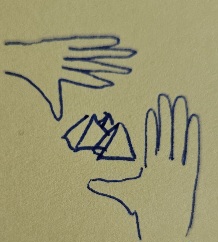
“Chiral” for me sounds like the city “Cairo”, I’d use that for a mnemonic. You could use somebody looking at the pyramids of Cairo through their hands (meaning you see the chiral symmetry) – like an artist would do before painting.
In this case, our hands are an easily understandable example of what this kind of symmetry is, so it’s useful because it’s an illustration explaining the concept.
As for etymology in general, it doesn’t seem that much work to include it in the mnemonic (you don’t actually need to learn any Greek, just doing a quick google search with “[term] etymology” is enough) .
People like to learn roots because it allows you to understand other words later without having to search for their definition: chirography is “hand-writing”, calligraphy is “pretty-writing”, chiromancy is “hand-divination”, oneiromancy is “dream-divination”, etc. If you learn French we have “chirurgien” for surgeon, etc. So the idea is to put a bit more effort upfront, that pays dividends later in a variety of subjects.
But if you don’t want to bother with etymology there is, strictly speaking, no need. Eventually your brain is going to notice the pattern “oh another scientific word beginning with “chiro”… so these concept all have something in common!” (Etymology is just the shortcut to understand it sooner ).
Yeah, just get started, you need to accumulate experience, and your practice will change anyway. When I look at the first memory palaces I made, they are… not great. (Or at least I would do things differently now).
In the beginning I thought it would be good idea to have reserves of memory palaces at my disposal, just in case, and I spend way too much time preparing empty memory palaces. Most of the time, when I then wanted to use them, I had to modify them: change the journey a little bit or change the number of stations in this or that chapter, to adapt it to the things I wanted to learn.
It can be a form of procrastination.
For scientific terminology, I feel it’s like learning vocabulary in a foreign language. There are lots of threads on this forum (if you search “memory palace for vocabulary”), some people use memory palaces, some don’t (I fall into that camp, I feel soundalike/image mnemonics alone is more efficient). In the end it may be a personal preference. Always with spaced repetition of course, whether with or without memory palaces.
For science in general, I think that it’s more important to structure the knowledge first: drawing mind maps and the like, to understand how the concepts relate to each other and how they relate to your practice (meaning how they are useful for what you want to do with what you’re studying). It’s more useful to put them in a memory palace AFTER having done that work. Something understood is already half memorized after all.
Now if you’re studying with a well-made textbook, a lot of organizing is already done for you, but it’s always useful to see if you couldn’t trim down the amount of info you put into your memory palace. Memory palaces are very efficient, but there still is an opportunity cost: you need to take the time to review them (even if way less often), so all the time you’ll spend reviewing you can’t learn other new things .
Same for mathematic formulas. If you understand the formula and how the concepts relate to each other, you probably can reconstruct it (mostly). You then need only to encode the few points that you always forget or tend to remember wrong. Also plenty of threads on this forum, for example: Physics Equations - 180+ - Video Inside - General Memory Chat - Art of Memory Forum .
For verbatim (for example, if you need to learn a definition word for word), I find the first letter method (or redux method) very useful (again always with spaced repetition).
For presentations, a memory palace is super useful (because you’re going to give it in linear order, and you don’t want to forget a part, etc.). One of the most straightforward uses of memory palaces imo.
The most common one is the major system. You don’t need to make it complicated, only learn which sounds translate to which number (so ten of them, from 0 to 9), and you’re ready to replace abstract number with images to memorize them more easily.
Let’s say you need to remember that the absolute zero is 273,15°C, you need to have a word/sentence with the sounds N for 2 / K or G for 7 / M for 3 / T or D for 1 / L for 5. Whether you want to choose a frozen sheep “the Enigma Dolly”, “neko metal” (cat that looks frozen, is actually just metal), or “Nekoma ('s) tool” (extreme cold used as weapon to win at volleyball) is up to you. Usually the first association coming to mind is the one your brain is going to remember, no matter how dumb it is.
Spaced repetition. You need to review everything. Using memory techniques means that you’ll need to review much less often, but you still do need to review.
Most people use spaced repetition software to schedule their reviews, but you can organize it however you want.