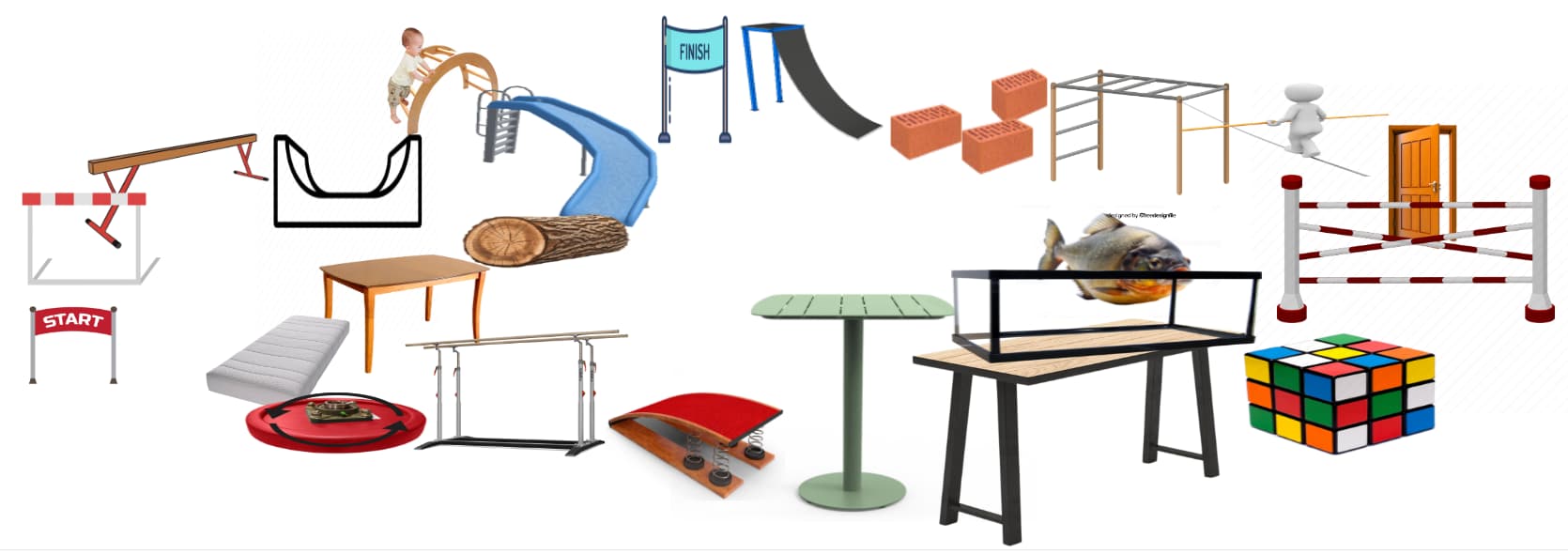
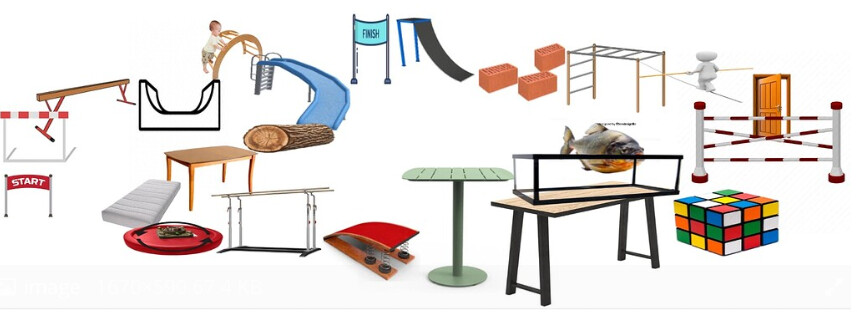
I decided to place 100 obstacles in a memory palace route with the idea of learning their 2 digit number value using nothing but spaced repetition. Learning their sequence was very easy once I placed them in a memory palace; I only needed about ten minutes for that without even having to try very hard. However, learning the number value without using any mnemonics felt to difficult for it to be worth the effort. So I just decided to just use my old number to letter (and or sound) translation system and see if I could connect the (possible) meaning of those 1 syllable 2 digit words to all obstacles without changing the order of the sequence. Much to my surprise this was also very easy, so that also in about ten minutes I was able to translate each 2 digit number into an obstacle. It turns out that having or not having a logical connection between an image and a 2 digit number translation makes no noticeable difference at all.
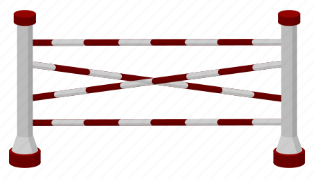
One example of a completely random, but surprisingly easy connection is this obstacle …
… ; this happens to be obstacle number 93, pronounced as GEE (dutch word for the letter G), so the obstacle is now a G-level jump (whatever that might mean).
General motivation for the system
Unlike with random images of all kinds, consecutive images of obstacles tend to be automatically connected by an observer if that observer tries to simply imagine how he or she would go from one obstacle to the next. I think that this aspect makes such a system very suitable for a linking approach.
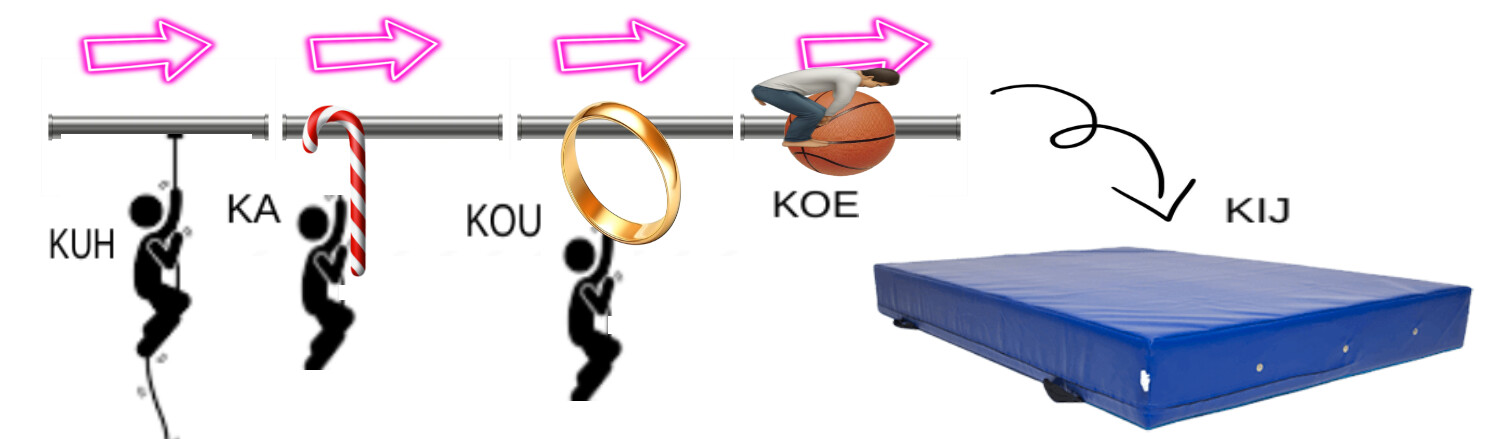
Without any type of premonition I created a sequence of obstacles for the numbers 45, 46, 47, 48, 49 that combined with my old number to letter translation system translates as kuh ka kou koe kij. Without much alterations we get the sentence pronounced by someone with a stutter: “Kuh cacao koe, kijk!”. A direct translation to English would be: “Kuh cacao cow, look”. So technically speaking the person in the bent over position is riding the cow.
When I’ve done binary digits memorization (on stage or once in a livestreamed competition) people tell me that I make various movements (simulating actions) as I go through the memorization (I use the method of loci with an adjective–noun system). But I don’t really realize if/when I’m doing it, because I’m focusing only on the memorization.
I can only imagine how this would be it I used a system of literal obstacles like in your image
Nice idea though—especially if you’re worried you’d otherwise omit some of the items using other methods.
I once was at a team building day organized by the company I worked for and in the first 5 minutes we were supposed to make acquaintance with the other group members (group total was 30) and try to memorize their names that were on their name tags. After the introduction the name tags were flipped and one by one everyone had to say the names of as many persons they had memorized and point at them. Most managed about 2 or 3 names and when it was my turn I got really nervous but somehow managed to get all 30 names correct. Everyone was looking at me like there was something wrong with me and because of that I got even more nervous. It was not a pleasant experience by any means.
I can only imagine how this would be it I used a system of literal obstacles like in your image
It has been my educated guess thus far that making movements with your avatar in this simulation we commonly refer to as reality limits what you can do in your mnemonic imaginary world and how fast you can do it.
Nice idea though—especially if you’re worried you’d otherwise omit some of the items using other methods.
You are not that far off regarding my motivations for trying out this system, but there is a little bit more to it. If I could choose to be good at any memory task using either the memory palace or a linking method, I would for sure choose the linking method, mostly because of the problems regarding using the same memory palace(s) over and over (as discussed on this forum in multiple threads). If I try to link a sequence of normal images I usually have no problem with the first 5 images or so, but then my creativity runs dry and the whole process slows down a lot. It always seemed unfair to me to compare the memory palace method and the linking method using the kind of images that appear in my view to be more compatible with the memory palace.
I really like this too. Is there any chance you could share your flashcards and/or complete list of images for this? I don’t have a consistent system for 2-digit numbers atm and I’d like to give this a go
I have never put images in a spreadsheet or something for this method, I just thought of 100 different obstacles and placed them in my memory palace, so that I could learn the number value of each obstacle. My inspiration comes mostly from tv shows such as American Ninja Warrior and Wipeout.
… you get a false sense of the strength of the method. The picture is very easy to memorize because you can see it as a whole, but if you are just translating numbers in your head it is in my experience not much easier than memorizing random objects. Some obstacles if placed after one another create a very memorable flow of movements, but some don’t make much sense; in reality the sequence of obstacles in obstacle courses is based on logic, like after a jump you could land on a matras, but a matras followed by an aquarium makes not much sense.
On the logic point, rather than use this system for numbers, I have a much smaller more simplified set of “obstacles/physical traversal mediums” that I use to create fully fictional memory palaces from scratch to memorize control flow structures in programming pseudo-code. Sort of a mnemonic pseudocode.
Probably part of why I like this idea.
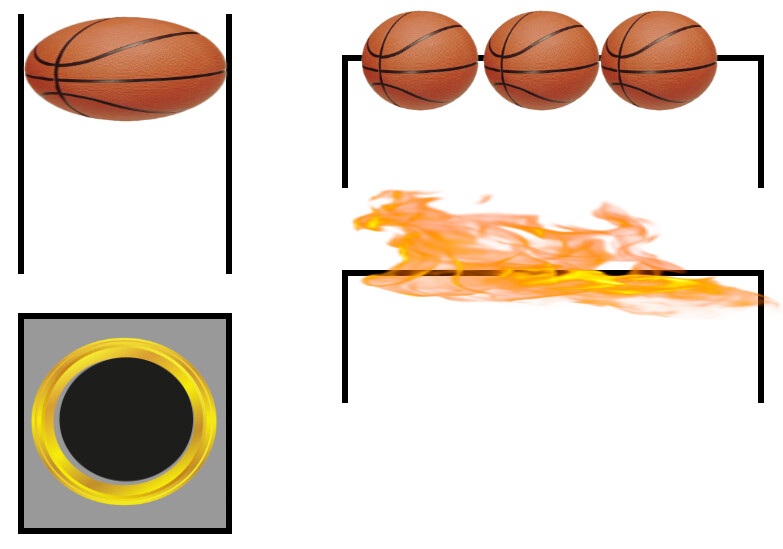
I utilize shapes and shape-form-patterns to indicate “how many”
—(eg, how many instructions within a level of a nested loop)
, and something like “traversal qualities” or “obstacles” to indicate logic and control flow structures.
—(eg, Curved traversal areas like a large curved wall or a paper airplane swooping in a big arc represent “If” statements, so can slides especially since they allow you/(the-flow-of-control) to literally slide-into to another “level” of control when you traverse it).
Thinking with my thumbs right now ,
I suppose I represent the “parser” traversing my pseudo-code palaces?






 ,
,