Hello everyone, I’m almost new to the memory tools. Till now used journey method and virtual memory palace. They are working fantastically for me . Now I want to learn major system 00-999 . For that I need 1000 loci. Where to find a memory palace with 1000 loci and manage them easily? Thanks in advanced.
1 Like
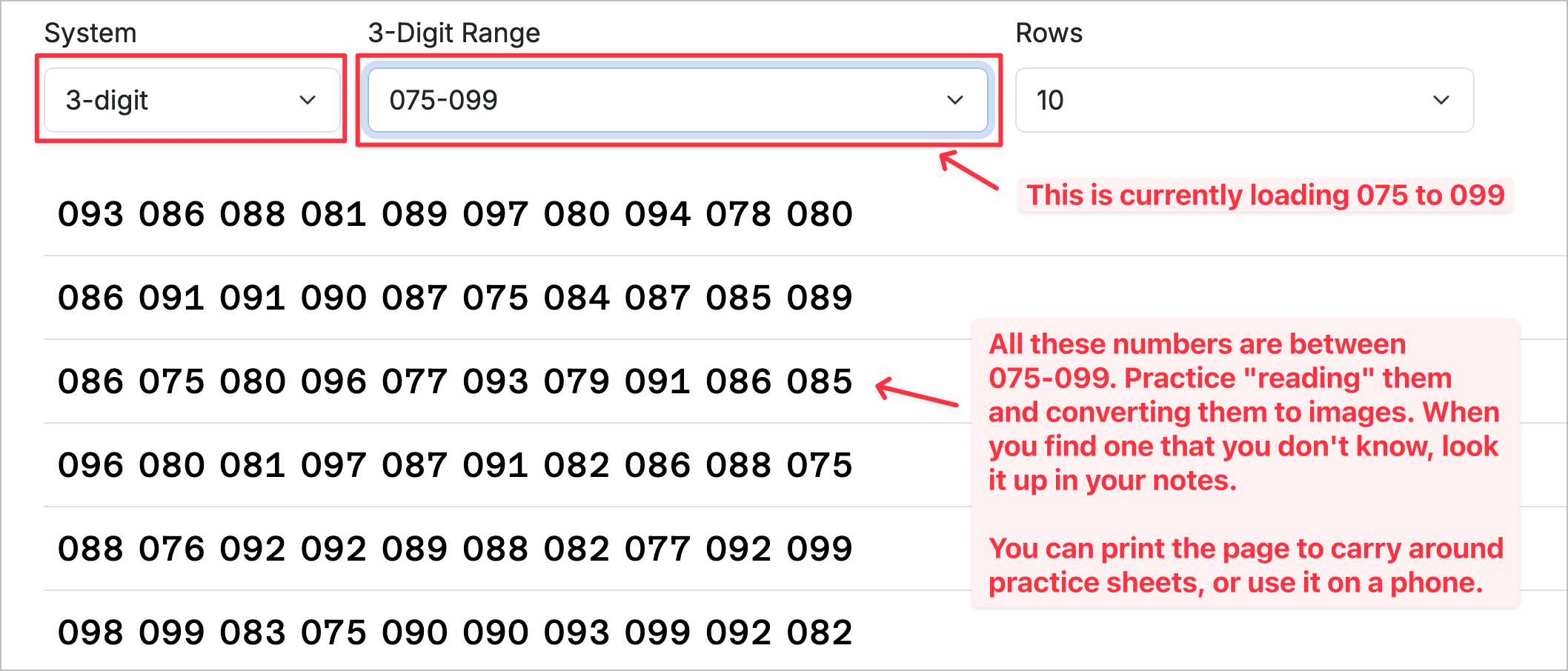
It might be easier to learn it without a memory palace. The major system helps connect the images to the numbers. There’s a major system practice tool on the site. Choose 3-digit system, and which group of numbers you want to practice in groups of 25. In this screenshot it’s limiting the numbers to 075-099. Once you learn a set of 25, move on to the next group.
5 Likes
That’s great!! I’ll try this immediately …
1 Like
I don’t think using memory palace for a system like that is a good idea.
I would use Anki only and let the phonetics guide me to the mnemonic image.
With time, after countless drilling of all images, you wouldn’t even need the phonetics no more. You’d just SEE the image for the number in question.
3 Likes
You can use the link method and create a story connecting one image to the next without using a palace.
Here’s what my story to remember 000 to 010 sounds like:
I throw a rock (SaSSo 000) in the sky at a super mario star (S.uper S.Tar 001) who in response send down on earth an aSSaSSiN (002) who generates an earthquake with rock spikes (SiSMa 003). SaSoRi (004) rush in defense and attack the assassin with a grain ladle (SaSSoLa 005), in the ladle there’s Trunks (SSJ 006) who is attacked by SaSuKe (007) who pulls out and start playing a saxophone (SaSSoFono 008) which recall SPike SPiegel (009) from Cowboy Bebop. ZeTSu from naruto (010) is assisting the scene and so on so on till 999 which is a BaoBaB
1 Like
This is still not feasible with a 3-digit system.
Here we are talking 1000 images meaning you would have 100 different stories. The recall would be a nightmare as well as the lack of structure.
Phonetic systems are best practiced with Anki/ Paper flashcards and spaced repetition strategy.
Anki does the above automatically but one can create their own schedule if they decide to go with the traditional route with writing the flashcards by hand.
1 Like
Yes it is.
Creating 1 story for 1000 images is quite easy and good practice. You can lay down any pivots you want in the story to create a structure for example 100/200/300 can mark a new “chapter”
Learning a system with mnemonic techniques allows you to practice without the system list at hand
1 Like
It certainly is possible to store your number system in a memory palace or create several story links or even a massive single connected one.
But…
The Major system is designed so that the numbers and sounds themselves provide the cues. 125 - T N L - ToeNaiL. It is very simple to use direct association from the numbers and sounds to bring you straight to your word/phrase and image. And that is the goal of a number system via major. Read the number as the thing. Not “read the number, then find it’s place in the story, then remember the thing from the story.” That is kind of bypassing what you’re trying to accomplish with major. It still “works” but it uses a lot of extra steps that you really don’t want to be doing when you look at what your end goal is with major.
When you actually apply the number system to memorizing, you won’t want to be spending time searching your palace or reviewing your story in order to get you to the right part of the story or location that tells you what 125 is supposed to be. You’ll be reading 125 as TNL and that will trigger the image of a toenail, no other mnemonic technique required. If you practice and learn with all those extra steps, you’ll need to work to break that habit and eliminate those steps before you can become fluent. So why not just skip those extra steps and learn to read the numbers and sounds directly?
I used a palace and story method when learned my 0-9 system and at first for my 00-99 PAO. It worked fine because of the smaller scale, but I soon realized that it was holding me back from fluency and that it really wasn’t providing much of an advantage vs just learning to read the numbers. I never bothered with it for the 3-digit system and I realized that I didn’t need it. It was a bunch of extra stuff that would eventually need to be phased out so that I could get to direct association.
Palaces and story links are amazing tools when applied in situations that work well for them. In situations where there is maybe no logical or clear way to connect the number and the image it makes total sense.
Like in freeform association where you arbitrarily assign images it would be a great way to learn them. If 1 was a mailbox, 2 was a shark, 3 was your mom, 4 was a landmine… With no logical connection, a palace where those appeared in sequence would make it really easy. Or a story where a mailbox opened and a shark flew out and bit your mom who fell over onto a landmine, that would be super memorable and as long as you could count along, you could learn those associations real quick. But for quite a while in order to remember what 4’s image was you’d have to rehearse that story until you counted to the landmine and then you’d have to build the association between 4 and the landmine via story review…
But with major, the logical connection is built in. 125 is a toenail. Because 125 sounds like toenail. I don’t need to tell a story or count palace locations til I get to the 125th locus and see a pile of toenails there. If I do that, I learn to associate 125 more with the locus and less with the sound of toenail. I want to build towards direct connection and major lets me reinforce that direct connection right from the start. Memory palace and story on top of major inserts a secondary connection conversion that will need to be eliminated to truly gain fluency.
Memory palaces and story links are great in many many situations but aren’t always the best tool for the job.
5 Likes
The major system doesn’t scale properly to 3 digit, there aren’t enough words, phonetics should be used as a guide and an extra tool to facilitate association. If you try to stick to the phonetic rule for all the numbers you are ending up with poor images that overlap or with odd combinations of words that are not handy.
Turning a system into a story is a good way to remember it and good practice.
1 Like
This is just flat out wrong, demonstrably, on every point.
As many users on this forum can attest, Major scales wonderfully across 1, 2, and 3 digit systems and as the foundation for large-scale 2-block and true 2704 image two-card systems.
I myself have used it to design multiple large systems that include full 3-digit lists, and others, including champion-level memory athletes, have also applied these rules in their system builds. Every single entry in my system is unique and vivid, follows pronunciation exactly, and is usually subvocalized with one or two syllables. It is intuitive and simple to use.
Not only is Major VERY effective at generating words and phrases that provide unique imagery for all these entries with it’s standard phonetic mapping, it can also do so with an even more restricted format where just one of the phonetic options is used for each number.
Just because an individual user finds it too challenging and can’t see how to apply it effectively or is unable to create unique imagery with it, absolutely does not mean that the system itself doesn’t work just fine.
It may not “click” well for some people, but to dismiss it out of hand in such an absolute way when there are many examples of it being successfully implemented at an elite level here on the forum is just silly.
2 Likes
It seems you’ve missed my point.
I’m not claiming that stories are ineffective or saying that you shouldn’t use them as a way to practice. I just think that for this specific application, the juice isn’t worth the squeeze.
Specifically with Major, and with the size of the 3-digit system, it can be an unnecessary “extra” effort that may not actually give much benefit to the practical application of the system. It does not really lend itself to an optimal learning process for what you are trying to achieve with the system. It teaches you to associate the mnemonic imagery with things OTHER than the actual number and phonetics that it is designed to go with. Those associations are irrelevant when actually using the system. I don’t care what palace location the image is stored in and I don’t care what comes before and after the image in the story. When I need to memorize 858, I read it as “fluff” and visualize marshmallow fluff. I don’t find loci 858 and then recall what was stored there, or mentally go through the story to section 8 - scene 5 - image 8. I don’t first jump to the nearest round number and start making links forward or back until I get to 858. None of that really helps me form the fluent association that I’m after that “858 is fluff.” It’s extra stuff that actually needs to be dropped in order to attain fluency. And it isn’t really needed because Major gives you the association directly via the phonetic language.
Out of curiosity, what system do you use for your 3-digit list and what was your process like for training it to fluency?
I think you are possibly misinterpreting Icefool’s comments. Icefool seems to imply that the Major system doesn’t scale properly to 3 digits because if you try to make 3 digit words with it you have to use the phonetics as a guide. I have created multiple completely predetermined 2 digit phonetic systems and every one of these systems had words that don’t actually qualify as such. Trying to make a 3 digit system in this way has always been a complete failure for me. I believe Ben Pridmore had the same problem with his Ben system in that he just had to make up a meaning for words that don’t actually exist.
Your 3 digit system uses the Major phonetics as a very loose guide, precisely in accordance with Icefool’s comments.
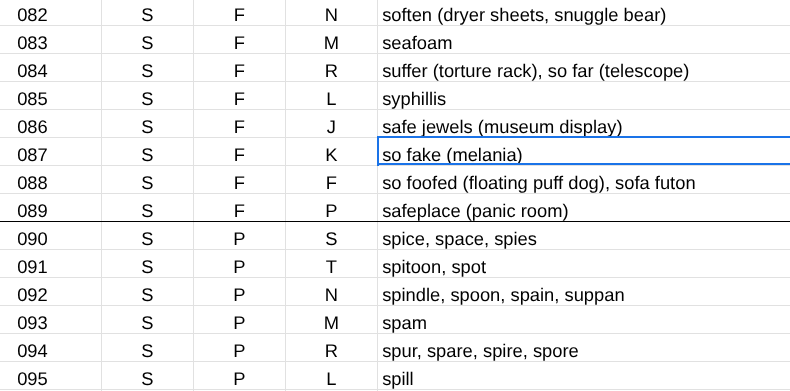
If 087 is “so fake” and 088 is “so foofed” I would be inclined to translate 094 as “soprano”, but for some reason you decided to not go with the s = “so …” translation. It looks like you need a lot of practice to become fluent with this system.
I think your system supports Icefool’s evaluation of the Major system (or any other phonetic system).
Not only is Major VERY effective at generating words
It doesn’t generate words at all, you have made all your 3 digit words using the Major phonetics as a (very loose) guide.
All the other problems Icefool mentioned are based on the idea of using the Major system as a completely predetermined way of creating words, which is the opposite of what your 3 digit system does.
it being successfully implemented at an elite level …
I don’t think the success people have had with this system actually proves that much. It is close to impossible to determine if the Major system is what makes these people successful. There are plenty of memory champions that have used more of an eclectic random associations based 3 digit system.
1 Like
Personally i don’t think it scale up properly, demonstrably there aren’t enough words in the vocabulary to associate each number to a word while preserving unique images and not resorting to gimmicks or made-up words (which mess up with the natural and intuitive phonetic association)
The major system is useful as a ground rule because it helps building a system and generates an extra association with pronunciation/sounds. Setting up phonetic association with numbers as the main goal rule would be a limitation for a 3 digit system.
I would argue that the juice is indeed worth the squeeze. Creating a story to remember a system is no different than creating a story to remember any other combination of numbers, you are looking to do the same effort that you would do by using your system to remember anything else.
Learning the system with a story is quite useful to practice without the system at hand as it is a fast way to memorize it.
I think my point was also missed, i’m not arguing that you should practicing a system through stories alone or use loci to do it.
I use a major system adapted to work with multiple languages, i rely to phonetics as a guide not as a rule. For training i use anki and practice using the system, i learned the system with a story first memorizing 20/40 images each day this allows me to train without a copy of the system at hand.
Edit: saw erikfromholland comment after i posted. I agree with what he said, thanks for explaining it clearly
1 Like
Thats a fair take.
There may be some misunderstanding of how we both view the application of the phonetics.
Since the actual “how” of how a word or phrase triggers an image can vary widely across people, the way the Major gets implemented to build out a list can also vary.
I will definitely agree that it is extremely difficult if not impossible to come up with single words or nouns that fit 3-digit major with only the three consonant sounds.
But that isn’t how I approach using it. (And I’m not sure that anyone really does who is seriously trying to build a complete 000-999 list.)
What I DO know is that it is very much possible to use exact major phonetics to generate words or phrases that can easily trigger unique images.
Like in that example of “So FaKe” that is a perfect major fit for 087, and even though it isn’t a specific noun, it triggers (for my brain) an instant image of someone that I consider to be “so fake.” Just as easily as 747 as the literal name “kirk” would make me picture william shatner’s captain kirk.
I think each person has those “non-noun” direct connections that are just as good as using standard nouns when it comes to using major.
I think I get what you’re saying about the variability of how the phonetics guide you to words or phrases being different from them literally generating those words. The user still has to decide how to fill the gaps between consonants and decide what they want the result to mean. I don’t see that as a downside though.
I think that in the initial stages of trying to bake in those associations, having a story that helps you remember that “858 is fluff” rather than falafal or “fully fat” or whatever other many possibilities it could be can be helpful, sure. But my point was more that the user will need to move beyond that fairly quickly to get fluent with reading 858 directly as those sounds, and I don’t see it as necessary to effectively learn to apply the list.
It does take quite a bit of practice, just as any new language would, and the size of the system is going to also require lots of work. The more ways you can interact with the information, the better, sure, but if that is the primary way of review rather tha buckling down and working on those direct connection, I think it will make it harder to get where you are trying to go.
I think Major isn’t ideal for everyone, especially with variations with language and accent/pronunciation. But for those that it clicks with it is amazingly effective on its own.
1 Like
as long as we are using more than one languages, and not just sticking with only English language. It’s possible to create 000-999 with just one word for each 3 digit.
my 3 digit system most words are from English and Hindi language (and few are from Japanese, Sanskrit, Spanish, Arabic)
00 - 99 (pronunciation system for 2 digit)
000 - 999 (phonetic system - consonant + consonant + consonant) with H00-H99, H’00-H’99)
1 Like
Can you please share with me your major system? As you are using hindi, so that I think, I can relate with your system.
Hi. Maybe create a story or an image or movie. Ex. Unite the word with 6 to the word with 86 and you have 686. Just an idea.