I hope you’re all doing well! I wanted to start a thread about something that I want to intergrate more into my life lately: puzzles. There is a wide range of diffrent Puzzles, whether it’s jigsaw puzzles, crosswords, Sudoku, or brain teasers. Why? Puzzles are a fantastic way to pass the time and keep our minds sharp. It´s help to improve critical thinking, memorie… Recently I started to look for new puzzle to try, finding Cryptogram, Word Puzzle and a number puzzle. Therefore I want to asked if somebody knows any other puzzle, I could try (Applications…) and what are the best puzzles to train your brain and memory?
How about the Rubik’s cube and then learning to do it blind? I’ve been wanting to learn the “blind cube” for almost a year, but I feel the need to learn and solve it for myself first. No easy task.
Languages are puzzles in a sense. They are figured out with unconscious pattern recognition. I’ve recently picked up Esperanto. It feels rewarding because the language was built from the ground up to be simple (for Europeans at least).
Hate to be that guy, but brain training doesn’t have any effect on general intelligence. Lumosity, which is a company you might’ve heard of, settled for 2 million bucks for claiming brain training had such an effect:
You can find a ton of studies showing that brain training similar to lumosity stuff doesn’t sharpen the mind. It doesn’t mean not to do them. Puzzles are fun. But if you’re looking to get sharper you might wanna try something else.
I am confused about the goal of this post. The title suggests you want a discussion about whether or not puzzles have positive effects. However the quote from above suggests that you have already decided what the answer is to that question. How have you come to this conclusion?
Sudoku
I used to do sudoku puzzles from the daily free newspaper at work during lunch break for some time. My experience is that you get somewhat faster at first, then you reach what Joshua Foer describes as an OK-level (a level that is the result of low hanging fruit progress as a result of for example a better understanding of simple sudoku solving algorithms) and finally you get bored and because of that you get even slower than this OK-level speed.
I honestly don’t see how doing sudoku puzzles will make me better at anything other than sudoku puzzles.
Do you think that it does make you better at other things …
when you are making progress with solving sudoku puzzles?
when you are no longer making progress with solving sudoku puzzles?
What other things would you possibly get better at as a result of doing sudoku puzzles?
What are the best puzzles to train your brain and memory?
I have a feeling you want to improve certain brain abilities without doing the obvious things that would be the most effective way for that. The more vague you keep your goals (train your brain) the easier it is to fool yourself that doing something you enjoy as for example puzzles is going to help you achieve those goals.
The marketing of the brain trainer and the music therapy are surprisingly similar.
Music/(brain trainer puzzles) stimulate(s) multiple brain areas and that sounds like a good thing, so with some rhetorical magic we can link that to anything we want.
Diseases such as dementia and Alzheimer will always grab the attention of the reader. You don’t even have to make any specific claims about the relationship between whatever it is you are selling and these diseases as long as you include them in the marketing text in a way that suggests some kind of related positive effect of the product.
In the music discussion I did get some reactions, although in my view no one was willing to debate the actual arguments I presented. In many other discussions being “that guy” as you put it has caused the discussion to just stop completely. I am curious to see if and how this discussion will evolve.
If you haven’t written code before, Python is a safe place to start (official tutorial and a random video tutorial). Any programming language will work though.
I don’t think that reference supports your claim. What that states is that Lumosity made advertising claims that exceed their scientific evidence. It says nothing about the ability of the brain to be exercised, via digital tools, or integrative protocols.
“Brain training doesn’t have any effect on general intelligence”
is quite a broad claim, and I don’t think your cynicism is scientifically supported.
The scientific literature suggests that people can drive changes in fluid intelligence, this can also be corroborated by “The Flynn Effect”. However, it is difficult to do so, and it requires elaborate and intensive interventions, and typically requires intrinsic motivation to sustain.
In general, the literature shows a wide range of findings, and even in studies that don’t find an “average statistical effect”, you find outliers and superresponders.
I think a more scientifically accurate stance is that it is difficult to drive statistically significant changes in fluid intelligence in clinical controlled trials, and that typically it requires intrinsic motivation rather than participants randomly assigned to some temporary and partitioned intervention.
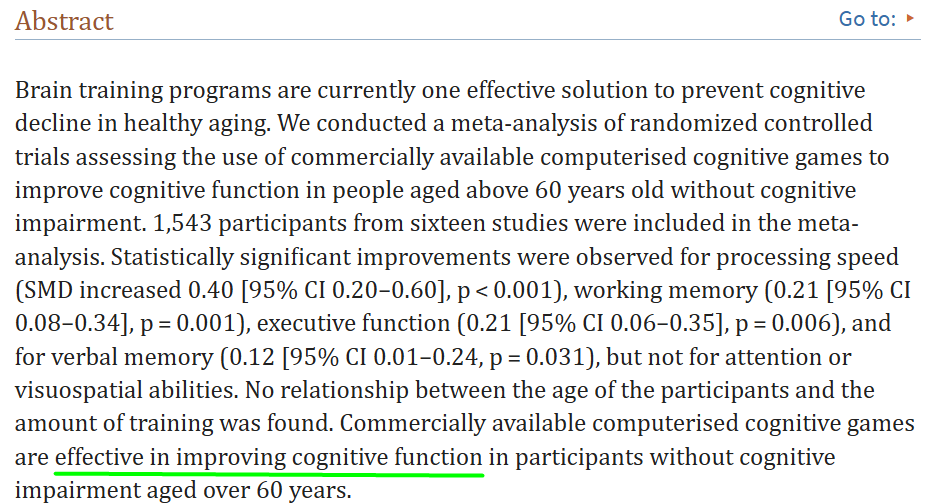
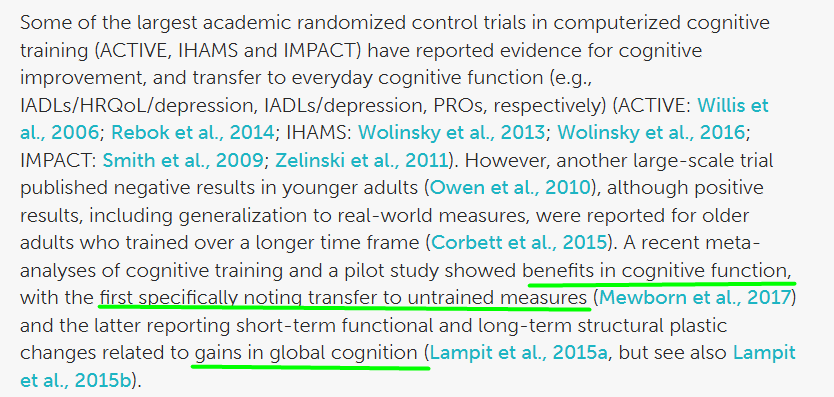
Hmm… I don’t think the fact that some “music training or puzzles” may not be beneficial to cognition rules out the possibility that the right form of rigorous musical training or exercises couldn’t. These meta-analyses seem to suggest that benefits can be derived, in a way that is reminiscent of Anders Ericsson’s literature on deliberate practice.
I don’t fully understand what statements of mine you are reacting to. As far as I remember, I have not made any claims about music training or puzzles being or not being beneficial to cognition. It appears that whenever I am criticizing the arguments used to support some scientific claim or the lack of clarity in the articulation of those claims, people assume that I have also made a statement about the claim being false even if that is not the case.
These meta-analyses seem to suggest that benefits can be derived, in a way that is reminiscent of Anders Ericsson’s literature on deliberate practice.
I take every scientific study with a grain of salt for a variety of reasons. One reason is pretty much what you articulated already:
I think a more scientifically accurate stance is that it is difficult to drive statistically significant changes in fluid intelligence in clinical controlled trials, and that typically it requires intrinsic motivation rather than participants randomly assigned to some temporary and partitioned intervention.
I can only read the abstract of the study you linked (not going to spend money for the full version) and this gives me no clue of how the studies were actually done.
People creating a topic and not reacting to responses
Since I am responding, I might as well take this opportunity to do some ranting (that has nothing to do with you ). Snorlax has created this topic, but doesn’t seem to be involved in the discussion at all. There can be all kinds of reasons for this of course. However it seems to be happening quite often on this forum that the person that starts a topic shows no sign of even watching the discussion that is the result of his/her post (by means of “liking” responses for example) let alone take some time to answer questions that are directed at him/her. A couple of days ago someone asked me how to do something and I replied with an extensive tutorial I made myself and the person that asked for the information has not even bothered to give a like (I did get a like from someone else).
The vast majority of studies on effects of brain training on general intelligence say it doesn’t have an effect. That is good enough for me and a lot of other people to disregard them.
If you think they are effective, go ahead and play them, more power to you.
Well, it would serve people well if you referenced a meta-analysis that corroborated your point, then they can decide for themselves. But, your inference of the scientific literature seems inaccurate to me. If 99 brain training programs are scams but 1 works great, then all you have to do is choose the one that works great.
So, if you are arguing what you wrote before “…brain training doesn’t have any effect on general intelligence.”, even a single efficacious protocol would contradict your claim, and give people reason for hope.
Furthermore, there is a huge difference what can be achieved by an intrinsically motivated person over years vs some person randomly assigned to a clinical intervention for a few weeks or months.
It is interesting to conclude that deductive reasoning puzzles like sudoku—founded on formal logic—would have no beneficial effect on… deductive reasoning… or one’s ability to deduce using formal logic.
It is interesting to conclude that deductive reasoning puzzles like sudoku—founded on formal logic—would have no beneficial effect on… deductive reasoning… or one’s ability to deduce using formal logic.
Most people that solve sudokus learn some algorithms first and then they do nothing other than applying those algorithms over and over. Finding out what algorithms can be used might be seen as training your deductive reasoning to some extent, but using those algorithms to solve sudokus is simply not going to make you smarter in any shape or form in my humble opinion.
On a more positive note, I did learn some basic spreadsheet skills by making a “program” that solves just about any sudoku you can find in newspapers with just 2 algorithms that are run after one another multiple times.
I don’t disagree so much as I think:
"Well, there’s a lotta folks who don’t learn a foreign language any more than just being able to get some basic communicating across…
But there’s also a lot of folks who don’t even do that much. I see no reason to believe the little bit of effort is totally insignificant in terms of an affect on our lives and ways of relating to each other."
I guess I feel the same with deduction.
Imagining that a little goes a long way.
If I’ve ever done sudoku myself, I sure didn’t ever finish one.
I’ll guiltily admit I wish I did more puzzles related to formal logics… The whole concept of programming—as well as 70ish? years of artificial intelligence research—are based on formal logics.
All the early computer geeks back in the 40s, 50s, and 60s (early) dreamed of computers that capable of “deducing.”
And I’d say, any entities that can deduce can also change the dag-nab world.
Little bits add up.
What a boringly righteous thought this is I’m having.
Ah well. It’s a thought.
 ). Snorlax has created this topic, but doesn’t seem to be involved in the discussion at all. There can be all kinds of reasons for this of course. However it seems to be happening quite often on this forum that the person that starts a topic shows no sign of even watching the discussion that is the result of his/her post (by means of “liking” responses for example) let alone take some time to answer questions that are directed at him/her. A couple of days ago someone asked me how to do something and I replied with an extensive tutorial I made myself and the person that asked for the information has not even bothered to give a like (I did get a like from someone else).