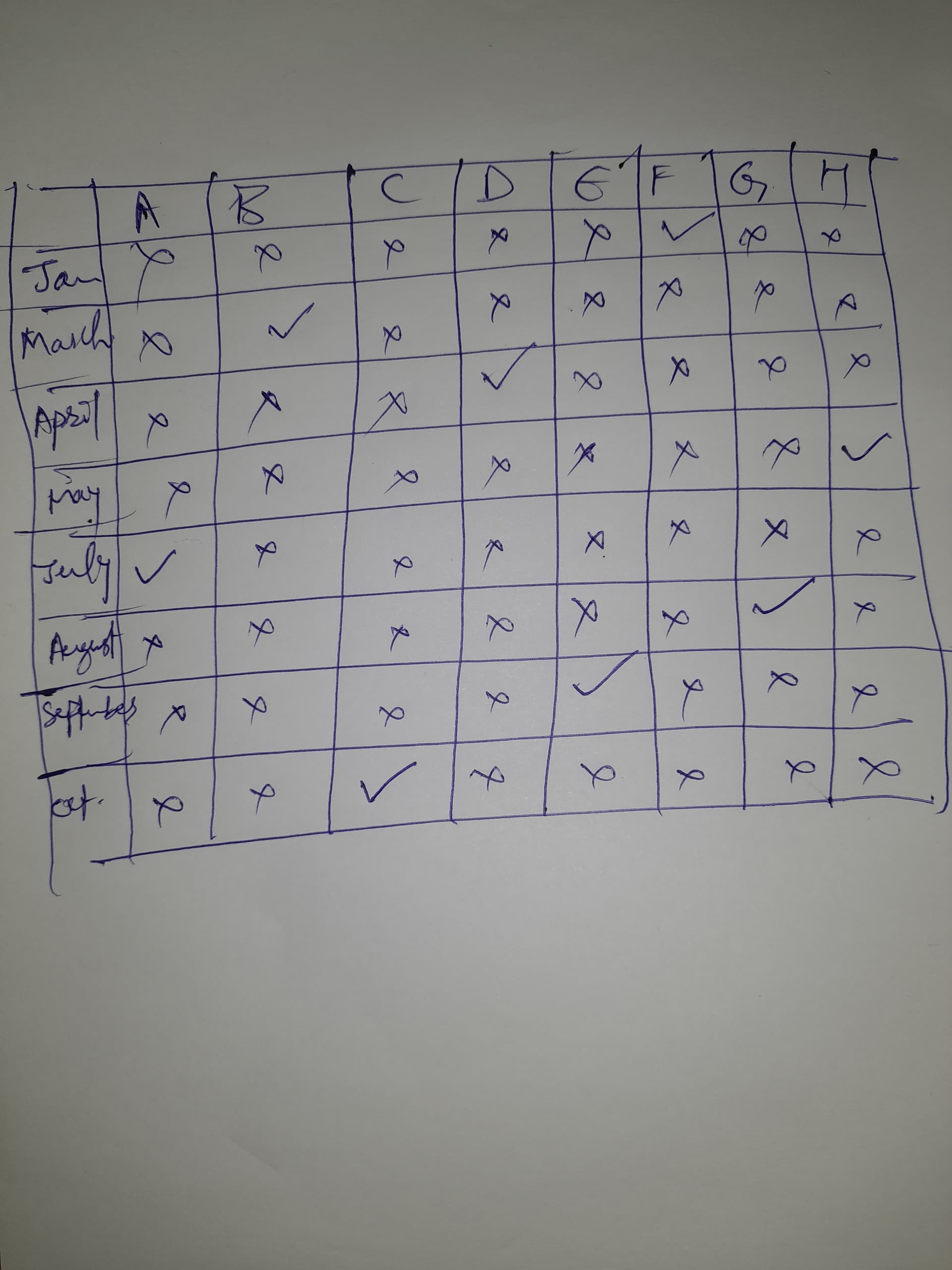
Eight people A, B, C, D, E, F, G, and H are going to attend meetings in the eight different months viz.January, March, April, May, July, August, September and October but not necessarily in the same order. No one will attend the meeting after C. D attends the meeting in the month which has 30 days but before August. B attends the meeting in the month after F. H attends the meeting in the month before the person who attends the meeting in the July. Neither G nor E attends the meeting in the month of July. B and F both attend the meeting in the months before May. E attends the meeting in the 3rd month after the month in which H attends.
There are total of 3 people will attend the meeting after A. (G, E & C.)
First I wrote all months list vertically and all candidates list horizontally.
Step 0 :
And I know which month have how many days so let’s fill it for info otherwise you can do it in mind.
Jan (31) - F (first step - point 3)
Mar (31) - B (first step - point 3)
Apr (30) - D (first step - point 2)
May (31) - H (first step - point 4) July (31) - A (final step)
Aug (31) - G (first step - point 5)
Sep (30) - E (first step - point 5)
Oct (31) - C (first step - point 1)
Step 1:
Follow all points
1• No one will attend the meeting after C, so no more thinking just put C at the last month.
2• D attends the meeting in the month which has 30 days but before August
There are only 2 month which have 30 days here and because it’s said before august so answer is april, so here put D on the month april.
3• B attends the meeting in the month after F (now here we will fastly look, Is there anywhere again B or F mentioned .)
And here we got another info for them. B and F both attend the meeting in the months before May
So F will come first and B will comes after it (there is only 2 month left before may , so you know where the candidate will go)
4•H attends the meeting in the month before the person who attends the meeting in the July
There is only 1 month left which is before july and no one went there yet.
So H => may
5 •Neither G nor E attends the meeting in the month of July. (When we look at our candidate list now, there are only 3 people left A, E, G obviously in the beginning we look what we need to find so they will not tell the position of A. So we only need to focus on E & G.
We are now looking at another info, where E or G is mentioned E attends the meeting in the 3rd month after the month in which H attends
Now we know E attends the meeting in the 3rd month after H.
So E => Sept.
And G => Aug. (Because G didn’t attend July)
Final step : Now only 1 month left and that’s july. So put A will there.
Now we know there are 3 people A, E & G will attend the meeting after A.
You are such a nice guy and helped me a lot. I was finding unique solution. You here in art of memory gave me the best solution I need. Thanks a lot brother. Thank you
I found another way,
Its almost like a Sudoku…i hope u have solved a sudoku before…
I felt it like a sudoku kind situation so i designed one
Make a 9 x 9 table.
Write names in first row and first column so that we still have 8 rows and 8 columns left for analysis.
Use pencil and eraser preferably.
Analyse the text and put a tick mark in the solution.
Simultaneously put a cross sign in the solved column and row as its not possible to have another allocation in the same row or column.
For texts like “B & F both attend in the month before May” we can put cross marks in the month of may and the months after it…it will limit the possibility to the months before may, means jan, march, april…
And this will make it all more visual and clear.
This same method can be applied to the other question also that u had asked
"Twelve persons M, N, O, P, Q, R, S, T, U, V, W, and X live on different floors of a 12-floor building but not necessary in the same order. "
Here u will have to make a 13x 13 table…all else remains same.
Can you calculate faster ? Your name @ramanujansri suggests that you are a math lover. I need help with fast calculation. I know vedic math. Can memory systems can improve calculation?
More Puzzle : Floor Based Puzzle with three variables ( Floor, Person and Color )
Seven persons live on different floors of a building having seven floors where lowermost floor is numbered as 1 and topmost floor is numbered as 7. They like different colours- Blue, Pink, Black, Purple, Green, Yellow, and White (but not necessarily in the same order).
P likes Pink and lives on an even numbered floor but not more than two people live below P. V lives on 5th floor and does not like Yellow. T likes Black and lives on one of the odd numbered floors above the one who likes Blue. Q likes Purple. R lives just above U who likes Green. S likes White and lives below P.
Q1. Who among the following likes Blue?
(a) Q
(b) P
(c) V
(d) S
(e) None of these
Q2. Who among the following lives just below the one who likes Yellow?
(a) U
(b) S
(c) The one who likes Green
(d) Both (a) and (c)
(e) None of these
Q3. R lives on which of the following floor?
(a) 3rd
(b) 4th
(c) 5th
(d) 7th
(e) None of these
Q4. How many persons live between Q and P?
(a) Three
(b) Two
(c) One
(d) Four
(e) None of these
Q5. Who among the following lives just above V?
(a) T
(b) S
(c) P
(d) Q
(e) None of these
Memory techniques are not useful for most types of calculation—whether we’re talking about everyday calculation or for competing in e.g. the Mental Calculation World Cup.
One important thing I work on when coaching mental maths to adults is to have a rapid knowledge of mathematical facts (like times tables, but also e.g. complements, fractions, etc.) Some people might find memory techniques useful for those, but I find anything more than the occasional mnemonic to be a distraction, as you need more efficient recall during calculations.
The most important things in general are:
knowing mathematical facts
knowing efficient methods
practice using visual working memory for handling numbers
If you’re doing most calculations, you’re just using working memory (RAM), which can hold 5–10 digits, depending how you’re using it.
If you need more than that, you probably need a better method. For example, to solve 73568319 × 28843245, you never need to store more than 5 digits if using cross-multiplication.
In some extreme cases, like verbally solving seventy-three million, five hundred and sixty-eight thousand, three hundred and nineteen times twenty-eight million, eight hundred and forty-three thousand, two hundred and forty-five, you would need something similar to a memory palace in order to solve it. However, this type of calculation is not as useful as the other types that people practise.

 .)
.)