Please suggest ANY other memorization technique. I cannot make memory palace images to save my life!

I have to memorize 15 different subjects. All of them involving a combination of numbers and concepts.

I did try to create my own memory palaces and peg system. I set numbers like this:
1 V
2 I
3 B
4 G
5 Y
6 O
7 R
8 8) glass emoji
9 N
0 @

But it is so complicated to combine them together. I have to memorize laws. It goes like this:

Section 100: HEADING: (1) Law here
(a) part 1
(b) part 2
(c) part 3
(2) Law here
(A) sub part 1
(B) sub part 2
(3) Law here
Clause 1
Clause 2
Exception 1
Exception 2
Exception 3
Illustrations:
1
2
3
4
5

That’s only one section!
Then goes:

Section 101: Law here… and same as above.

As you can see this is extremely complicated. Memory champions use memory palaces but they only have to memorize numbers, pie numbers, names, faces, etc. But what about heavy concepts as I mention above?

My outcome: I’ve read that most of the people don’t follow memory palaces because they can’t make images or stick to them. Yes, that’s the most exhaustive part. That’s why I don’t want to do this too. Rather than memorizing law, I’ll keep making images only! Plus, I have to memorize the law verbatim, so story making won’t do.

My current routine: Well, I don’t have any routine. I rely on the cramming and rote memorization. With rote memorization, sometimes I can see the pages in memory. But that’s about it. Law has neither diagrams nor visuals. It cant be visualized.

Cons of rote memorization: 1) time consuming (but every memory technique consumes time, doesn’t it?)
2) THIS IS IMPORTANT: it’s easy/interesting when I rote memorize in one round. But revision gets boring. I never revise, consequently I forget it all! I’ll rote memorize something but revision is daunting and horrifying.

My questions: 1) Please suggest ANY technique other than memory palaces to memorize such massive data.
2) Why do I not like to revise after rote memorization? There must be some science behind this.
2 Likes

Agree with user_7e. Pushing yourself like that is counterproductive. Once your brain is tired it’s not learning much. And if you continue to press, you develop a bad association and your brain is wired to get rid of unpleasant memories.

I learning habits, physical or mental, 15 mins a day is better than solid training.

It takes time to develop these techniques and it takes work, which is why most people quit. You seem to have taken on a full size practice for your

Much harder to absorb unprocessed or meaningless information especially in large volumes. Memory palaces by themselves serve to jog you memory but you can’t expect them to encode text or involved techical details by themselves. Find some way to engage with the material. To make it more interesting and less abstract.

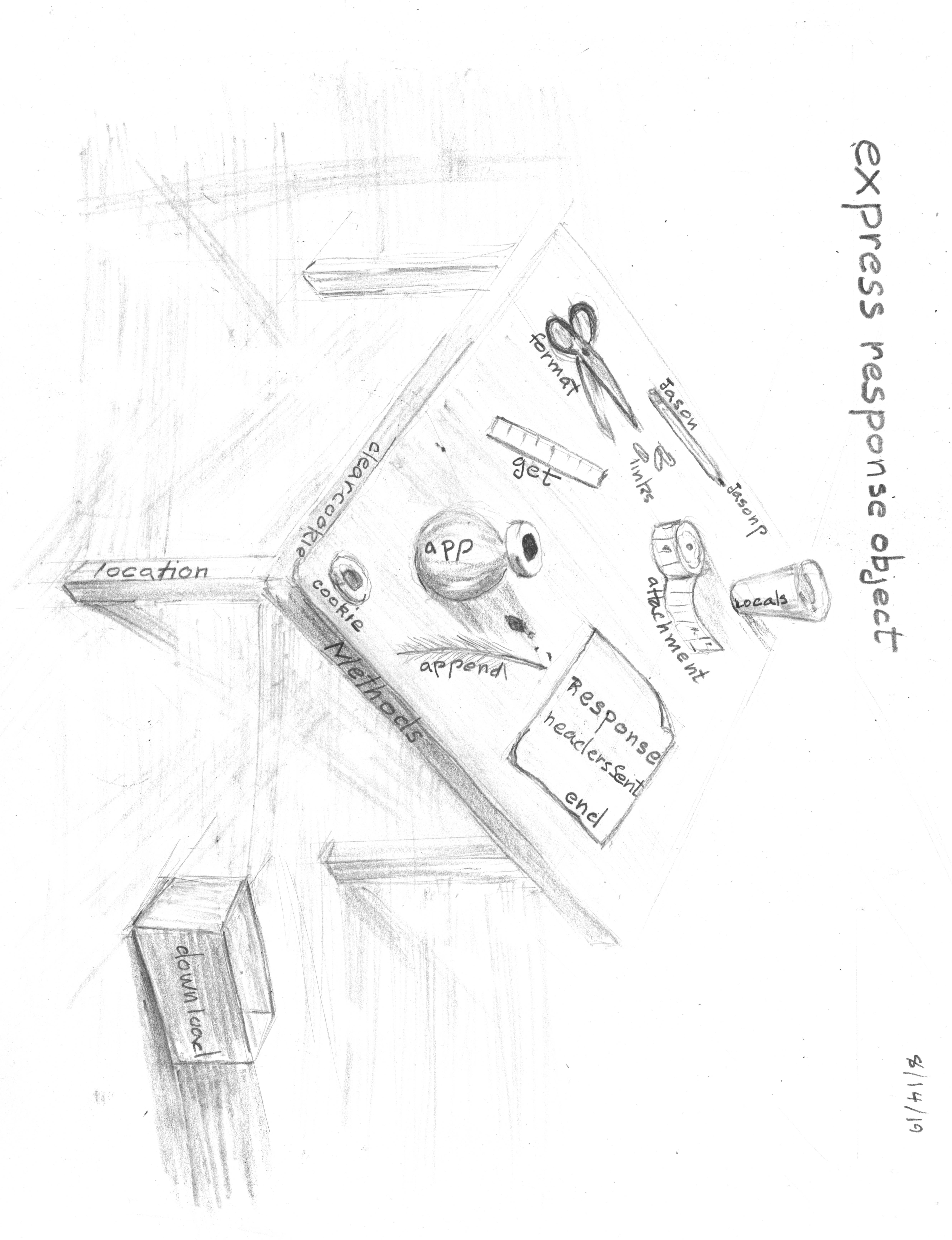
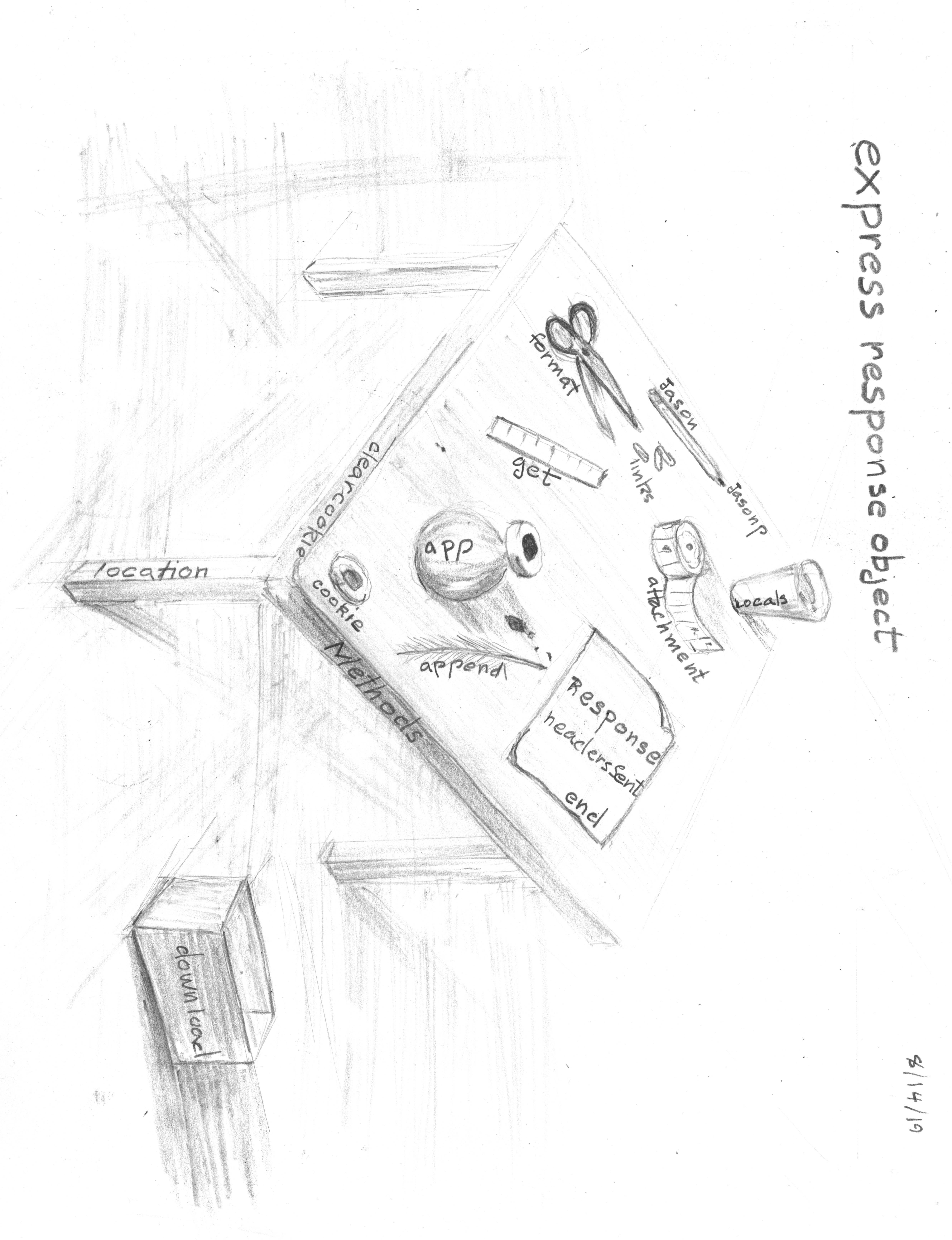
I have to take in a lot of software documentation. I turn the abstractions into thing, animals, buildings, whatever and draw pictures and write notes on each picture element. Perhaps, make Mind Map out of it but invest more in the elements than just colored circles.

A journey can serve as a memory palace. Is there a hike or route you travell routinely and know well? Identify locations along the way and use those to store memories. A 50 locus memory palace is well beyond my range but I can easily do 50 locii on a hike.!

Here’s something I drew up to collect all the parts associated with the response object. Most people would add some color. It’s not art. It’s cartoons. You can cut and paste online images if you liked. It takes time, but when I’m done, I have the material.

expressResponse|383x500

3 Likes

I love your drawings and the way you work your images to encode even the most abstract!!! I would love you one day there would be a thread for your drawings!!!

1 Like

Thank you for your kind words!

I enjoy drawing, which is why I use this technique. It doesn’t feel like work. And I enjoy spending time with them when they are done - this is important. But I’m a bodger and I really don’t think they are worth displaying as drawings. I showed a couple as an example of how one might develop a private language.

I wish you success in your project. It would be good to hear how it goes and what progress you are able to make. I’m a big believer in the principle that everyone’s mind is different and you have to invest some time investigating what your mind likes to hold onto and how it does it.

1 Like

Sometimes I feel like I’m cheating. Perhaps I don’t really have a strong natural facility for abstract things. I think, most naturally, I am a craftsman. I love to make things and think about their design. But I was born into a family of intellectuals, educated to be one and did spend my career doing things like math. Not much money in woodwork. My technique has always been to give some physical form to abstractions which allows me to mentally handle these things in a way that feels comfortable, perhaps like chess pieces. I’ve been faking it all my life :slight_smile:

1 Like

The folks where I work specifically told me DON’T MEMORIZE THE REGULATIONS! Now, about thirty years later, they ask me for help when they can’t find a particular law or reg. No, I did not try to memorize laws, but when I learned how some of them came to be written it made them a natural part of a story. When I studied accounting, the fellow who taught Income Tax Law during evening classes would tell us why a particular tax law was written or why it was better than an alternative.

My “any other” method is to embrace the story where the solution or conclusion of the story is that regulation or law. I suppose it helps that I can mentally see portions of the page where I saw the citation number written, but if you can mentally hear your voice reciting or mentally feel your hand writing, those are just as good as mentally seeing (probably).

4 Likes