Was that created by Vaughn? Is it the same as the diagram I posted on this card memorization tutorial?
Hey nice blog post Josh! Ya it looks very similar! Personally, I’m getting a little bored with just using cube rooms. I’m graduating to complex polyhedrons! haha
1 Like
That’s a very interesting idea. I was working on something related, but didn’t think to apply it to positions in a room.
A dodecahedron would provide 20 points in a room. It has 12 faces, so that would be two faces per face of the room (a cube).
Or it might be easier to visualize the cube (room) inside of the dodecahedron like this:
Then the locations would be the corners, with two locations on each cube-face.
I wonder if the imaginary faces of the dodecahedron could also be transformed into locations.
It would probably work with other polyhedra too.
1 Like
Exactly! The effectiveness of using polyhedrons can only be utilized, however, if the mnemonist pre-determines a sequence, just like a journey/memory palace, and if prior knowledge is attached to these abstract faces. For me, I like to add phonetic “major” system number images to each in sequence, and then “jump” through that face into another room that is themed with that one image everywhere. Then I walk around the room sequentially to store and retrieve ideas, while also still seeing the theme of the room everywhere: for example, I’ve been memorizing the periodic table of elements, and when I get to the fifth place on my wall (I’m just using the cube room for this), I see an owl (5) open the little door, peak out it’s head as it wears sunglasses (chemical element 5, Boron, and B symbol looks like sideways sunglasses), then I jump into that room and see a giant owl with little owls everywhere. I have memorized a few more things about each element, so it would be tedious to explain the rest here, but the main idea is that using this artificial memory palace, and a sequence with a theme, one can memorize large amounts of knowledge.
The Vaughn Cube comes from Dean Vaughn. He has a decent book on memory. Has a bunch of interesting ideas for making grids, links, memorizing spatial relationships, etc.
1 Like
Nice! Thanks for the information jmsmall! I didn’t know about Dean Vaughn until you mentioned him.
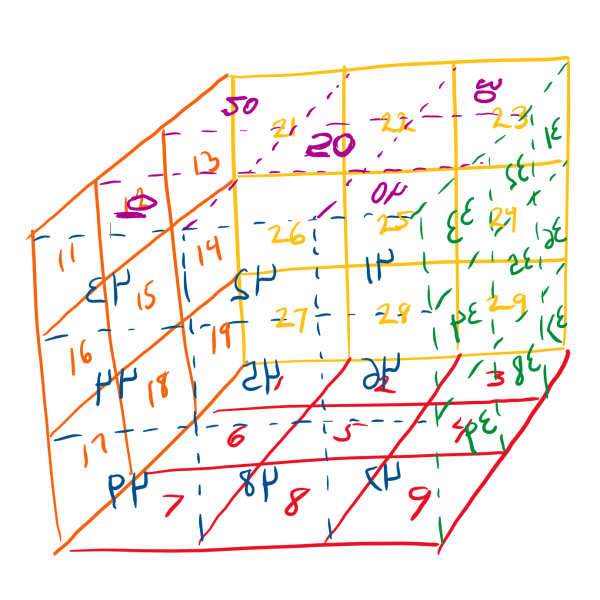
I’m thinking it makes more sense to modify the Feinaigle numbering in this way so that the 3s and 4s are next to each other and the 6s and 7s are next to each other. I also moved the 10s over one spot so that they touch the 11s. This way there can be a more fluid journey through the squares without as much jumping.
Am I correct that less jumping is better for a memory journey? It seems to be for me anyway…
1 Like
Superb idea, Slate! Yes indeed the need for speed in a mental journey is a most sumptuous thing. Great insight, if I might highlight your foresight - with memory and might! 
Hi Mnemon,
I’m sorry, but I’m having difficulty understanding this method because of the older type of speech in the book (I’m also pretty new to mnemonics).
Does every wall have a key image for every slot? Or is it a key image for every different room?
I just read through more of Feinaigle’s book. He made some very interesting suggestions for how to build artificial memory rooms for learning geography (being inside a cubic map as opposed to outside), history, language and other subjects.
Regarding the basic memory room, you’ll see the sketch in Post 10 that gives the numbering. Now refer to the following image which is one of the illustrations given in Feinaigle’s book. It’s of the first 50 of his 100 peg images which is maybe what you’re referring to as a key image.
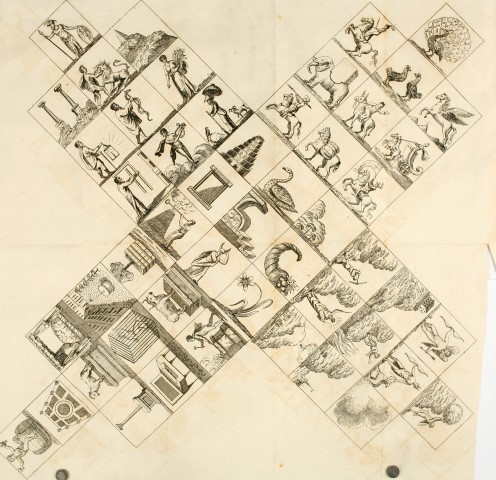
This is a 2D illustration of a 3D cube, so you have to envision folding it up into a cube. You’ll see in the “first place,” as Feinaigle calls it, there is a Tower of Babel which is his image for the number 1. In the “second place” to its right is an image of a Swan which is his image for the number 2. You proceed in this manner through all the images on the floor and then to 10 on the ceiling above the left wall, followed by 11-19 on the left wall and so on.
Now in practice of using these Feinaigle rooms you can put whatever images you need at each place or locus instead of those number images, because the location itself tells you what the number order is. If you place an interesting image of something you want to remember in the lower-right corner of the floor, that is always location 9. The middle of the wall to your left is 15, the upper-left of the wall ahead of you is 21, and so on. So peg images / number images are not necessary at all in these artificial memory rooms except when used to encode numbers that are part of the content being memorized.
I’ve suggested in this thread using nested iterations of these Feinaigle rooms, which allows you to take up to 50 of these Feinaigle rooms and place them in the same numbering order for quick encoding and retrieval of information. By nesting Feinaigle arrangements inside of Feinaigle arrangements, any size of memory palace, for a few up to thousands of loci, can be quickly constructed.
2 Likes
Thank you for answering! What results have you had using this?
You’re welcome. I can’t speak too much for results yet as I’ve mostly been experimenting with possible variations of this concept to see what I like best.
At this point I wouldn’t recommend the approach for just starting with the method of loci because it has some challenges, namely since the rooms are artificial they don’t have many pre-defined characteristics or furniture like rooms of your house.
But for very large undertakings like what I intend to do with the text of the Bible I need in the range of 31,000 loci, and it can become time-consuming and somewhat haphazard to come up with enough real-life places to accommodate that number. This nested Feinaigle method allows me to put that many loci in a surprisingly compact format that is all coherent and easily navigable. After I have a better idea of how well this method works in practice I’ll report back here on the forum.
1 Like
Hey Slate. I’ve been busy working lately, but it looks like you are still going strong on this  I’m glad to see it. I just formed a local memory/mnemonics society and will be teaching this Feinaigle system as well. Let us know in a few weeks or months how that Bible memorization is coming along.
Hello, all!
I apologize for my layman question but; How do you actually manage to use the method of feinagle? My difficulties are as follows;
My biggest problem with this method; How do you keep yourself from confusing your feinagle rooms? By their very nature, they all look the same.
I really want to use this method because, theoretically, it sounds superb. but I cant wrap my head around how practically I could make use of it because of what I described above.
I would be immensly grateful for an explanation+a couple of exambles where you make up a feinagle room from scratch, how you enter it, how you “see” your stored information there (from which point of view etc) and how you discern which item was in which spot of the 9-grid, because, like the feinagle room itself, each spot of the 9-grid itself on the wall is similar to every single other spot.
Hey that sounds good! Thanks for your interest, I’m making good progress on the concept of nested cube rooms with consistent loci numbering.
When nesting rooms inside of rooms I was finding the ceiling loci to be a real challenge, so I’ve decided to put the 10s on the top row of the walls.
Then I needed a good way to deal with the 4th wall (the 40s numbers) so as not to completely close off the room. The solution I like best is to use columns. The columns allow a view into the room, while also being aesthetically pleasing and an homage to the Greeks (who are known for their columns!) who pioneered the Method of Loci. Columns or Grid Floors also provide access into secondary rooms when they are needed.
The order of loci is still something I’m working on… top contenders are:
- Vertical numbering (shown in the pictures below)
- Horizontal Journey numbering (left-to-right, right-to-left, and left-to-right again) which makes for less jumps
- Horizontal numbering (as in Feinaigle’s original concept)
We all know here that pictures are worth thousands of words, so maybe this will give you an idea of how I envision the nested cube rooms as a memory palace.
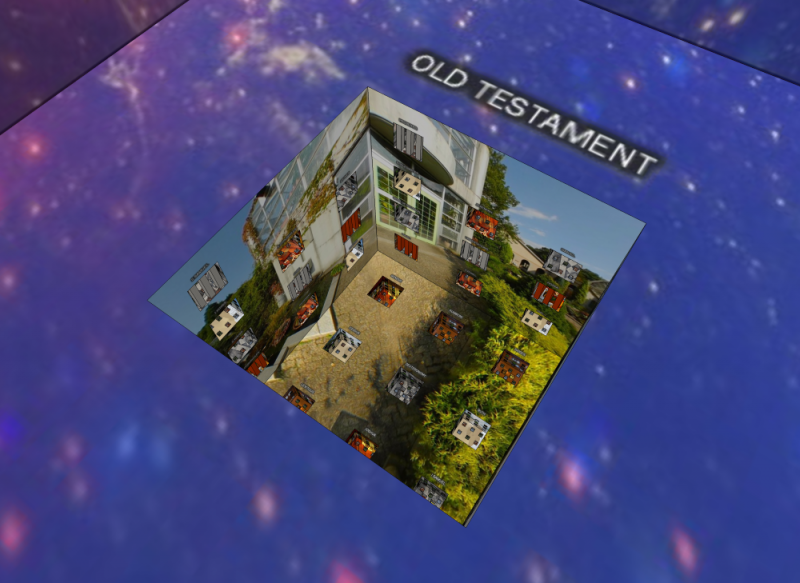
View of the Old Testament and its 39 books from inside the largest room:
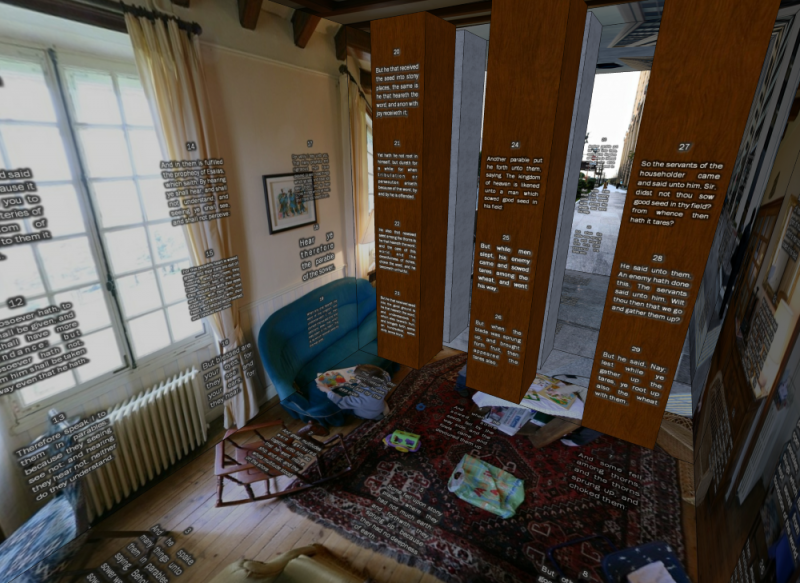
View of loci containing text inside the smallest of rooms, representing a single chapter:
1 Like
I should add that I don’t just read the text, but I actively visualize the events of the text taking place at the location of the words. In this way the words themselves become sub-loci of the numbered loci.
3 Likes
Hello and thanks for the answer slate. Do I understand correctly that you use one giant “feinagle room” (picture 1) that connects your other feinagle rooms together(picture 2)?
This is an awesome idea. I think you combined gavinos massive memory palace with it.
However one question arises for me. Do I understand correctly that you use real locations as feinagle rooms?
Yes, the first picture is inside the largest Feinaigle-type room viewing locus #1. That locus is actually a room for the Old Testament, which contains 39 ordered “Book” rooms (Genesis, Exodus, Leviticus, etc.) at their appropriate locations. Do you see those tiny squares inside the bigger squares of the Old Testament? Those are chapter rooms like in the second picture. With the dimensions I’m using, every ‘parent cube’ is 8 times wider than it’s child cube. So if that chapter room is 10 feet wide, the book room that contains it is 80 feet wide, and the testament room that contains it is 640 feet wide–over 2 football fields! So it is a very large palace, yet infinitely expandable in either direction using the same rules.
Thanks! I’m pretty excited about it too. I’m not too familiar with gavino’s method so I just looked it up. I see there are some similarities and that he talks about nested palaces. The main differences I see are that gavino’s method is a way of linking existing memory palaces, whereas this is creating a totally artificial structure. There is certainly benefit to being more intimately familiar with the palaces being used, whereas this approach is kind of theoretical yet until I can use it long enough to report results. What I like best is that it is very orderly and easy to construct, so I can focus on the content of what I’m studying and how the content itself creates a unique web of information in 3D space (based on where it is placed).
If you are constructing such a palace solely in your mind you could definitely use real locations, more like what gavino does. My interest is in creating these palaces programmatically and using 360-degree panoramas (called cubemaps when projected onto the surface of a cube) and textures to differentiate the rooms. I could use my own 360 photos, but on the other hand I may not be familiar at all with the panorama backgrounds being used. But over time I’ll become acquainted with their subject matter which will act as anchor-points for the loci. The same way in which playing a video game enables me to recreate the map and levels later in my mind, I hope an extended amount of flying around inside my virtual memory palace will allow me to ‘see’ it when I don’t have the aid of a computer.
Oh, NOW I GET IT. Your idea is very nice!
You use a program to convert 360 panorama pictures to cubemaps, then add in 9 “locis” to each wall. I think using feinaigles rooms in conjunction with an external 3d software makes it an extremely potent tool indeed. One has to wonder how vivid and strong Feinaigles imagination (and that of his contemporaries) was, that they could easily use this technique without external help tho.
Im sorry for bugging you with yet another question;
which program do you use to convert pictures to cubemaps? I think it must be sketchup but I’m asking to be sure 
Well the part about nesting rooms inside of rooms is something that I incorporated into the Feinaigle concept, so I’m not sure he ever did anything like that (which increases the scale many-fold), or at least I didn’t read anything about such nesting in his book. I think it would be possible to do it all in one’s head, but much faster with the aid of 3D software.
Yes I’m using SketchUp. The pictures I posted are of a concept model, not the actual memory palace with complete text. The complete memory palace will be able to be generated once the code is in place to do so. In the design phase I’ve just been using an online converter to convert 360 panoramas into 6 cube faces.