Pegs vs Loci: Quantification

Regardless of mechanism, if the loci method really is inherently superior to more generalized pegs, it should be possible to measure.

I did a small literature review that some may find useful and might spur some discussion.

article 1
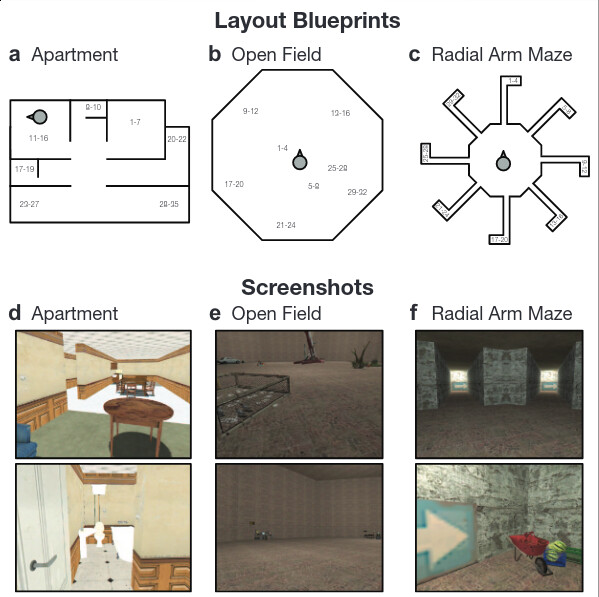
the authors teach volunteers one of the listed layouts, arguing that the open field/radial arm maze environments are not suited for imagined navigation and as such should perform worse if the navigational aspect of the method of loci is important.

Each arm of e. g. the maze has a peg object.
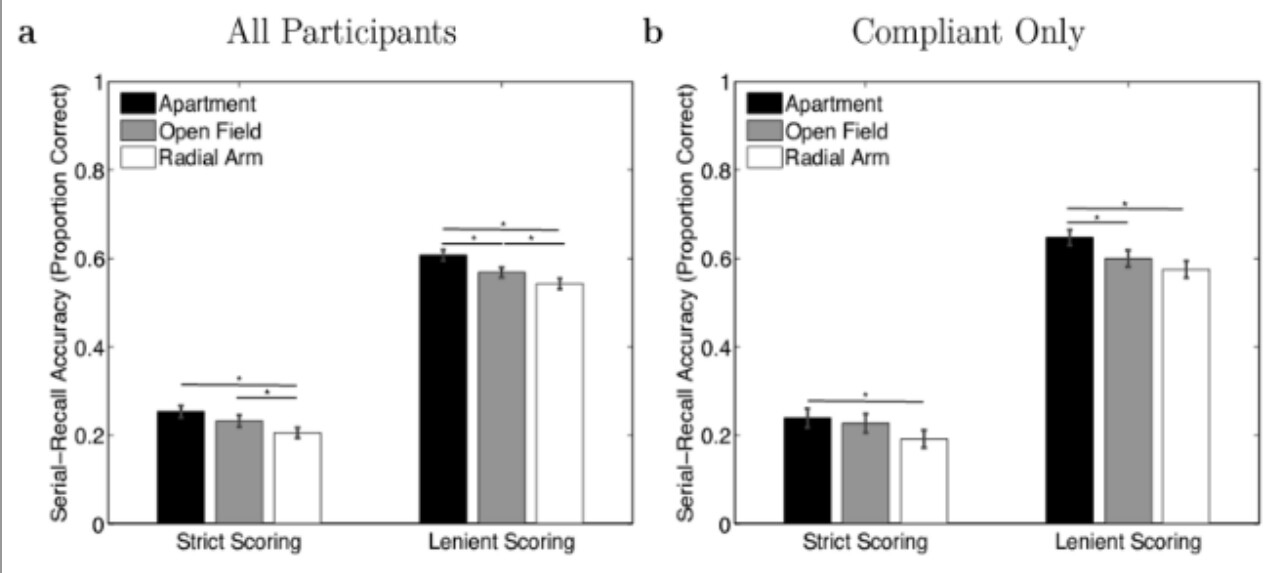

as can be seen, the methods more similar to generalized pegs do perform worse. The authors, however, argue, that it’s an insignificant difference.
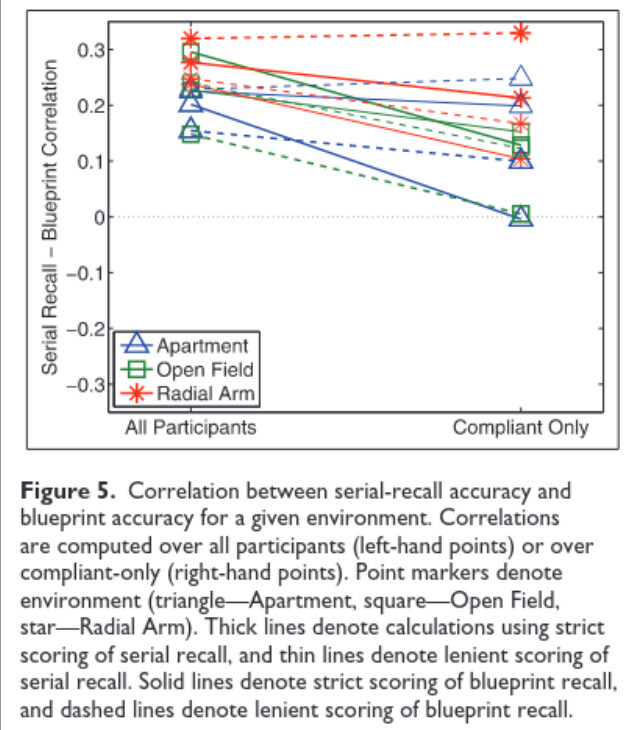

here it can also be seen that there is a positive correlation between poor learning of the environment and poor recall, which might explain the entire difference as just “not remembering the pegs as well”, potentially.

article 2

http://psychnet.wustl.edu/memory/wp-content/uploads/2018/04/Roediger-1980_JEPHLM.pdf
they instruct people on specific memory techniques, and the subjects are made to practice them on their own at home.
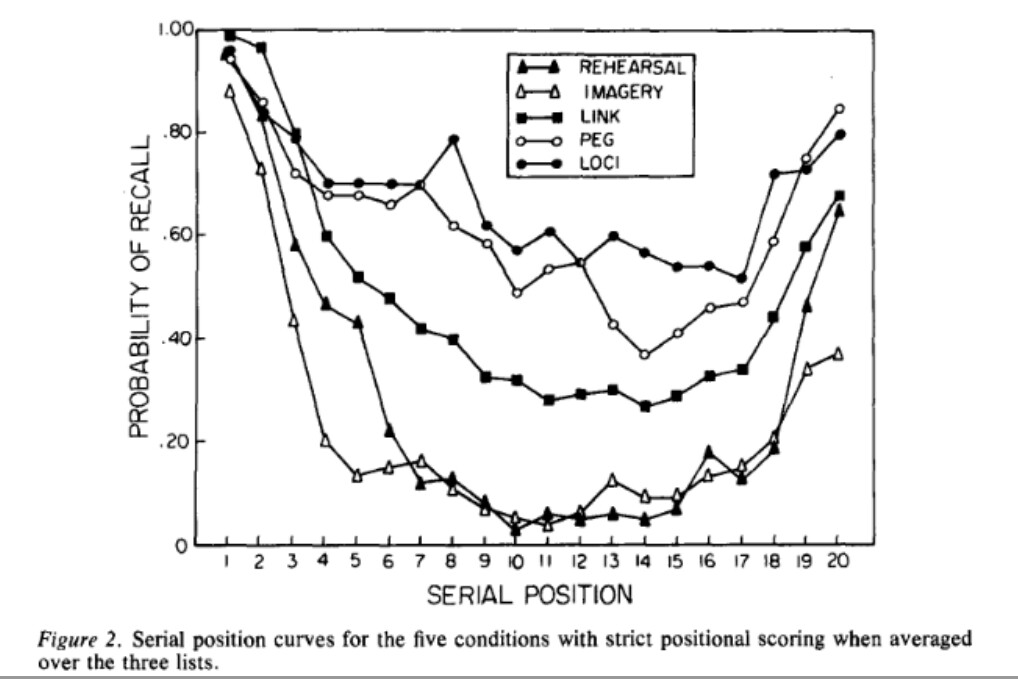

here, once again, the loci method stands as the clear winner, with pegs as a close second. However, the results are close (especially in other parts of the article, such as with lenient scoring).

article 3

they compare loci with their own devised “attach things to the steps of making a sandwich” or “attach steps to your life events”.
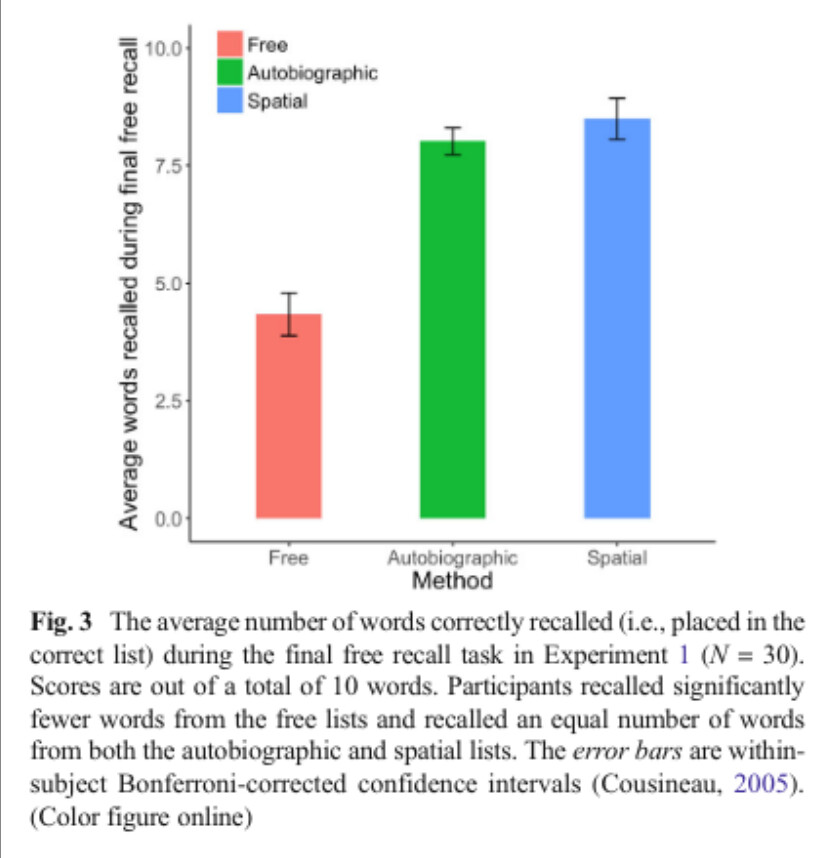
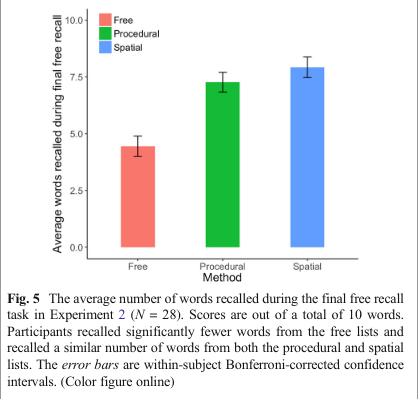
They find the other methods, which are similar to peg methods, perform well, but slightly more poorly, than loci

my impression

The differences in the papers are all relatively consistent - pegs work only slightly worse than loci, but the difference is there. However, I wonder how much of it is because of unfamiliarity with the various pegging methodologies. Noone needs to learn the environment of their living room, and learning a virtual, natural-like environment is surprisingly
easy. However, learning peg lists is significantly harder. I wish there was an article that standardized the recall of the peg list first against the loci method. I did not read the articles in full, but it appears noone has done it.
Because of this, I’m not sure if the difference between the researchers’ measurements is not solely due to the volunteers having more trouble remembering the peg list itself. The first article also hints at this with the positive correlation between poor learning of the ‘environment’ (for the peg list) and poor recall.

So I’m wondering - do you guys quantize your performance on these various techniques? Do you do 50 runs with one method, 50 with another, and then measure the differences? Would anyone be willing to share some real data? Thanks.

related posts

5 Likes

I can’t say that I have undertaken any scientific experimentation to compare pegs to loci systems. That being said, I have always found ‘loci’ to my mind to be a little more at a disadvantage to ‘peg words’ for the simple reason that ‘pegs’ usually have a more definite natural sequence to them than loci. I have for instance played around with Major system peg words 00 - 99 as well as a Dominic System’s PAOL which yields 4 sets of independant peg lists for 00 - 99, being P = People, A = Action, O = Object and L = Location. The beauty, well at least to my mind is I don’t need for instance to retrace my footsteps to get to peg #36 in my Dominic System’s PAOL as I instantly know that #36 is Colonel Sanders (KFC fame). The same can’t be said using a system of loci. Using loci does not give users that ‘advantage’! But I suppose the next logical question to be asked is: “What are you using your mnemonic system of pegs or loci for?” If for instance one wanted to remember a Tamariz stack (What magicians would know to be a deck that is apparently in no preconceived order (like a Sti-Stebbins deck would be), then using a peg system would be preferential to using a system of loci, as the magician needs to be familiar with both what card is in each position of the deck 1 - 52 as well as what card is located in a given position. To illustrate for the magician using a Tamariz stack it is both important for him to know that the Queen of Spades is in the 48th postion and the 48th position contains the Queen of Spades. On the other hand, I don’t think people engaged in memory competitions that are given 1000’s of numbers to recall are particularly phased by what number falls in position 278 say. I am guessing they would be using similar systems to PAO and are placing their stories for say each group of 6 numbers at one particular locus, they need only run in a forward direction from one loci to their next and need be only able to regurgitate their ‘learnt numbers’ in that particular type of order. I know many mnemonists will shoot me down in placing peg method above loci method but that’s just my particular take on things. I am not a competitor in memory competitions so it would be best to get first hand experiences from both memory competitors and their coaches to get a more balanced opinion. But opinion are opinions and what I’ve given you is my opinion for its worth?

1 Like

Places and nouns are the same thing in memory. The real is captured by the external eye, while the imaginary resides in the internal eye of imagination. Everything in the imagination can be amplified, modified, and multiplied beyond any number.

Orientation, places, and pegs held by memory are part of imagination and are not real. Objects also have depth, space, and a body, just like places, and can be inspected by the internal eye in three dimensions.

Places are very useful for memorizing large amounts of information due to the structure they can provide. To deny their usefulness is like saying “fruit is better than the tree”; one cannot exist without the other.

A place can also be modified, named, numbered, divided, ordered, sequenced, etc. It provides spatial orientation that pegs cannot provide. In a single place, a vast amount of information can be stored if you know how to modify and amplify the places, something that the ancients did not believe was possible, but methods for achieving it do exist.

2 Likes

I’m always confused as to why people speak of “retracing your footsteps” or needing to “teleport” or “create portals” or… I never go in the linear way in my memory palaces (unless I’m in the process of building it, or revising, in which case I want to go through it linearly, to be sure I didn’t forget any info). Basically I just think about the locus and I’m there, no need to “follow the path”…
A peg list may be learnt differently at first, but you’re still navigating it (because things are in a certain order), so honestly in the end, it’s basically the same.
Or am I missing something?

2 Likes

The difference between using objects alone or with places is the same as you just said, when you inscribe signs, images or shapes in a place to mean words, when they are inscribed you will not need to see the objects in the places but the words will come by themselves to your mind, and you will feel that your mind wanders in those places, and the difference will be in the background that you used and nothing can stop you to modify the places as well as the subjects, there are also ways to multiply the same place and subject, to make it really universal, but it would lengthen the simple comment.

1 Like

There are definitely still advantages to a peg list such as the ability to directly be able to retrieve #34 or #36 as @fred2 mentioned. So I wouldn’t say it is one or the other.

That’s the point I don’t understand. I don’t see why retrieval in memory palace is less direct than a peg list. Just think about the object/place and you’re there. It feels different, but why should a memory palace be slower?

You can, if you wish so, go through a memory palace linearly, but you don’t have to (that’s the whole point of knowing the loci well… if you’re forced to follow the path until you reach the locus, instead of being there instantly, it’s probable that you don’t really know the place well enough… (?)

1 Like

I think it’s referring to the idea that if you have a peg list that maps to numbers you can instantly access the 327th thing in your list by just jumping to the “MoNK” and recalling what’s linked.

If you have a journey with 1000 loci, it can be more difficult to directly jump to loci 327, unless you’ve structured the path and areas carefully so that you can nest down to 3rd general area representing hundreds → 2nd sub area representing tens → 7th individual loci.

In terms of navigating along the route, yes the “travel” can be instantaneous and so can pulling up the loci detail, but in terms of specific numbered recall, it seems to be a bit easier with a list.

You can always get the best of both worlds by integrating a number peg object or person into each loci!

2 Likes

Then we may be using memory palaces differently or for different things. In practice I’ll never think: “I need to go to station 31 of memory palace X” what would I need that for? (I mean sure some people may ask that kind of question for fun, but it seems kind of useless)

I think “what did the verbe arkeo mean”? And I see the image and I’m there. And then another vocab word. Not sure why jumping from one image to another should be longer than jumping from one number to another.

1 Like

Tim you’ve hit the nail on the head there. Exactly my point, if I need to know what element sits in the periodic table as an example at # 84th position (which happens to be Polonium) then the in Major System for 84 = “FuR” would take you there. Your image may be a Polo Horse (for Polonium) or even a roll of “Polony” (for Polonium) either of which could be dressed up in “Fur” and problem solved. If you have a memory palace that merely consists of loci, do you know which loci is in position #84? That’s the advantage a peg system has over a memory palace. But then again if you are remembering a thousand digits of Pi (Circumference of Circle divided by the Diameter) is it really necessary to know what the 84th digit of Pi is ‘as a stand-alone figure’, I very much doubt it! So its horses for courses or systems ‘fit-for-purpose’ that trumps all else!

1 Like

Well it’s interesting anyway to see the differences.

I can create a brand new 500 loci journey through a memory palace in under an hour

I admit I’m interested in that because my memory palace “creation” is very slow. Once it’s there, it’s solid and very easy to navigate, but it takes me a while to put everything into place. But maybe I’m too much of a perfectionist.

Poetic

1 Like

Thanks a lot for the great replies.

“Why use pegs instead of loci” - As others said, it feels like pegs support ‘random’ or indexed access better (@fred2’s example of periodic table is great).

However, considering everything, it does seem like @TheHumanTim’s suggestion of integrating pegs into loci might be the superior choice for indexed information, considering the facts that:

  1. loci MIGHT increase recall compared to pegs (the research above)
  2. a locus-based system is easier to come up with and learn than pegs.
  3. having everything in loci makes spaced repetition way easier.

The only concern is whether finding things by index then will be particularly slow - can you imagine the peg and find the location immediately, or do you have to go through the palace until you find the peg you’re looking for?

People mention ease with which you can “jump” to a location, but that is not the same as “jumping” to the place an object is - or is it? I’m not sure. Just playing around in my mind, it seems easy to jump to an object’s location - but I’m currently experimenting without pegs. I can imagine pegged locations to be more difficult, as the pegs are probably reused then elsewhere, which might make the picture more muddy.

If it’s true that access is just as fast in an indexed palace, there really isn’t much of an advantage to peg lists. The only remaining use-case I can think of is if you have a very large amount of multiply indexed information - say, you need 100k loci. Then I guess you might want to create them in some sort of grid/sem3 method - but the efficiency of those is still unclear to me, I’ll write a thread on my review of the method soon, but so far seems noone really uses it, maybe 1 guy.

This is interesting. I think if grids/SEM3 does not work, basic peg lists are probably… just inferior. I’ll be happy hear evidence to the contrary.

Cheers!

I think that the sem3 method is badly elaborated, because of the desperate effort to create something new and to multiply even more the retentive faculty.

The places should be quick to memorize, besides the places as well as the subjects are simulacra of the real, not something real, in question could be multiplied by the faculty of memory, there are scientific studies that talk about how the new places in the brain acquire priority in its retention by the hippocampus, the change of context, the people who were there, the objects that were there, etc., if something of the context changes it will be a different place although its real space is the same.

I should really throw a wrench in here and see what happens. My analysis shows that loci are pegs.

Basic peg qualities are well-known visual cues and ordered by a rule for forward and backwards traversal. A bestiary, ten items starting with an initial based on the Major system, or unique locations found by following a path are all pegs by that definition. Pegs are not random access so all lists must be traversed from a known peg to where you want to go.

The one thing that does get you random access of sorts is when you double up your pegs so that your item keywords are following a rule of digit conversion to Major system so that the order is not just the Major system but extended to all integers of a certain length. That’s @TheHumanTim’s idea. And composing two peg lists like he said is a good but slower solution. I’ve created a “palace” of numerically coded locations so that I know by the initial consonant that the garage is in the 70s and the attic is in the 10s.

The SEM3 or whatever geometric layout you use is just a rule you follow around to different locations. It’s inferior because it doesn’t have any detail associated with it unless you apply it to an existing location making it more of a template or abstract system than a concrete peg system.
I find it interesting that Harry Lorayne used a grid system based on two peg systems. A number peg was for x coordinates and an alphabet peg was for y coordinates. You still need to convert that pair to a visual keyword though.

I am of the opinion that locations are stronger than using items or subjects as pegs and it is for that reason that they’ve taken on separate names. Locations are just easier to review as you walk along their path and take little design time. Items and subjects tend to be virtual lists but don’t have to be as a lukasa shows.

I couldn’t find any research that said that the location datatype was stronger than other datatypes nor the MoL system was better than something else. I think it’s based on more of the convenience of learning and using it.

Doug

Did you read my first post? It contains the research you could not find. The results are pretty clear - the loci method is always slightly superior to regular pegs. Or are you saying you don’t like the research?

@ink,

OK, let’s look at the studies.

Effectiveness of the method of loci is only minimally related to factors that should influence imagined navigation

This confirms my analysis that the MoL is a variant of a peg system using locational cues and a necessary traversal (navigational) method. Scenarios tested were only locational but couldn’t conclude any relationship to thinking by location.

The Effectiveness of Four Mnemonics in Ordering Recall

Imagery (associations), the link method (story), a peg system (item or subject pegs), or the method of loci (terrain pegs) were compared. All types of peg systems performed similarly. The visual imagery associated with the responses were better than non-visual cues and bizarre imagery was not important (another of my beliefs that has pushback here). A story was only good because of the visual imagery in free recall. The ordered item pegs showed that people needed to know the system better to have an advantage over the story. Items placed in an English sentence (similar to my visual sentence SEA-IT system) produced results much like interactive associations. The study left ordered recall out of the picture, the main advantage of peg systems and found that they all improved free recall. They decided that creativity was important for an efficient system.

Temporal encoding strategies result in boosts to final free recall performance comparable to spatial ones

This one pins the effectiveness of the MoL on our brain’s design. (Lynne Kelly is working on a gene-based foundation of the locational peg system’s effectiveness.) But the main point that’s interesting here is the peg system that is based on actions, not discussed as far as I know on the forum here, but brought up as an option in my analysis. The action pegs are called a temporal system, having actions performed over time, as opposed to a locational system. Action pegs were found to be as effective as a terrain peg (MoL).


So, my conclusion is that the results are murky. The MoL has shown to be slightly better in one case but not anything to brag about in these studies. In truth, I think that the subjects are all newbies and have a hard time applying the technique since it’s more of the visualization that they need to apply rather than the MoL technique. They have to practice more I think and spend a few months on the Art of Memory forum.

Doug

Don’t read the authors’ conclusions. Look at their results. Collectively, it is clear that the loci always outperforms - but yes, it might be because the people involved in the studies are not good enough at the pegs.

2 Likes

@ink, I have to admit I didn’t fully look at the evidence. But even though I ready your first post more thoroughly, it still isn’t that clear cut of a conclusion. Locational pegs are physical and others aren’t which I think is the main difference as well as agreeing with your note about the subjects not learning them well.

I would have to learn a subject, an action, an item, and a terrain peg system equally well for me to start collecting data about how they are able to retrieve information better or faster. I haven’t done that yet and I doubt if I will. There’s just too much to do out there. But keep asking the questions, they are good ones. And the studies are good sources of info which I appreciate.

Doug

2 Likes