Objects, 2 in 1 and combination questions

hi all.

I am new to this forum - hello. i have read a lot of the posts from @Rajadodve786 and find them to be very interesting particularly about using objects.

i am trying to build up my levels on memory league and use memory technique in work

some questions -

1 when people pick objects for their list, do you pick every day objects? to experiment i can visualise in my mind up to about 5 or 6 objects all nested together. eg i can visualise a cup, a bowl, a banana, a carrot and a cigaratte all together, perhaps sitting on a mat. and i can then add to that, or i can sometimes imagine them in a row left to right. but it is much harder for me to visualise all my objects / images from my current system list.

2 the really fast memory atheltes talking about combining the images and condensing them. if my two images are cup and cigarette, i can easily see that in one image. but do really fast memory athletes see the object together in their mind, and then merge that into the object? Or do they do them 1 at a time, but super fast. i am wondering if there is then merit in picking objects that more easily combine

3 i do find 2 in 1 to be a bit harder than 1 in 1. i am just starting out and trying to pick out what are the best images for me.

4 people who favour objects - do you have any people and actions? or just really easy and meaningful ones? like one image might be surfer, it is a person but its also easy to visualise.

i really love just putting flashing numbers on and letting the images float into your mind - its like a meditation but highly stimulating!

here is a really nice article by a 30 sec card memoriser - Is the PAO system superior to 2in1? - How to memorize playing cards from the perspective of the PAOO system development history -|平田直也
1 Like

Thank you for sharing this article, it is amazing! It helped me to fix my experimental card system.

  1. Yes, sometimes I pick everyday objects. But I can visualise everyday objects and exotic objects equally easy.
    Maybe some images are hard for you to visualise because you try to keep too many details. When you practice memorisation with your system, your images naturally change little by little. Tiny details blend, but the most important detail becomes more pronounced. As a result, images become easier to visualise.
  2. I think it is not about merging into one object, but more about creating two objects simultaneously. These objects are not necessary merged into one solid thing. They are just connected as usual. If you are using 2 in 1 for cards you become familiar with some 2-card combinations. When you see this combination again you instantly imagine the whole scene. You recall this familiar scene as fast as you recall an image in your system.
    So it is not one object “cup made of cigarettes” (sometimes you can do this connection but it is not necessary). It is two objects created simultaneously: “cup is pierced by cigarette”.
  3. Don’t spend more then a week searching for better images without starting training the system. You can start training before your system is fully completed and just come up with some images on the fly. Remember that you can always change the images later, so they don’t need to be perfect right now.
  4. I favour objects. And when I use characters, I use just easy and meaningful characters. 30% Of my numbers system is professions (like king or cook), animals and animation characters. And only two images are real people.

Flashing information was really enjoyable to memorise for me lately, but i haven’t thought to memorise it regularly with online apps. Thank you for the idea!
Good luck with your memory journey, waverider!

1 Like

thanks for the write back, i really appreciate it.

you make an observation i have learned in my admittedly very much beginning steps in this. you kind of make your images into things that are easier to visualise. and i am sure this will change a lot over time. for example, my current 6S image is sash. originally i imagined a lovely blue sash just sort of doing nothing drapped on a woman (just a non exotic image). now i kind of imagine a whirlwind of spinning blue going like a tornado, and i dont imagine the woman

this is my first card system but originally i had a few people in it, which i had kind of imagined them doing things or with objects. eg an old judge. i was always imaginging him in the location needing peace and quiet to write his judgements. but i also know he always wore a bowler hat, so now i just focus on that. and its much easier to imagine me putting the bowler hat onto the location rather than him trying to sit there and write his judgement and being sad its noisy. another card image was a swimmer who won a medal at the olympics, but now i just imagine there shiny white goggles.

thank you again so much for your write back. i will keep these tips in mind as i try to improve my speed and have fun with this!

the author has good articles on other topics as well, but i have not read the other articles as well. Naoya Hirata is his name

1 Like

just one more thing on objects. when you actually read the harry lorrayne peg lists, most of these are all objects as well. only a very small number are people or actions. so he must have figured out earlier on that objects are easier to picture and visualise, rather than action or people. just a thought i had about one of the memory writers i have read.

for reference

Answers

1 I think you are attempting something unnecessary here. I almost never have to picture more than 5 things in a memory. Most mnemonists would see that as too taxing. If you have a lot of “things” there are two approaches-

They can exist in a chain- one linked to the next with or without loci. And you cannot reference them “all at once”

They can be indexed- any are accessible from some sort of system. They are then effectively able to be viewed “all at once” because of the level of orientation gained by indexing.

Most athletes dont index. Its slower. But if you were trying to memorize mnemonica stack for instance you might want an index.

If u connect letters to their respective numbers you have created an alphanumeric index. Now u know what number is which without starting at one end or the other- this is the general idea.
If an index is necessary for you, you probably want a way to connect numbers to your memorized content- with a loci system or number system this is achieved.

Loci is used most- each room is numbered or some sort of hierarchy is made.
I prefer my weird number system i just posted about.
Some people might use PAO or peg.

The ultimate goal in my opinion is to gain ORIENTATION. I do this mostly by applying geometry to my loci map.

2

This is compression. Its used when things like in your first question happen and is the basis for most mnemonic systems.

To answer you- it depends. If the thing is going to be compressed (which will require imaginal generation and work) keep it simple.

There is a contradiction here though, in that you can make something very complex but you cannot reference every complexity in the same way you cannot see all your items in number 1. This means no matter what- expect only the basic essence of whatever you are compressing to survive transformation. The scales can have engravings but it wont be there when the scales are a teeter toter in a different loci.

3 the ultimate goal is always one consolidated image. And then to chain them together by placing them in the same area or otherwise interacting.

Two things should be individual- ie- person and object- or setting and thing- not a carrot and a rock

Its good and strengthening to be able to hold multiple things, but it is not the goal for retention- successful compression that can be translated and recalled quickly is.

4
Check out my number system post for how I run it. Using people settings and objects. There is compression and pegs and imaginal generation. I tried to limit the amount of each

Good luck! You’re asking the right questions!

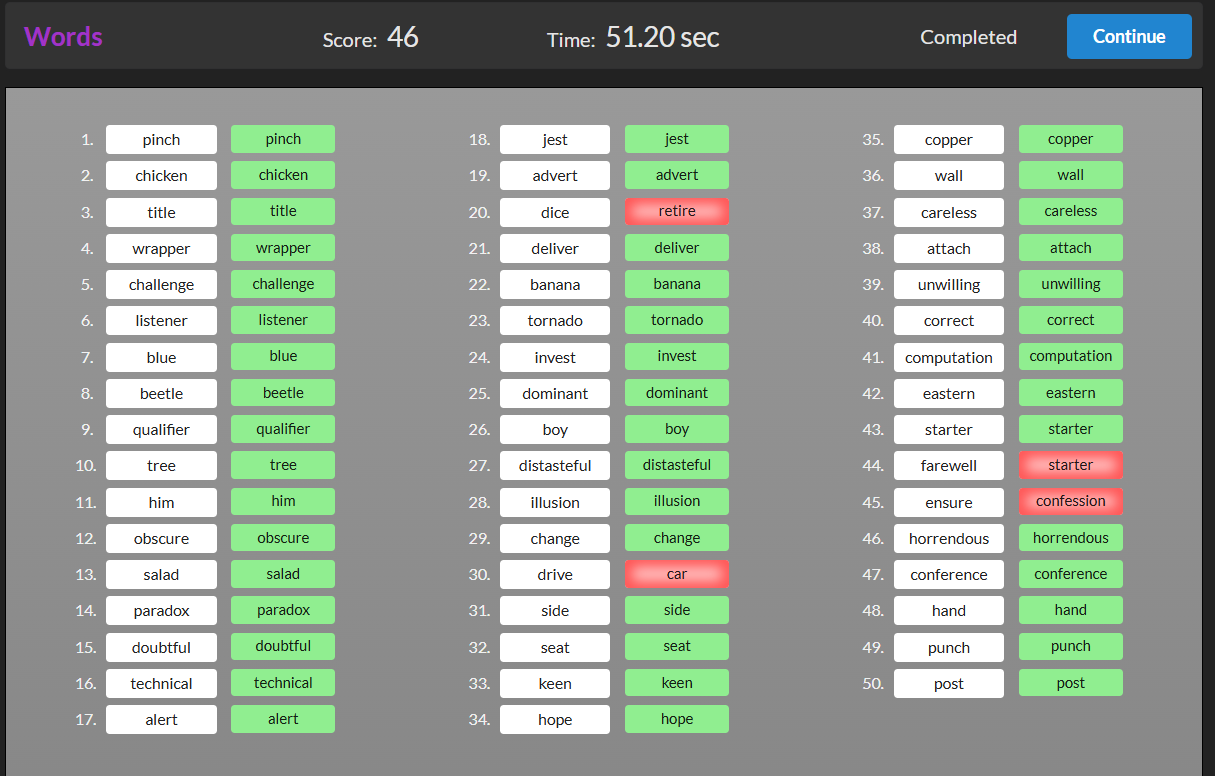
This is my best score on mem league with 1 word per location, although I have not got 30 images below 45 ever.

People all have very different ways of thinking and what comes easy to them. As while this is not a lights out score, its not a bad score.

I do have some people in my locations just naturally the way the journeys flow. Some of these help with visualising some words. Take for example the word ‘qualifier’ - I imagined a front desk person (which was where my journey was up to) as a qualifier for the world cup. But that isn’t a picture, I just imagined them sort of cheering and standing up.

I like reading all the posts on this forum, particularly where people who are good at Words explain the way they approach the other set disciplines.

Getting a ‘Diamond’ (a perfect score on one of the games) will be a nice feeling. Hopefully that happens for me one day.

3 Likes

well done brother. car and drive is where I’d be kicking myself hahahaha

2 Likes

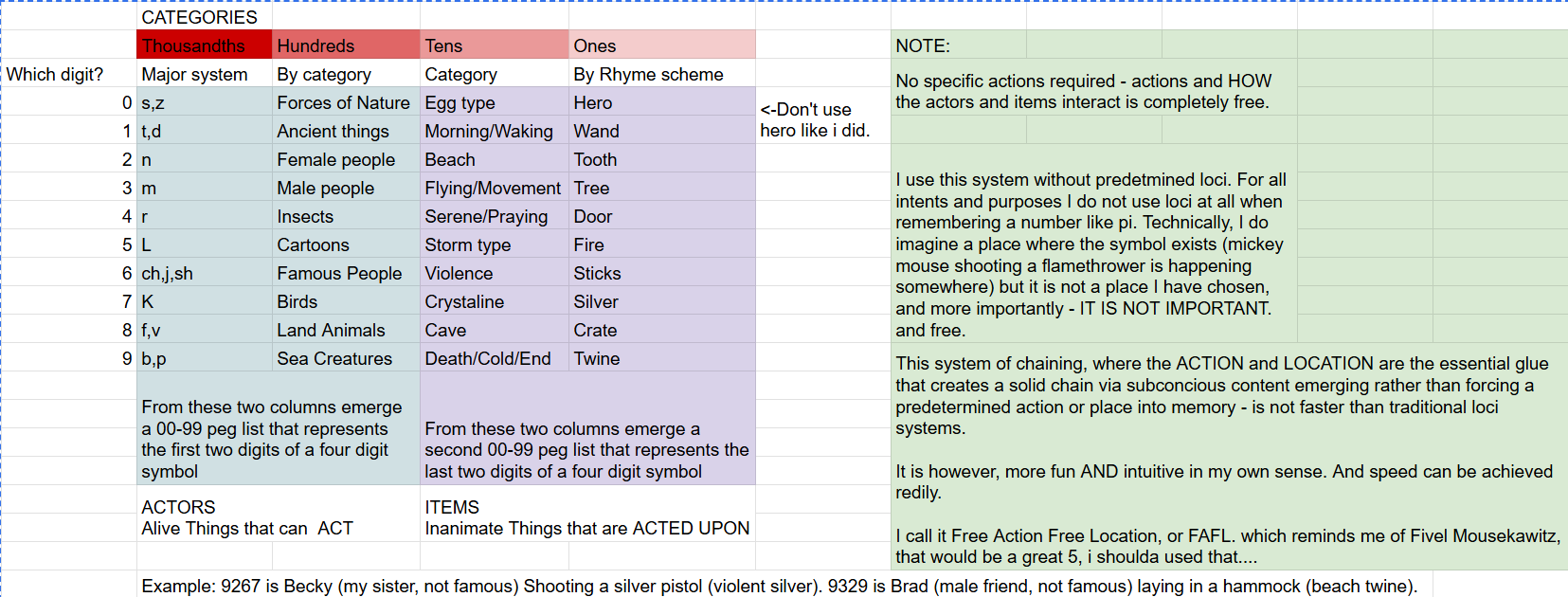
Posting as an example of my homebuilt system

3 Likes

Interesting, I am considering trying one image element per location for speed memorization, I just thought of this very recently. It’s nice to see that it’s quite efficient, I think with two elements, I was focusing on linking the objects rather than attaching to the location?:thinking:.

Of course my PAO will still require me staying for some time in a location and linking elements to each other instead of to location​:upside_down_face:. I hope to ‘run away’ from my PAO to a three-digit system as soon as possible as I made some mistakes that I believe are seriously slowing me down such as :
  1. Using actions not matching with objects (requiring another object or not being performed on the object for that number), for example: my 67 is Young Sheldon, Action: dragging a rope to ring a bell, Object: Suitcase.
  2. Changing images after having practised for a long period of time, I think anyone who has changed a large number of images in their system can tell how bad it can be. The old images just keep coming up.

indeed - I am one of those people who won’t start using until it is refined multiple times.

i know this is my final version because I can not compress it further and I have no more hiccups.

PAO I for whatever couldn’t do because of the strict action use. I need freedom within the interaction to really make the images stick together.

one image per loci is how most mnemonists do it, that is a good approach.

1 Like

Sharing in case anyone cares (other than me…)

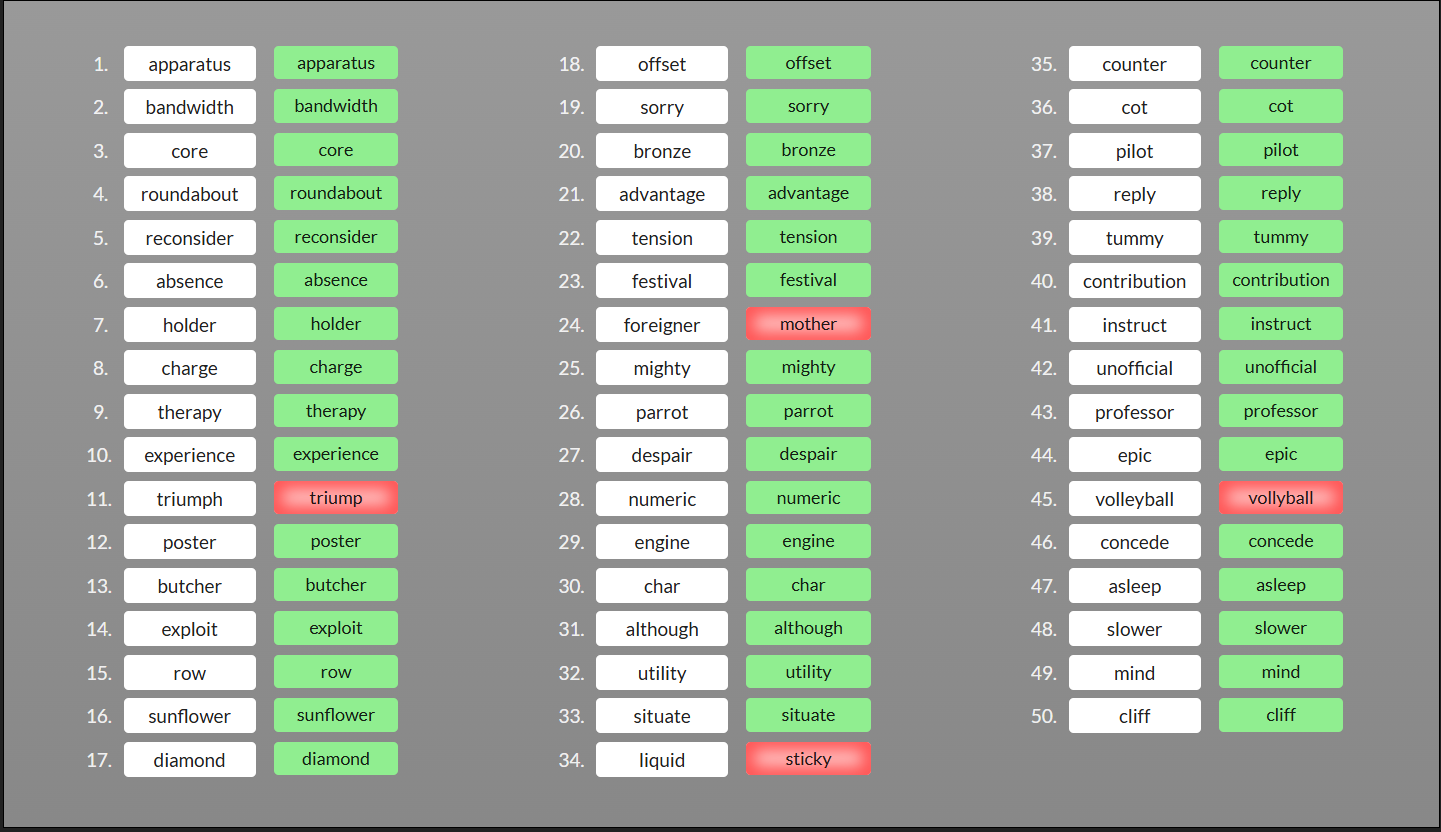
Got another 46 and my mistakes are very funny this time :slight_smile: I used a palace that goes through my office with a few different people and finishes at a restaurant near by, 1 word per location for the win.

been training at around 40 seconds, to make 55 seconds feel slow.

I feel that a lot of people use 2 images per location including for words but i find this very challenging to do, and not as accurate for me. Like how do you keep it accurate and not get swaps… or just forget the less dominant word?!

1 word per location requires me to think less, and not even really think of anything (and many of the words are not in pictures). The word ‘although’ was at a pedestrian crossing, and my association was, oh that is a hard association to make, although and pedestrian crossing? I’ve got nothing! but I remembered it fine.

For numbers and cards I am now using PO to deal with the order issues I was having and its been a lot of fun to learn to have both person and objects. Was inspired by the 2 digit users that are top of memory league that use PA / PO / OO - if you know you know!

1 Like

Nice score, I am back to 2 words per location now (I don’t waste time in changing my mind​:joy:). I get your point about one word per location but when I tried it, it seemed that I was spending too little time in a location therefore making recall more difficult but the memorization is so smooth.
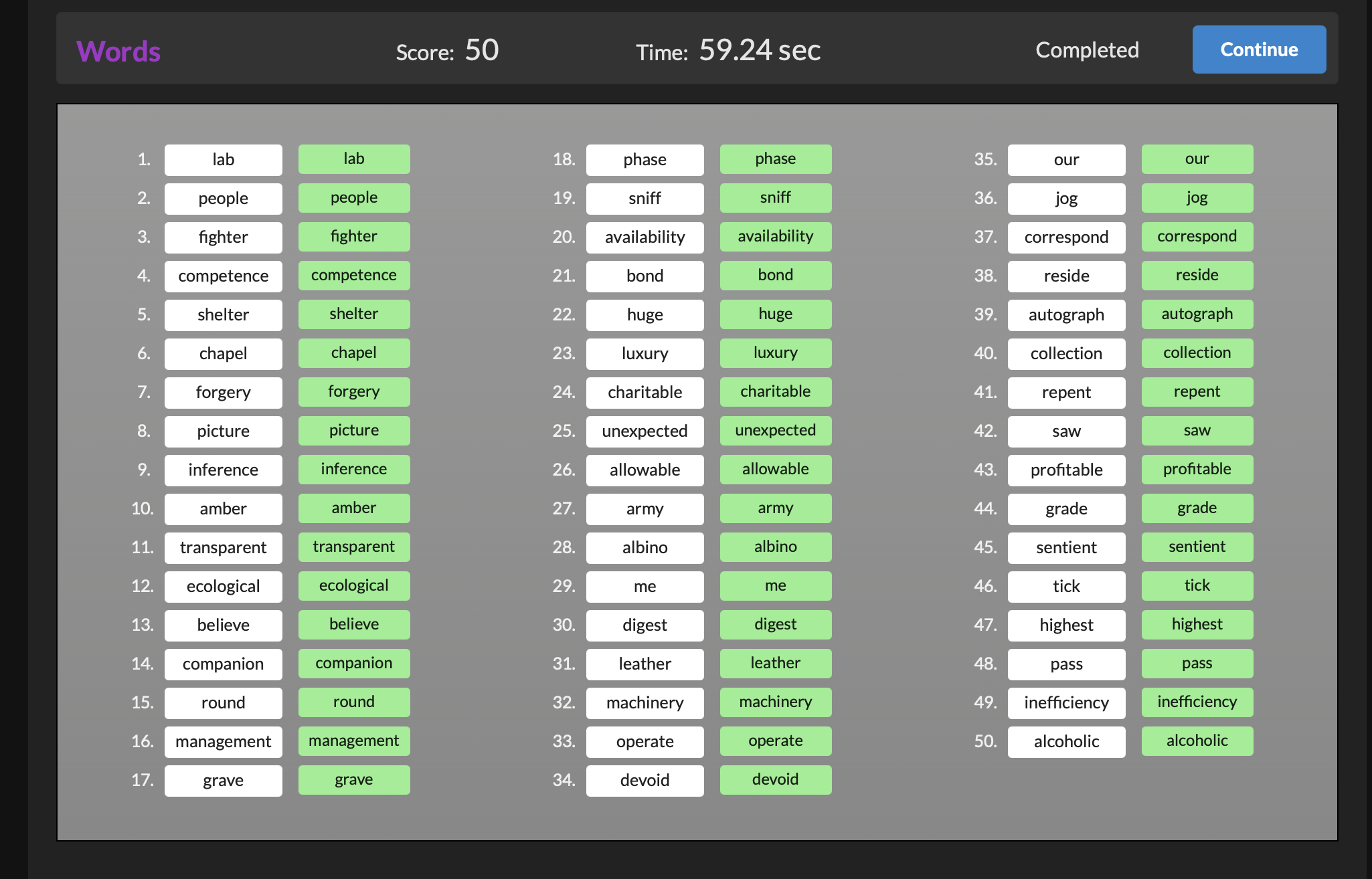
Another reason to consider two or more words per location will be to save space (not necessarily during training but for school lists?:thinking:, they’re so many that one word per location will feel wasteful).

My present best with two words per location are: 24/30 in 60 seconds, 10/10 in 10 seconds, 13/15 in 10 seconds. I think I stopped the clock before the time elapsed in some of these, but the only one for which I can remember the accurate time is the 10 words in 7.26 seconds.

P.S: I grab 6 words​:upside_down_face:.

1 Like

2 also makes a lot of sense because sometimes the words really naturally go together, if its an adjective and a verb! 2 words per location means you only have to make smaller palaces as well. 13/15 in 10 seconds is awesome. I havent done any sprints at like 15-20 seconds yet, youve given me a good idea to play with later. Less need to use up all my locations as well :slight_smile:

1 Like

I can only grab 4. I ALWAYS get words mixed up if i try to grab more than 4.

1 Like