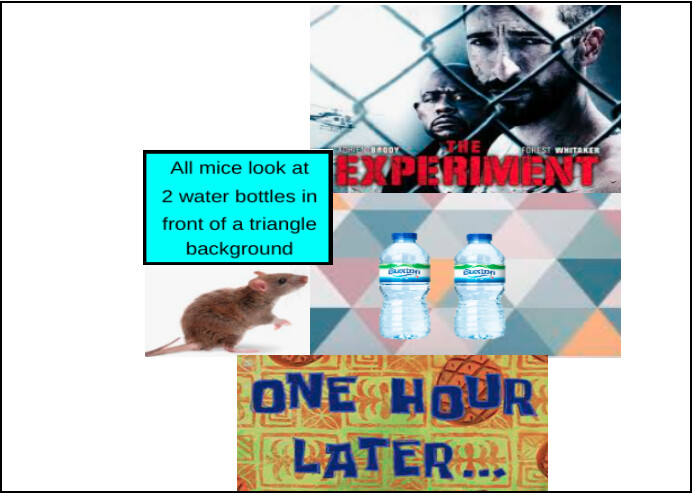
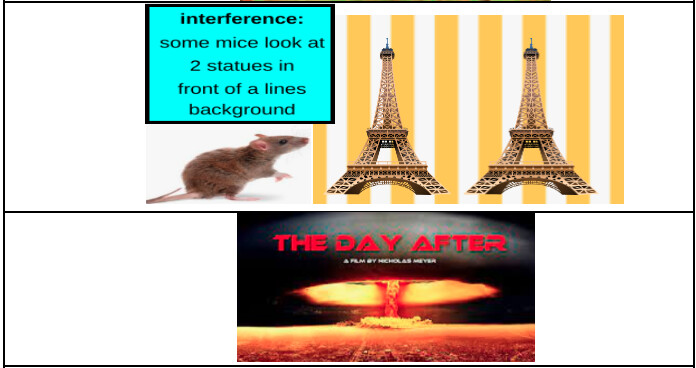
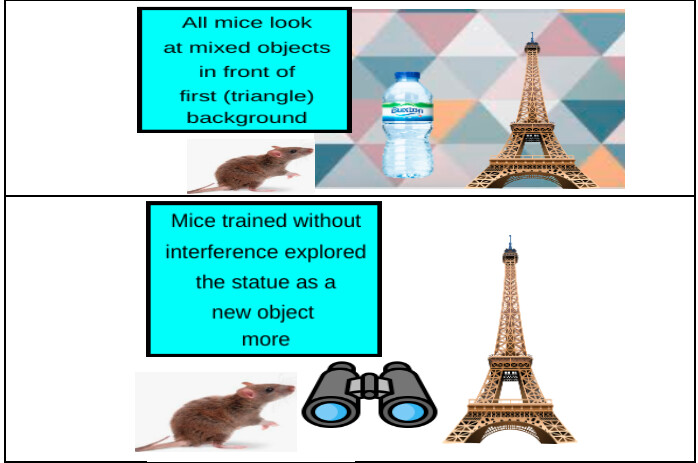
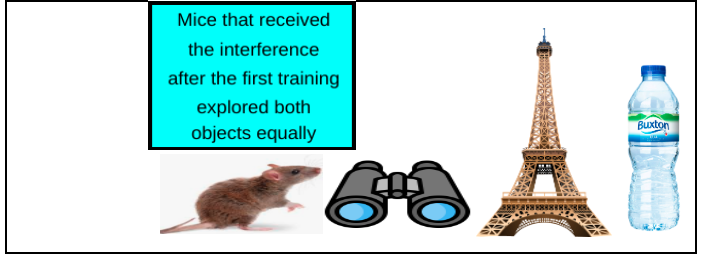
While forgetting is commonly considered a deficit of memory function due to its association with pathological states, an alternative emerging perspective considers forgetting as an adaptive function of the brain that may contribute to learning and memory updating. Recent findings suggest that forgetting is an active process that involves new plasticity that modulates the functionality of specific memory traces in order to promote adaptive behavior.
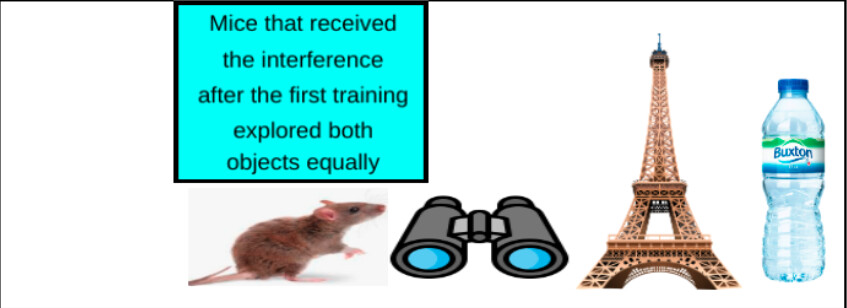
Based on the article I made an infographic. In my view there are so many variables that I don’t see how they can come to any kind of conclusion depending just on the behaviour of the mice. It’s not even clear to me what they were expecting the mice to do that saw both “water bottle and triangles” and “statue and stripes” if they hadn’t had any memory loss as a result of the interference.
Here’s a good quote from one of the researchers in that article:
". . . even when a memory is forgotten, … it’s actually still there; it’s not actually gone,” said Jacob Berry, a neurobiologist at the University of Alberta who was not involved in the study. “It’s almost like it gets demoted by the interference to a dormant stage. And then they show pretty elegantly that in that stage, they’re able to either update, or they can actually rescue or revive, the memory.”
… somehow proving that there was memory loss in that group of mice?
". . . even when a memory is forgotten, … it’s actually still there
This sounds like a gross overgeneralization to me. I mean the experiment involves a short term objects and backgrounds test with mice; who knows how much of human forgetting can actually be attributed to this mechanism of “forgetting”. And I am still not convinced they even proved there was any type of forgetting in the actual experiment.
Having said that, if the researchers are correct that sometimes memories become dormant but remain complete, that may have implications for how to (re)learn things more effectively. An interesting idea (if true) is that possibly everything we experience is recorded but most of it is in a dormant state. If you can then find a way to prevent the dormant state or reverse it you can increase the memorisation part of education to an incredible level.
Memory is very vast and can become overwhelmed by so much information… In short, memory needs order for the mental chaos of sensations, visualizations, sounds, touch, etc.
ive read probably too much research and literature covering research on memory, plasticity, and how the brain and nervous system relay info (too much for the layman that I am).
My understanding of the general scientific view is that memories are not stored like a video recording lost in an old storage building waiting to be retrieved.
It used to be a lot of folks believed that.
Instead, memory is essentially a (more or less) deeply embedded imagination. A sort of cognitive result of experiencing, more like smoke from a candle or a fingerprint left on an object. Being that it is an imagination, it can be altered and modified (and I believe there’s research showing we alter a memory/imagination pretty much every time we access it).
What they’re claiming here is that even when a memory “seems” lost (ie, forgotten), like the candle smoke fading into the invisible air, actual traces of the memory/image still remain and may be utilized to reinforce/alter/modify current knowledge and mental models.