Need advice for a newbie to mnemonic systems

Hi,
I’ve been using visual mnemonics of my own design for some time, but I’m new to Memory Palaces, the Peg System, PAO, Shaper System, Number Rhyme System, and the Major System.

I started with the Major System, but found it limiting. As practice, I would translate the house numbers in the neighborhood while walking my dogs.

My question: Knowing what you know now, what do you recommend is the best approach to mnemonics for someone who’s starting out?

I’m concerned that I might, say, invest in the Major System, but that that might get in the way of learning a more powerful way. Like learning to type with the one-finger, hunt-and-peck method instead of biting the bullet and learning to type with all fingers.

For context: I’m interested in learning in a way that I can teach/tutor others mostly to a young person about 10 years old. I’m interested in practical knowledge (history, geography, language, the periodic table) and tools for remembering people’s names and faces as well as phone numbers, dates, and to-do lists. Not as interested in counting a list of random digits or remembering a deck of cards.

As a 60-year-old, one challenge is that I have broader background knowledge than my target audience. I noticed for example, that William McKinley looks like Jeff Daniels and Millard Fillmore’s doppelganger is Alec Baldwin. I aim to focus on systems and techniques I can teach to, and will be understood by, a fifth grader.

Thanks!

The simplest one that I’ve used and have shown my kids (ages 10 and 7) is a combo of the “soundalike” and “story link” methods.

As a family we memorized all 50 US States in alphabetical order over the course of a couple dinnertime sessions.

This approach worked great for information that was unfamiliar. The kids didnt even know the names of all the states so for something like “Wisconsin” they were forced to generate a stand-in. They came up with “whisked cousins” (picturing all their cousins being stirred around with a kitchen whisk in a swimming pool sized bowl.)

Story Linking one thing after another keeps the order intact. "George Washington (Georgia) needs a vacation so he flys to yhe beach in Hawaii.

For numbers, you can use a rhyming approach for single digit numbers at first (think of the “This Old Man, He Played One” song) to generate stand-in images for simple numbers.

The major system is my go to for numbers but IS daunting and may not be a good idea for a first attempt. (I do encourage you to explore it eventually!)

Hope that gives you some ideas to get started!

2 Likes

Thanks, @TheHumanTim I’ve memorized the states by shape and position of their neighbors. I never thought of using story linking for alphabetical order. The order I recall them is usually from West to East and North to South and in groups used by The Census Bureau (with some name changes for ease of use): Pacific, Mountain, Plains States (WNC), Lake States (ENC), etc.

Re the Major System, my mind wants to add elements of my own: Zeros become Ohs, 3s work as Ms and Ws. Remembering 6s as Gs is easy, but I struggle to connect 6 with CH, SH, or ZH sounds. I also struggle with decoding: Saying back the numbers while holding the word in my head.

4732 becomes Rock Man easily enough, but going back from Rock Man to 4732 is slow. Maybe I just need practice. Also, it takes me too long to convert the numbers to words.

Faced with 4985, it becomes R B/P F L, then I encode to Reb Fail as in Confederate Rebels failed to win the Civil War. Again, maybe it’s just an issue of practice, but I can imagine this would be a challenge for a 5th grader.

@Erol Using the Shaper System 4985 would be 49 : Mice + 85 Girl on a Unicycle. I can imagine a girl mouse on a unicycle because it’s easier, but I would need to invest more upfront energy to learn the 100+ visuals that correspond to the numbers. Major System = Hunt and peck typing. Shaper System = Typing with all fingers. IMHO.

1 Like

So, a little pushback on this. :wink:

The major system is really just a way to turn numbers into consonant sounds that form the underlying structure/foundation of a more advanced and useful structure.

Usually the next step after learning the sounds is to apply them via a PAO (person action object) system so that you have instant association and visualization of all every 2-digit number. With practice, you can get to the point where you read 119955 as “ted pooping a lolly” instant pre-built visual that you can then store in a mem palace.

When you recall, you reverse the process. You see “ted pooping a lolly” and immediately know that ted is your person for 11, pooping is your action for 99, and lolly is your object for 55.

String these scenes together and the limits are seemingly endless. I used the major system to memorize over 4000 digits of pi and recall them with zero mistakes.

ANY system is going to be challenging at first. You can use the shaper, or ben, or major, and get pretty much the same results. The importance should be placed on knowing your system cold so that theres instant association from number to image and image to number.

I love major because I can use the sounds as the basis for all elements in my PAO list (and even for adjectives and locations.) Shaper is good for a single object for each number, but then if you want to expand, you need a way to associate actions and people to those numbers too. With Major, there is a direct logical connection from the number directly to those P’s and A’s and O’s (and Ad’s and L’s!)

The example you gave of ReB FaiL is interesting. I like ReB triggering a visual of the confederate flag, but FaiL is an abstract concept that is incredibly tough to visualize in detail. If you substituted something like FooL and visualized a jester’s hat then “ReB Fool” could be a confederate flag that had pictures of jester hats on it instead of stars. A more solid single visual.

Or in a more traditional PAO mode, ReBa FooL, could be Reba McEntire wearing a Fool’s hat.

Major (and the other number systems) are most effective when you pre determine a list that you know cold. They’re all much less effective used on the fly.

2 Likes

It’s all about that. There are no shortcuts to learning the shortcuts!

When I started with major, my brain hurt for a few weeks. Then it reached a point where the in between decoding steps fell away.

I’d hate for you to quit before that moment, but you have to have a motivation for pushing through the slog of locking in the sound to number stuff and then of determining your preset imagery.

1 Like

I think I got it. Use Major (or other) in conjunction with other systems.

Okay, this helps. Invest in a PAO system (and the Shaper System?) so I have a “prebuilt” library of mnemonics. I’m thinking this is akin to sight reading words rather than sounding every letter of a word when one is first learning to read.

144 3410 34 284 0972
Truer words were never spoken.

1 Like

:grinning:

Bingo on the sight reading vs. sound it out. Theres a very similar arc to watching reading “click” with a young kid.

There’s nothing keeping you from doing both major-based PAO and Shaper, or a hybrid of both. I think an important thing is to have a consistent set of rules you follow.

I know the initial number to sound rules of major can be tricky especially for some numbers that don’t intuit the sounds. Best I can give you is just try to find some way to connect those sounds and just drill them until they’re automatic.

I used a deck of cards, using only the number cards (10 = 0) to randomize and practice the sounds. If you have a metronome or metronome app on your phone, set it to just fast enough that you can barely keep up and start flipping cards and saying the sound(s) for the numbers. If you cant come up with the sound before the next beat, set the card aside and move on. Then do another round with all your misses.

You’ll sound and feel like a crazy person at first, haha. Just going "suh, zuh, tuh thuh, duh, nuh, muh, ruh, luh, juh chuh, shuh, kuh quah, puh, buh… in various combinations as the deck allows, but in short order the sounds will start becoming automatic.

Once the sounds are locked in, THEN start filling in your Person / Action / Object grid based on those sounds. Don’t skip the sounds step! Its tempting to rush on ahead, and its fine to play around, but dedicate time to specifically work on the system and it’ll pay of exponentially later.

IMO major system is one of the most powerful techniques out there, but its also one of the biggest “no shortcuts” commitments up front.

Shaper is great for letters! I have been trying to get faster at it in that application.

1 Like

I started with the Major System and I believe it is powerful enough. I regret not starting with the Shaper System simply because I like it better and think that ultimately it is the best. You can always combine different systems. I am working on moving over to the Shaper System. A big mistake is always wanting a better, brighter and shinier system. The best is to start practising encoding (turning words into pictures) as fast as possible.

1 Like

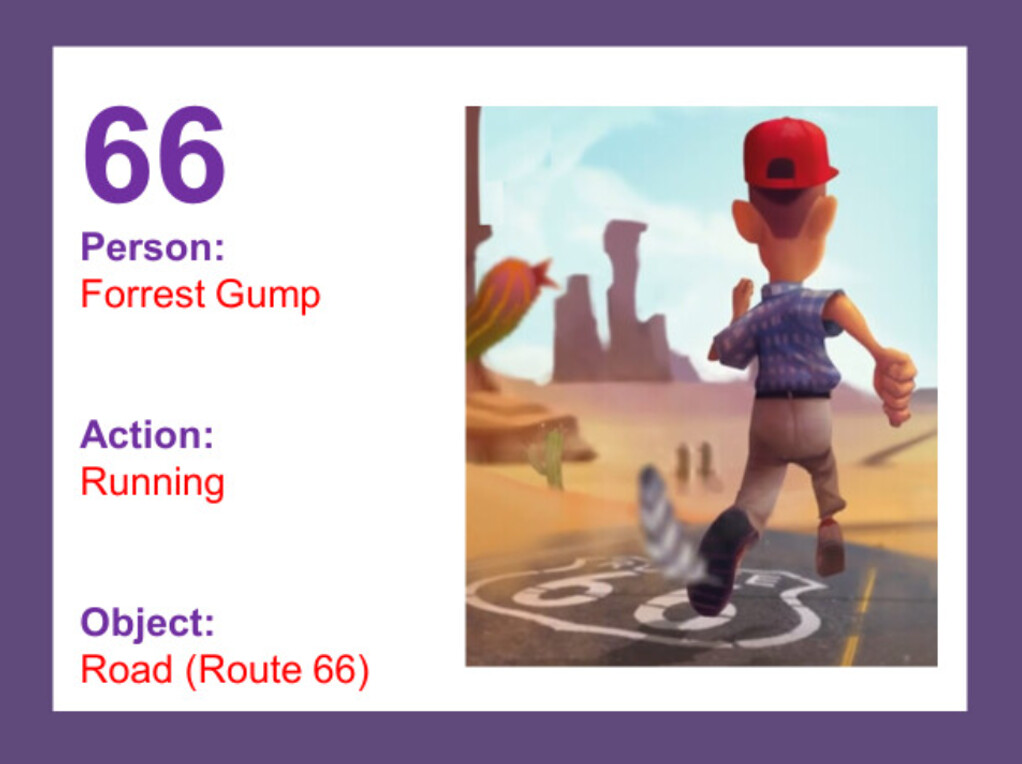
You may also want to dabble with a PAO Unencoded System. This works by having your cast of 100 characters not linked to any specific number system by an encoding system in any way. This system would of course be unique to yourself and your associations of people to numbers and ultimately actions and objects branching out therefrom. A couple of examples may assist you, as 66 I have “Forrest Gump” (Person) - Running (Action) - Road “Route 66” (Object). Hopefully the image below will explain. I have written elsewhere on this forum about an “Unencoded PAO System” but to be honest it didn’t find favour with most memory pundits however? I will say it works for me though. I have also devised a Dominic PAO and Major System PAO too. Its almost like being ‘multi-lingual’ learning a different language. It seems to come naturally to me. Another system devised by @magicpauluk who is also on this forum is known as the “letter getter system” which arises from encoding “rhyming peg word numbers” into letters. There is some merit to @magicpaulik system too but I suggest you try out an Unencoded People Peg System from 00 - 99. I found it fun coming up with all my crazy images!!

2 Likes