As a young child, I was both good at mathematics and lazy - which made me end up not knowing my multiplication tables very well (specially the 6, 7, 8 tables). Later, I noticed that it created unecessary troubles for simple mental calculations since I could not get over those specific table’s shortcuts in order to chunk bigger calculations.
E.g.: 7 x 8 x 7 = 392
As I try to improve my speed at mental calculation, I was wondering if learning those tables quite “late” (I’m 22 but it’s still sort of late compared to a child) was a problem in terms of speed and recalling process ? Do you guys think that one can learn those tables at any age ?
Also, do any of you know a quicker system than the 10-based system for mental calculation ?
Yes, I do think that. also, the Anchor method can be really helpful here.
For example:
6 times 4 equals 5 times 5 minus 1
8 times 6 equals 7 times 7 minus 1
I don’t think so. We are too used to 10-based. With mental calculation one needs to be able to mentally see the partial results. In your example of 7X8X7, one needs to see 350 and the 42 to get to 392.
Also you need to be able to mentally rearrange items. In the example of 7X8X7, if you realise that 7X7=49=50-1, (50-1)X8 = 400-8 = 392.
So rearranging could help sometimes.
With any system other than the decimal system, one also needs to be able to quickly go back and forth the different systems. Example: 16X16 (decimal) = 10X10 (hexadecimal) = 100 (hexadecimal) = 256 (decimal).
Because of all this I do not think you will save time using any other system than the decimal.
Today I was thinking about you.
I was training myself with random numbers to multiply.
At some point the system gave me 95X14.
I contemplated using the anchor method, when I realized that calculating 100X14 - 5X14 would be quicker.
100X14 - 5X14 = 1400 - 10X7 = 1330.
In about one in three calculations you will need to use the 6, 7, or 8 table.
So learning them well is a good thing!
Here’s some videos that teach by showing you some visual patterns made by the times tables. Getting familiar with these patterns may help you learn them more quickly:
4s and 6s:
3s, 6s, and 9s:
7s:
8s and 2s:
In addition, here’s a few videos that teach the 6-, 7-, and 8-times tables. I grew up on them, and they really helped me learn my times tables (you may want to check out the other videos in the series just for fun):
It does. I never realized this property.
A lot of civilizations (used to) calculate in 60’s, which would be a 3, a 4 and a 5 added.
Just makes more sense now.
Is there any advantage a numer system that ends in a prime has? This is something in Smiths book about mental caluclation that still remains senseless for me.
I am sure anthropologists have extensively studied the real reason behind the establishment of base-10 .
The answer is very simple. As humans we have 10 fingers.
So, the base-10 decimal system is by default the most familiar and practical to us.
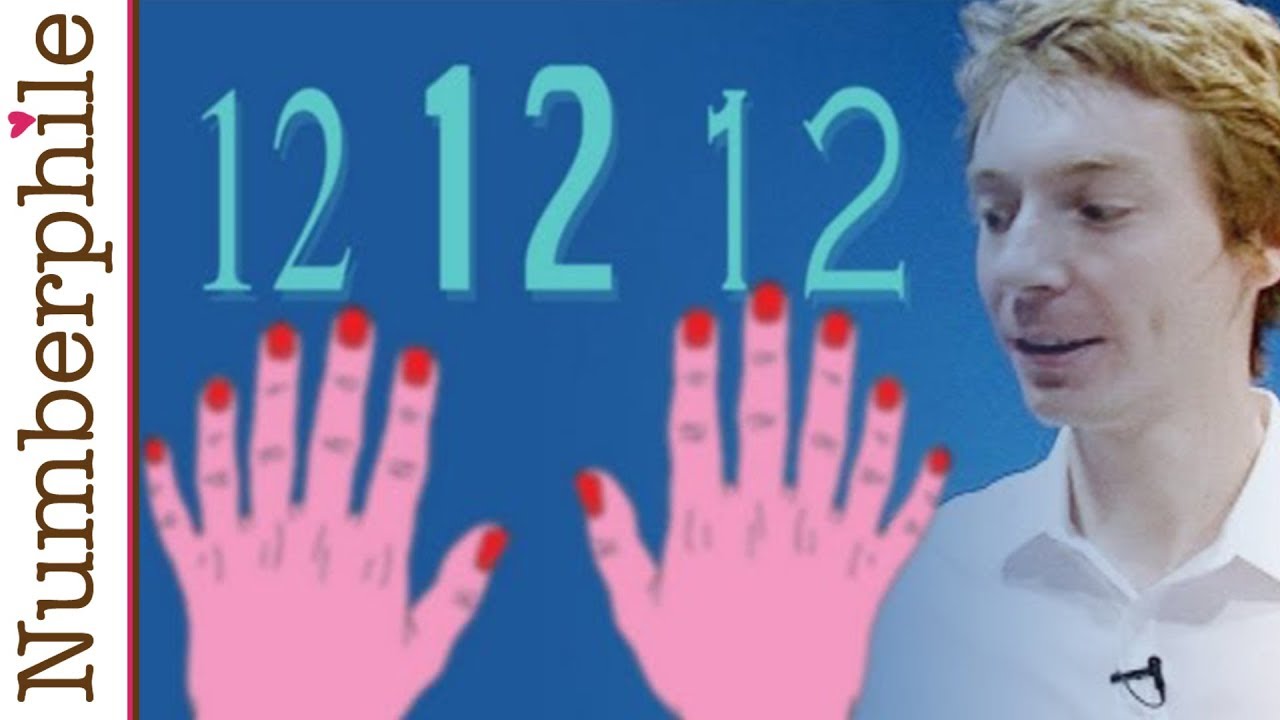
Sumerians, Mesopotamians, Incas have used some base-12 and base-60 systems. But all other major civilisations like Greeks, Romans, Chinese, Hindu or Arabic, have used mainly base-10.
(except in clocks and calendars)
from wiki on decimal:
Some cultures do, or did, use other bases of numbers.
Pre-Columbian Mesoamerican cultures such as the Maya used a base-20 system (presumably using all twenty fingers and toes).
The Yuki language in California and the Pamean languages[27] in Mexico have octal (base-8) systems because the speakers count using the spaces between their fingers rather than the fingers themselves.[28]
The existence of a non-decimal base in the earliest traces of the Germanic languages, is attested by the presence of words and glosses meaning that the count is in decimal (cognates to ten-count or tenty-wise), such would be expected if normal counting is not decimal, and unusual if it were.[improper synthesis?] Where this counting system is known, it is based on the long hundred of 120 in number, and a long thousand of 1200 in number. The descriptions like 'long' only appear after the small hundred of 100 in number appeared with the Christians. Gordon's Introduction to Old Norse p 293, gives number names that belong to this system. An expression cognate to 'one hundred and eighty' is translated to 200, and the cognate to 'two hundred' is translated at 240. Goodare details the use of the long hundred in Scotland in the Middle Ages, giving examples, calculations where the carry implies i C (i.e. one hundred) as 120, etc. That the general population were not alarmed to encounter such numbers suggests common enough use. It is also possible to avoid hundred-like numbers by using intermediate units, such as stones and pounds, rather than a long count of pounds. Goodare gives examples of numbers like vii score, where one avoids the hundred by using extended scores. There is also a paper by W.H. Stevenson, on 'Long Hundred and its uses in England'.[citation needed]
Many or all of the Chumashan languages originally used a base-4 counting system, in which the names for numbers were structured according to multiples of 4 and 16.[29]
Many languages[30] use quinary (base-5) number systems, including Gumatj, Nunggubuyu,[31] Kuurn Kopan Noot[32] and Saraveca. Of these, Gumatj is the only true 5–25 language known, in which 25 is the higher group of 5.
Some Nigerians use duodecimal systems.[33] So did some small communities in India and Nepal, as indicated by their languages.[34]
The Huli language of Papua New Guinea is reported to have base-15 numbers.[35] Ngui means 15, ngui ki means 15×2 = 30, and ngui ngui means 15×15 = 225.
Umbu-Ungu, also known as Kakoli, is reported to have base-24 numbers.[36] Tokapu means 24, tokapu talu means 24×2 = 48, and tokapu tokapu means 24×24 = 576.
Ngiti is reported to have a base-32 number system with base-4 cycles.[30]
The Ndom language of Papua New Guinea is reported to have base-6 numerals.[37] Mer means 6, mer an thef means 6×2 = 12, nif means 36, and nif thef means 36×2 = 72.
Hi I am a grandmother and trying to help my granddaughter who is 9 years old. But alas she can not memorize the normal time tables which is 1 - 12. Any suggestions how I can help her?