Most essential mental calculation techniques?

I’m trying to gather the most essential tools to calculate quickly in everyday life to teach my kid.
The goal is not to do competitions and stuff but to have a basic toolkit that will put my kid in a comfortable place whenever she needs to calculate something.

Please tell me which methods do you think are most essential and would absolutely need to be learned.
Also, please correct me if I say anything dumb, I’m discovering all of this for the first time.

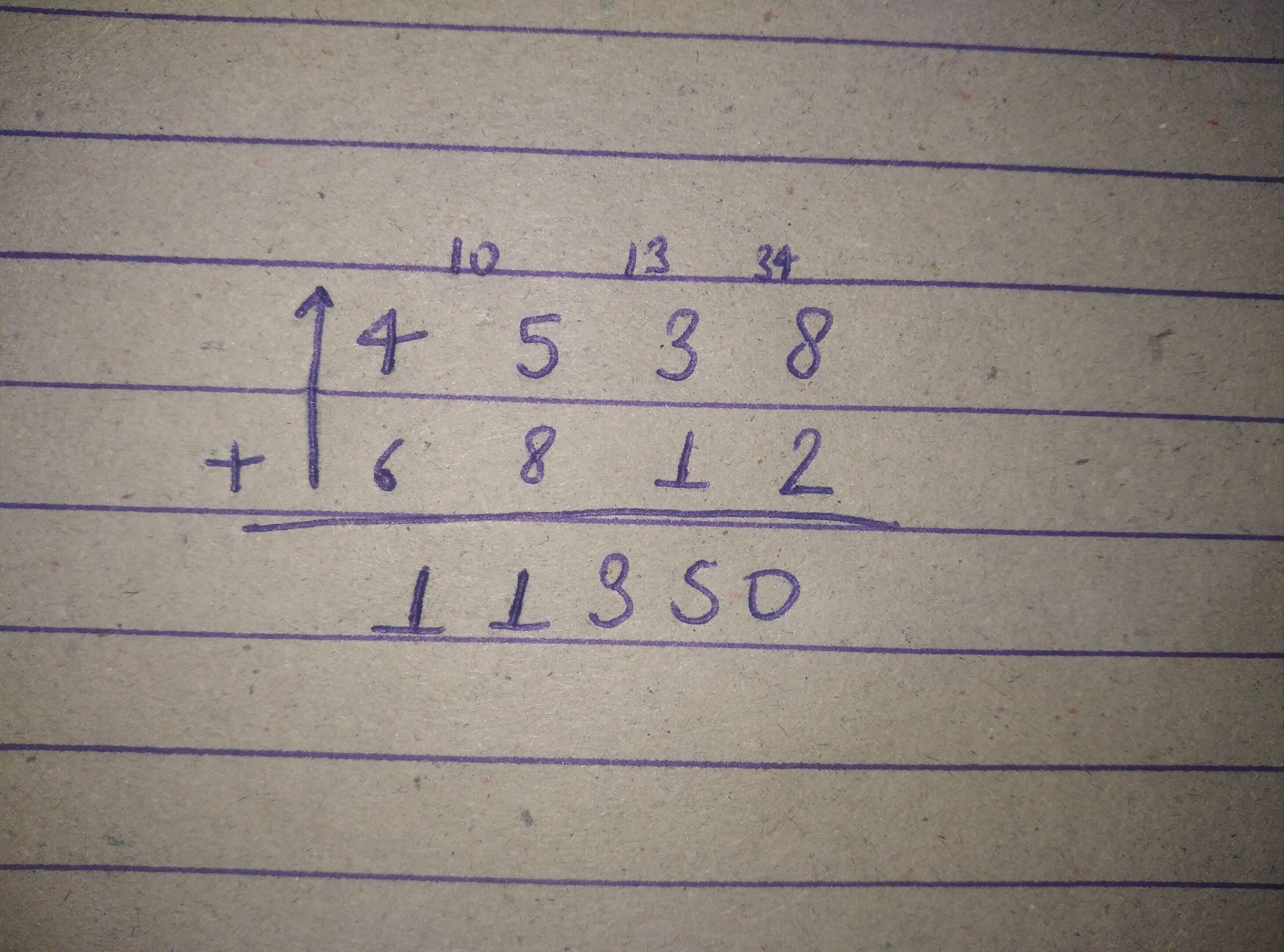
So far, for additions I’ve come across the method to add from left to right, for exampe, adding :
557+
789+
246

Just do 5+7+2, then 5+8+4, then 7+9+6, so keep 14, 17, and 22 in mind.
Then laying them down diagonally like this
14
_.17
___22
and add vertically, so 1592.

Is this a good method, or can it be improved ?

For the multiplication, I’ve read about the criss cross method, for example :
96x24

Do 90x4+20x6 + 6x4, so 504 + 90x20 which is 2304.

Or think of it as 100-4 and 24, which would be :
100x4+20x(-4) + 4x(-4), so 304 + 100x20, which is 2304.
Maybe this is easier for this example using this slight twist to the method ?

That’s all I know for now, and I’ve read also that you need to learn all the 2 digit squares to speed up your calculations.

What else would be useful ?

Thanks

1 Like

Hi benjamin, thanks for the N technique tip, looks good.
I’ll search about the complement technique, thanks.

1 Like

Great skill to teach your daughter :slight_smile:

Additions on pen and paper are best done right-to-left (it has lower memory complexity, feels easier, and it’s what the fastest people all do). Spoken additions (in “everyday life”) are best done left-to right, but typically only two numbers are presented at once, and these are most likely to be 2-digit numbers. I would consider these two different techniques.

The method for calculating the big sum is a good way to do it left-to-right, but I’m not sure how useful in practice. One detail: you don’t calculate the 14, 17 and 22 first, as it’s too much to remember at once. Imagine if you had three 7-digit numbers! It’s easier to calculate the 14, say the “1”, remember the “4” while calculating the “17”, etc.

For multiplication, the fastest general method is criss-cross (explanation for larger numbers), but if you’re given a smaller multiplication like 96 × 24 (especially verbally) then there are several shortcuts:

  • 96 × 24 = 48² = 2304 (memory)
  • 100 × 24 – 4 × 24 = 2400 – 96 (as you said)
  • 25% of 9600 – 96 = 2400 – 96
  • etc.

The “difference of two squares” technique is amazing for certain multiplications, if you know enough squares. E.g. 74 × 86 = 80² – 6² = 6364. However, teaching your daughter all the 2-digit squares should be a much lower priority than many other things.

If your daughter is young, she could learn to work with the soroban, but it’s not necessary. If you do follow that route, make an effort to teach her some number sense as well (estimation, relationship between numbers, numberline etc.) as many soroban experts are poor in this regard, even if they are very fast at the more mechanical calculations.

1 Like

Lol , long time ago I am talking about this technique with you in private message. I am huge fan of it too.

Lol I thought I discovered it. Well in maths nothing is certain. There is always someone who already discovered it. :sweat_smile:

Edit - you said you don’t know about this technique that time .

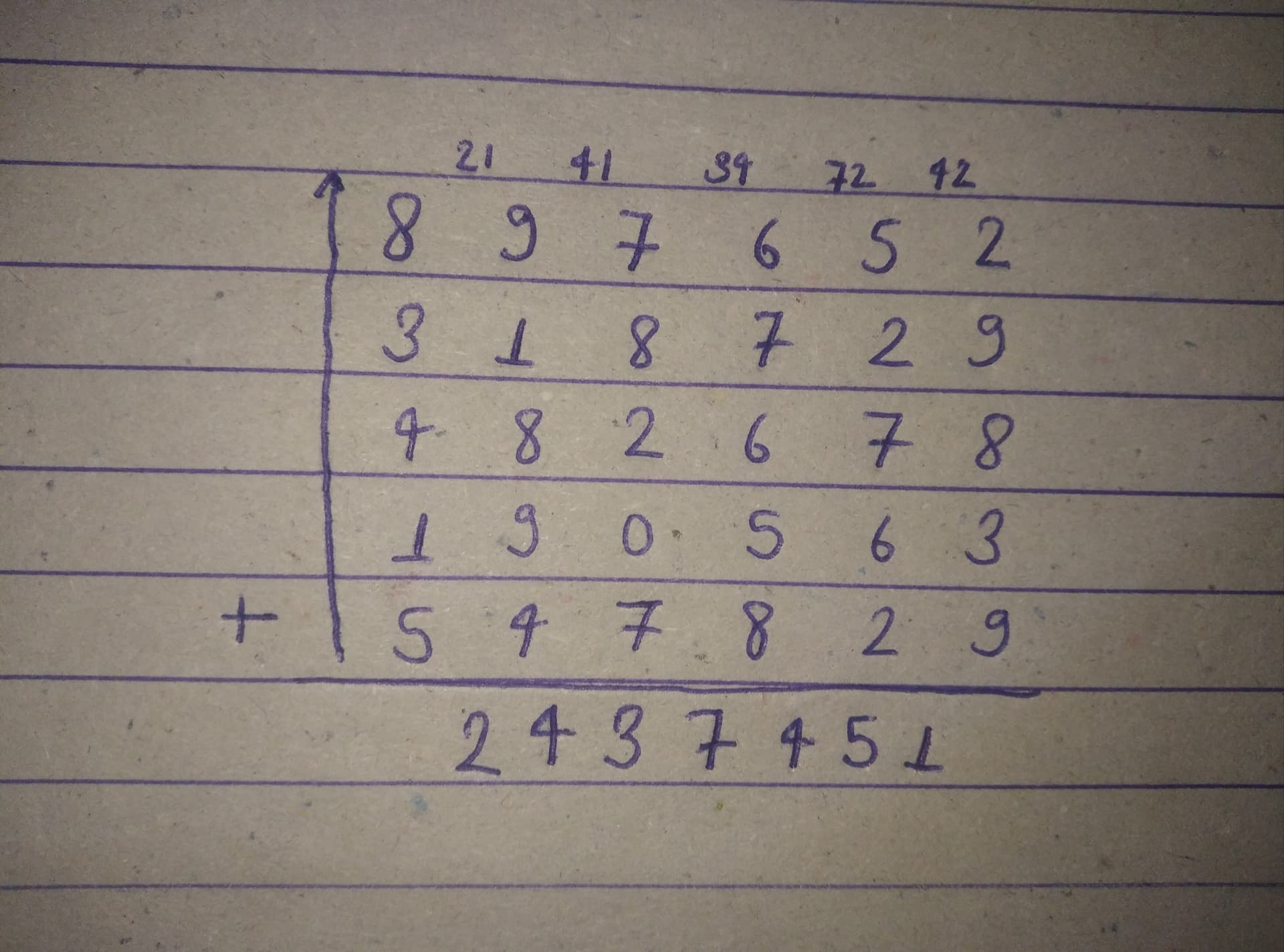
If it’s even more bigger you just need to follow the rythm and you will get your answer.
you can put your answers in memory palace while doing calculation it will take some time to do it but worth it .

1 Like

Well , this is just 1 more example. the more example you have you can understand better.

Forget about which methods… what you need is an understanding of…

Basic Algebra

2 digit squares are only useful if you can see what’s going on and don’t blindly try and apply a method you read about…

…half of 96 is 48 and double of 24 is 48, which will give you 48^2=2,304

Couldn’t agree more… the above 96x24 should scream 100x25 at you. Also, {25\over100}={1\over4}, so you can do the above described doubling/halving for 50^2=2,500 and every time you move one away from the 25, you should move 4 away from the 100…

92x23, 88x22, 84x21, 80x20, etc. can all be done as 46^2, 44^2, 42^2, 40^2, etc. respectively. As far as alternative approaches, even though the above should be the most obvious one…

…seems rather clumsy, seeing how 96 and (25-1) is much less of an effort. A quarter of 96 happens to be 24 as we already know. and then you just subtract the missing 96 from 2,400.

Maybe you could elaborate a little on what you consider everyday life calculation. Most the everyday stuff can be done by estimation rather than calculation.

Mayby not directly mental calculation tool, but depending on her age, you may give her some math games to try, may be on mobile phone. Sorban may also be worth trying.

1 Like

I use an app called “mental math practice” on the play store. The best there is apparently, and it’s fun. You can then apply the techniques to a peglist, loci, etc.

I would advise to do multiplication criss cross also from left to right:
So in the case of 96 X 24, start with 9X2.

But, like you said, in this case starting with 100X24 is easier.

Et tu , Brute ? :wink:


Am I the only one who saw that half of 96 is 48 and double of 24 is 48, so you end up with \color{red}48^2? I mean, it’s prime factors, you just move the 2 from the left to the right…

yeah that’s literally the easiest way. (Not even took 1 sec to answer that by that way)

@bjoern.gumboldt & @Rajadodve786, It appears to me that you are missing my point entirely. :slight_smile:
I am not talking about the best way to do 96 X 24. Not at all even.

I’ll try to rephrase my point.
@woob first explains that he does addition from left to right. Ok, points for that.
The he/she tells us that he does multiplication criss cross. Again; great!

However; the order he/she does it is:

Do 90x4+20x6 + 6x4, so 504 + 90x20 which is 2304.

In terms of order this translates to; middle, right and only then left.
I was merely pointing out that this is not “left to right”.

1 Like

Thanks everyone for answering.
About that @Kinma, I was indeed wondering if middle then right then left for criss isn’t easier than left to right, because you have to store less things in your short memory ?

Because if starting with 90x20, you then have to store 1800 in your memory while you do 3 more calculations of “another magnitude” number (not as long), or a method where you don’t have to store it in your memory but you add each subsequent calculation to the total, and you have to repeat a long number in your head after each operation.
Whereas if starting from the middle, adding stuff along the way is more manageable, and you don’t have to remember 1800 throughout the process, so at the end you just add it and you’re done.
Does that make sense ?

Maybe I’m wrong and it’s easier from left to right, but it seems that way at first glance.

First of all, find out for yourself if starting from the middle works better for you or for your daughter.
Just try out different ways of calculation. Use what works for you.

Here is my take on this.
In the case of doing 96 X 24 and if you want to do this criss-cross wise, it doesn’t really matter much if you do left first or middle first.

It might become a bit more complex however on numbers with more digits.
For example try to do 9612 X 1234. Going from left to right in this case will give you structure.

Going from left to right will produce digits from most significant to least.
It is the same with long division; you produce digits from most significant to least.
I use mental calculation in my day to day life. For me producing digits from most significant to least is important, since I can stop when I have enough digits.
Let’s say that I calculate a mortgage price. It is important to know the first 2-3 digits. After that, not so much.
This is the way it works for me.

If you want to be academic and be able to calculate all digits of 4x4 digit multiplication, then whether going from left to right or from right to left does not matter much. In some cases going from right to left is even better.

2 Likes

I hear the argument about hierachisation of numbers, makes sense.

Since the goal is everyday fluency rather than competition, I’d strip the toolkit right down and drill a handful of things until they’re automatic. In real life a fast good-enough estimate beats a slow exact answer, so I’d weight it toward estimation and number sense.

Roughly the order I’d teach:

1. Basics to automaticity first. Times tables to 10, and the pairs that make 10 and 100, instant. Every trick below falls apart if the atomic facts aren’t automatic, so this is most of the battle.

2. Round and adjust. For 557 + 789, think 560 + 790 = 1350, then hand back the 4. This one habit covers most everyday addition and subtraction, and it gives you the most significant digits first, which is usually what you care about.

3. Left to right, as you found. Good instinct, and worth keeping because you can stop early once it’s precise enough. Your diagonal layout works, but it asks the kid to hold three column-sums at once. A running total (start at the biggest place, fold in the next) is usually lighter on working memory.

4. A few multiplication levers rather than one big algorithm:

  • x10 and x100, and x5 as “x10 then halve”

  • doubling and halving (14 x 5 = 7 x 10)

  • near a round number, use base and offset. Your 96 x 24 as (100 - 4) x 24 is exactly this, same idea as criss-cross but anchored to 100 so there’s less to hold. Nice.

5. Percentages via 10% and 1%. Decimal shift for 10%, halve it for 5%, and tips and discounts are covered. Probably the most-used math in adult daily life.

6. Squares: I’d gently push back on learning all the 2-digit squares. For everyday use that’s competition-level overkill. Squares to about 15 plus the “ends in 5” trick (35^2 = 3x4 then 25 = 1225) gives almost all the practical value.

On criss-cross specifically (following @Kinma and @woob above): for a kid I’d lean left-to-right for the reason discussed, you get the important digits first and can round off the rest. Middle-first saves a little memory on 2x2 but stops helping once the numbers grow.

Most important thing for a kid, honestly: short frequent sessions, five or ten minutes, tied to real things like money, cooking, time. Number sense comes from reps in context. One method per operation, mastered, before adding any tricks.