Morse Code fun

Starting learning Morse Code today as a side project to give my brain an easier change of pace in the midst of my Shadow System cramming.

I actually am simultaneously learning it and teaching it along with some core memory techniques to one of my coworkers. I had shown him a basic way to do red-black card sequence memorizing a while back, and he really enjoyed it and asked me if I had anything else to try, so we’re messing around with this together.

I had him first write out a 26 loci memory journey through his house, which he really got into. Then we used @Simon’s awesome codeword technique to provide the initial thing to visualize that would represent how to encode the letters. (I modified some of the words to make them all easy to visualize.)

Once we had those locked in (which was quite fast, under an hour from the start of defining the memory palace to creating images and loci interactions with each word), we started adding a secondary image linked to each codeword which uses the major system to give an easy way to determine the dash-dot sequence of every color. We got through the first 10 or so today before our lunch break was over, and should be able to learn the rest tomorrow pretty quickly!

I’ll elaborate more on the substitute words and major system additions tomorrow, but I think they’re pretty cool and seem to work well both for encoding and hearing the code and deciphering it!

4 Likes

Flag semaphore may also be something of interest to delve into as its ‘visual’ unlike Morse code which is ‘aural’. I have witnessed an old sea Captain tapping out ‘morse code’ with his finger on a bar counter to words that were written on a beermat recently. Learning ‘Morse code’ from keywords wouldn’t be the way its taught in practice and for practical knowledge of using morse code but I’ll grant you its nevertheless a novel approach and having nuggets of knowledge like ‘morse code’ stored away is good practice in ‘association’ of morse code keywords to loci I’m guessing?

1 Like

Nice @TheHumanTim

Learning Morse is on my LikeToDo list as well!

Have you checked out some of the Morse code games that are available?

Something like?

1 Like

So here we go:

Palace Letter Morse Code Encoding via Simon’s System Binary For Decoding Major System for Decoding
driveway A . _ Abs 01 SeaT
sidewalk B _ . . . Bread 1000 DiZZy SoSa
front steps C _ . _ . Cobra 1010 DoZy DeSi
wreath D _ . . Dole 100 oDySSeuS
blue couch E . Ed 0 Saw
fireplace F . . _ . Flash 0010 ZeuS ToeS
dining table G _ _ . Gore 110 TooTSie
fridge H . . . . Heidi 0000 SaSSy SuZy
stove I . . Ice 00 SauCe
coffee maker J . _ _ _ Jenny 0111 SaD TeDDy
sink K _ . _ Knit 101 ToaST
stair railing L . _ . . Lathe 0100 SooTy SeuSS
shower M _ _ Mop 11 ToaD
toilet N _ . Nye 10 DiCe
medicine cabinet O _ _ _ Ozzy 111 DDT
closet P . _ _ . Pasta 0110 ZiTTy TaZ
dresser Q _ _ . _ Quran 1101 TieDye SaT
bed R . _ . Ring 010 CD’S
lamp S . . . Sale 000 SoySauCe
water heater T _ Ty 1 Tee
washing machine U . . _ Uber 001 CyST
freezer V . . . _ Vicar 0001 SauCy SoDa
workbench W . _ _ Wasp 011 CiTaDel
garden X _ . . _ Xraay 1001 DaiSy SiT
shed Y _ . _ _ Yukon 1011 TaZeD Di
lawn tractor Z _ _ . . Zoned* 1100 DeaD Sea Scroll

Ok, what does all this mean?

I’ll walk through the process of learning the letter A.

  1. Create a palace with 26 loci, one for each letter of the alphabet.

In our example the first loci is the parking spot in the driveway. We will store the imagery for the letter A here.

  1. Fuse the image from Simon’s system into that first loci.

For “A,” the codeword is “Abs.” By following the “first-half” / “last half” differentiation, we see that for the word “aBS,” the A represents the letter we’re trying to code, the “B” is in the first half of the alphabet, so it corresponds to a “dot” and the “S” is in the second half of the alphabet, so it corresponds to a “dash.”

Abs = A(dot)(dash)

We imagined just a mannequin’s limbless and headless torso blocking the parking spot. This torso has massive muscular abs like a bodybuilder, glistening with oil thats dripping onto the pavement.

Note: Simon’s original list has some different words than mine. I changed a few of the original words that were a bit too “abstract” for me so that they all could be fairly easily represented visually.

  1. add in the “decoding” imagery

Here’s where the next level happens. I realized that while Simon’s coding system works ingeniously for being able to ENcode letters into Morse Code, it didn’t seem to offer a way to easily DEcode it. If I received the message “dot-dash,” all that would tell me is that the code word is three letters, the second letter is in the first half of the alphabet, and the third letter is in the second half. I feel its extremely difficult to come up with “Abs” from that clue. Yes, I suppose with practice and repetition, you’d get used to associating that, but I wanted an instantly translatable option for the initial learning phase.

So, I realized that since Morse Code is just a binary system, then much like Simon is differentiating dots and dashes by representing them with first-half / last-half letters, I associate them with major system number sounds.

I turned each letter code into just a binary type sequence of 0’s and/or 1’s. 0 for dot (round like a dot.) 1 for dash (a straight line like a dash.) So, Morse for the letter “A” is dot-dash, which converted to “binary” is 01.

Once you convert to 0’s and 1’s, use the major system to build an image with those consonant sounds (S/Z for 0, T/D/TH for 1.)

So dot-dash = 01 = S-T = SeaT.

We’ve got our mental image of the mannequin’s torso ABS on the driveway, now picture that torso strapped into a child’s car SEAT.

  1. Encode or decode in either direction!

If you want to encode the letter A:
With a few reps, you’ll easily associate the letter A with “Abs.” Now you have the option of using that word and Simon’s encoding technique to translate the b-s into dot-dash, OR that mental image of Abs should ALSO easily trigger the element of the “SEAT” and if you’re somewhat fluent in major system phonetics, you can easily recognize SEAT as 01, and 01 is easy to translate to “dot-dash.”

If you want to decode “dot-dash”:
Dot-dash = S-T via the major system.
This should trigger the word/image SeaT.
The image of “seat” should trigger the image of the mannequin “abs.”
Abs starts with A.
Dot-Dash = A.

If you already have a 1 and 2-digit Major System PAO list (or a PAAO with adjectives as part of it) you can easily create unique imagery for all 26 binary series.

(IMPORTANT NOTE: I’m using the term “binary” to just indicate that only two numbers are used. We’re NOT translating the “binary sequence” into an actual base10 number. So 010 (dot-dash-dot) would not translate to “2 / N,” it would be read literally as “010 / S-D-S.” This is because binary translation to base10 typically disregards the leading zeros. 10, 010, 0010, would all be read as “2” if we completed the translation. We need them to be distinct for our Morse purposes. Every image word you translate here is solely constructed out of 0 and 1 sounds, with leading zeros included.)

This process (like most mnemonic techniques) sounds insane and overly complicated at first, but if you try it I think you’ll find that it works really well and is surprisingly easy to learn. The thing that took the most time for us was just coming up with a new palace to store it in!

If you REALLY want to take the associations to the next level, you could create an imaginary palace where each loci starts with the corresponding letter of the alphabet. For example, the palace is a military base. Loci 1 is the Airfield, 2 is the Barracks, 3 is a Checkpoint station, 4 is a Dining hall… etc. Then you can very quickly jump around to different letters, and may actually be able to skip the “Simon technique images”, as the loci will give you the Letter, and the major binary will give you the code in either direction.

Happy learning!

1-00-11

4 Likes

So, what’s interesting is that in just an hour or so of effort, the imagery from some letters is already starting to disappear and the link between “A” and “dot-dash” and vice versa is just there and easy to associate.

I’ve had this happen with almost all of my “long term” projects, that the surrounding story, imagery, etc, eventually becomes background and the important meaning just springs to mind while eliminating all the “middleman mnemonic imagery.”

I suppose that’s the goal, instant recall without having to actively think about how the image decoding works, and mnemonics are the tool that gets you to that place, hopefully in a faster and more fun way.

3 Likes

Looks really cool. I think using that in tandem with setting up your basic associations via a mnemonic system would be very effective.

Tim that is a fantastic idea to memorize “Morse Code”. I have taken the liberty of changing your “Shop’s mannequin with Abs” to a “Crash-Test Dummy” used in testing the braking capacities of motor vehicles. I also picture the “Crash-Test Dummy” headless, armless and legless and ‘grey’ in colour, with a (SABS) South African Bureau of Standards sticker stuck on his body (yet another clue from the acronym (SABS) to ABS again!! The “Crash-Test Dummy” strapped to a car SeaT is a particularly strong image to decipher and encode the letter “A” with the SeaT (01) denoting a “Dot - Dash” and the first letter of “Abs” denoting the letter “A” itself. Now I’m keen to tackling the other 25 morse code letters!!

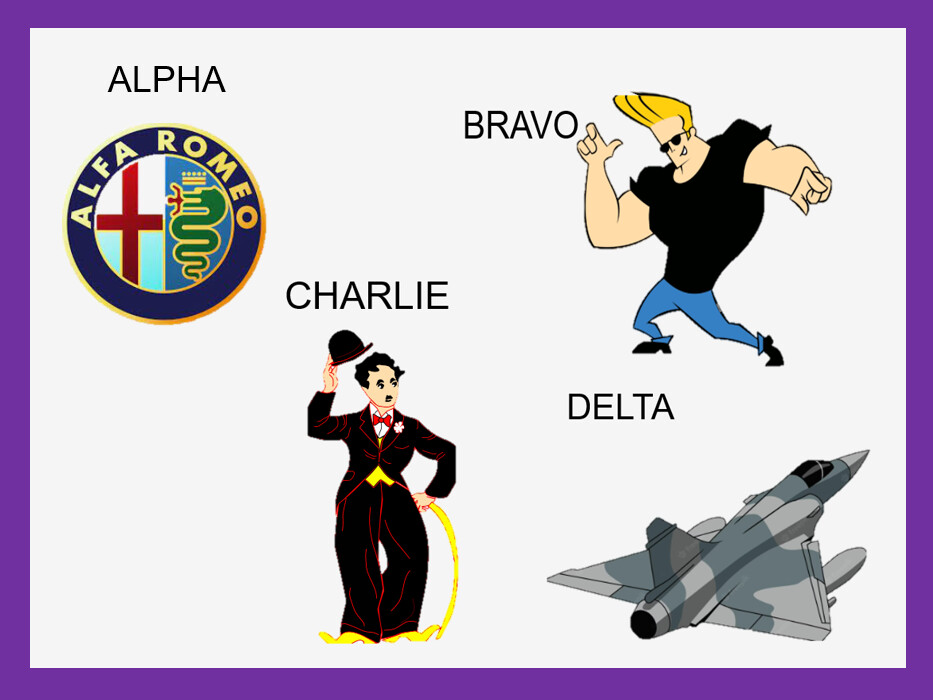
As for a “Memory Palace” I think it makes most sense to use the NATO’s alphabet as a palace where you convert each of the NATO’s Alphabet letters into images themselves e.g. Alpha, Bravo, Charlie, Delta, Echo, Foxtrot, Golf, Hotel, India, Juliet, Kilo, Lima, Mike, November, Oscar, Papa, Quebec, Romeo, Sierra, Tango, Uniform, Victory, Whiskey, X-ray, Zulu which is very easy to do:

  1. Alpha = Alfa Romeo sports car
  2. Bravo = Johnny Bravo
  3. Charlie = Charlie Chaplin etc. etc.

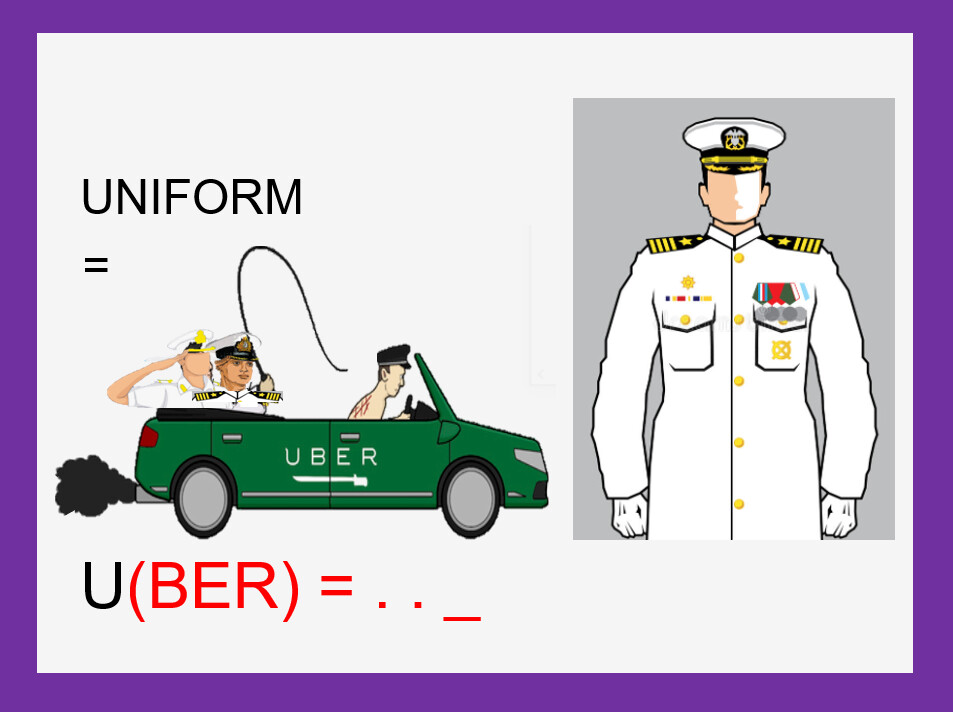
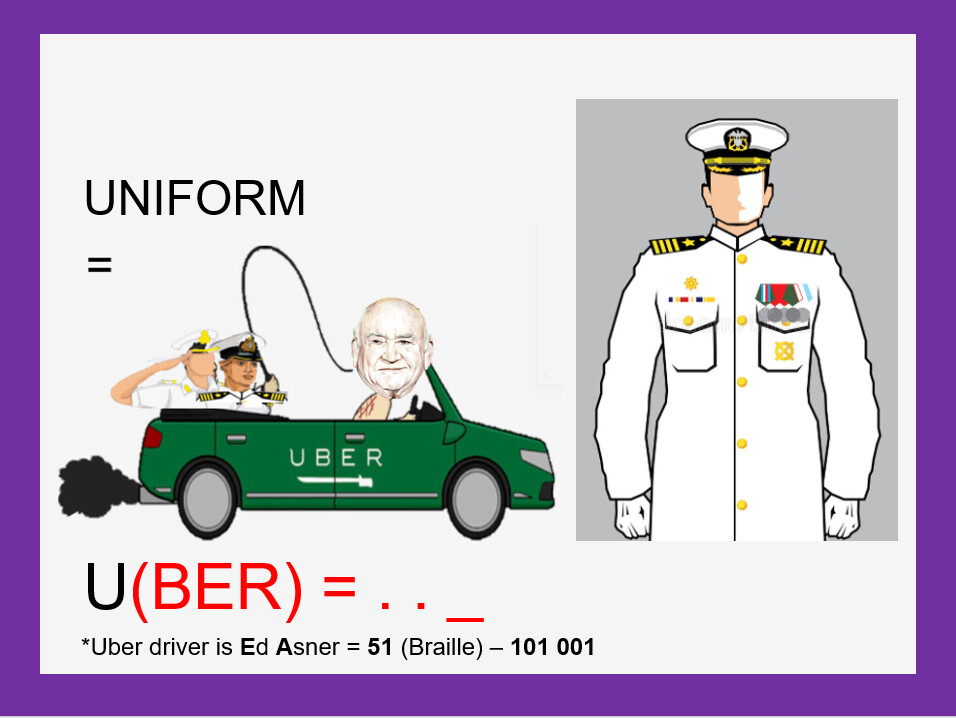
An alternative example using the “Simon” method is:

1 Like

Back to “Abs” and your system of Major System’s “SeaT”. The (SABS approved) Crash-Test-Dummy with Abdominal muscles = (Abs) is doing Automatic-Braking-System testing = (ABS again) strapped into his SeaT (Dash-Dot). I like it when ‘multiple cues’ exist as it connects more neural pathways towards finding your answer.

1 Like

I also modified a bit -

A - Air
B - Bread
C - Cobra
D - Doll
E - Ed
F - Flare
G - Good
H - Halal
I - Ice
J - Jerry
K - Knit
L - Linga
M - Mop
N - Nok
O - Oppo
P - Pizza
Q - Quran
R - Ring
S - Safe
T - Tv
U - Ugly
V - Video
W - Wasp
X - ? (Going to steal your Xraay :sweat_smile:)
Y - Yo-boy
Z - Zoola

2 Likes

Flare - Halal - Jerry from your list all work better for me. As I’m encoding the ‘morse-code’ directly associated with NATO - Alpha Call Signs your choices work better for me.

So for H = HOTEL = (H)alal “dot dot dot dot”. I imagine a HOTEL that only serves (H)ALAL food. For F = FOXTROT, I imagine a strictly-come-dancing contestant dancing the FOXTROT and shooting a (F)lare “dot dot dash dot” at the judges.

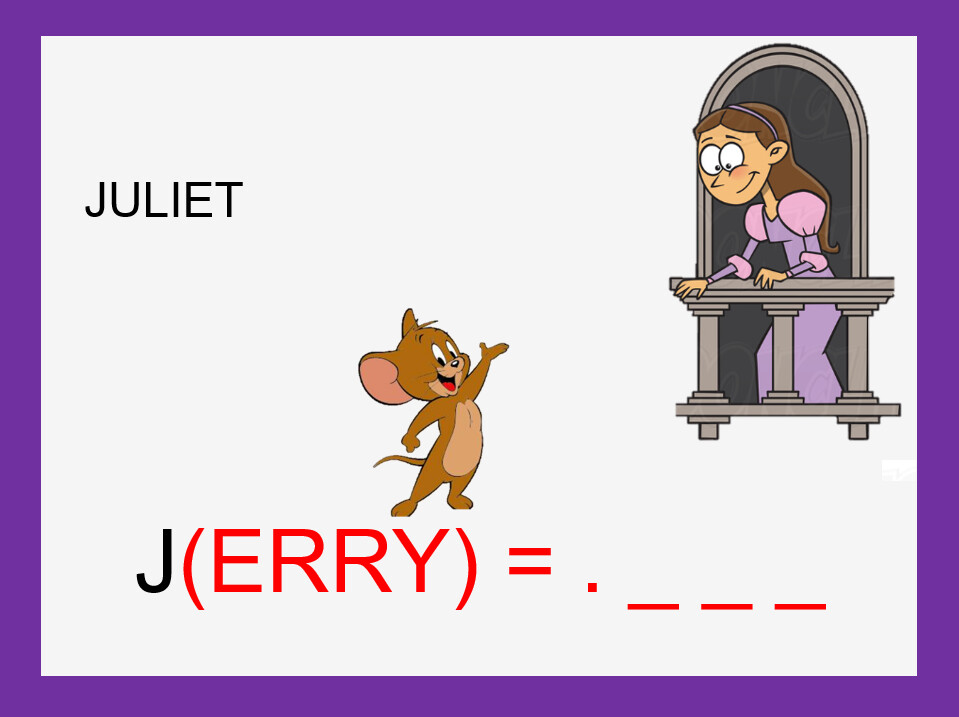
And lastly, JULIET (from William Shakespeare fame) is being flirted with in the balcony scene, with no other than (J)ERRY “dot dash dash dash” (from Tom and Jerry fame). I enjoy mix-and-matching words and taking the best words from multiple sources as it makes my ‘morse code list’ stick far better in my memory.

My example for the letter “I” in morse code linked to the NATO alphabet is India = Ice. I imagine tons on “ice cubes” pouring out of the Taj Mahal (India)

2 Likes

@fred2 The call signs are also on my list to learn, maybe I’ll take your approach and link the codes to those images!

1 Like

@fred2 how are you creating those pictures? They’re really memorable and well done!

Internet is full of ‘free pictures’ if you google the ‘image’ you are looking for it’s guaranteed to be there. I don’t publish the pictures into books or anything like that as obviously ‘fair use’ comes into practice. Obviously as ‘memory’ requires ‘association’ I often have to use my cropping tools on my PC to put two images together. From time to time, I do delete the pictures I post erring on the side of caution. Watch this space!

Here’s the first four NATO alphabet words to get you started if you haven’t already completed your list?:

1 Like

My Personal favourites below but change your" Jenny" to “Jerry”:

1 Like

Don’t forget to add 1 more layer fred.
I mean to say, Braille alphabet

Just like you connect juliet to jerry, now link braille J with it, simple.

J =>
01
11
00

(010-110 => 26)
0 => White dot
1 => Black dot

I gave 1 example, rest you can do it. Just convert, braille alphabets in binary and use your 2 digit system there.

2 Likes

I hadn’t thought of that thank you for the suggestion. Did you do the braille letters only A - Z or also numbers and special characters too?

I did for numbers and special characters too.
For numbers I use shaper system images and then connect it to the braille. and for the morse code the pattern was simple though.

For special characters, I did only for some characters.
Are you planning to do ASCII ?

1 Like

How would you apply things to ASCI Rajadodve? I would welcome your ideas. Perhaps the Juliet (Jerry) + 26 (Bart Simpson) might be better using Bart Simpson’s action in my PAO system which for Dominic’s #26 I have: Bart Simpson (Person); Skateboarding (Action); Object (Skateboard). Just thinking the image may work better than the one I currently have?

I like Doll, Safe, and Tv! Will probably switch to those!