I constructed a mnemonic conlang. Its extremely logical and has ready-made images. Not sure where to post this? But I’d be curious to see if anyone wants to talk about it or help develop the language even further.
This sounds novel albeit your message is a little vague. Can you elaborate upon what exactly a mnemonic constructed language (MCL) is that you are specifically referring to? I think that it could be argued that both the popular: Major Systems and Dominic Systems are also “mnemonic constructed languages” too? Perhaps some examples from your side would assist in clearing up what the unique features of your MCL is that distinguishes it from other MCLs.
1 Like
There’s so much more to it than something like the major system or Dominic system. It works using binary and every place is interconnected. I’ll give you an example. Its 2D language. Hopefully you can appreciate it.
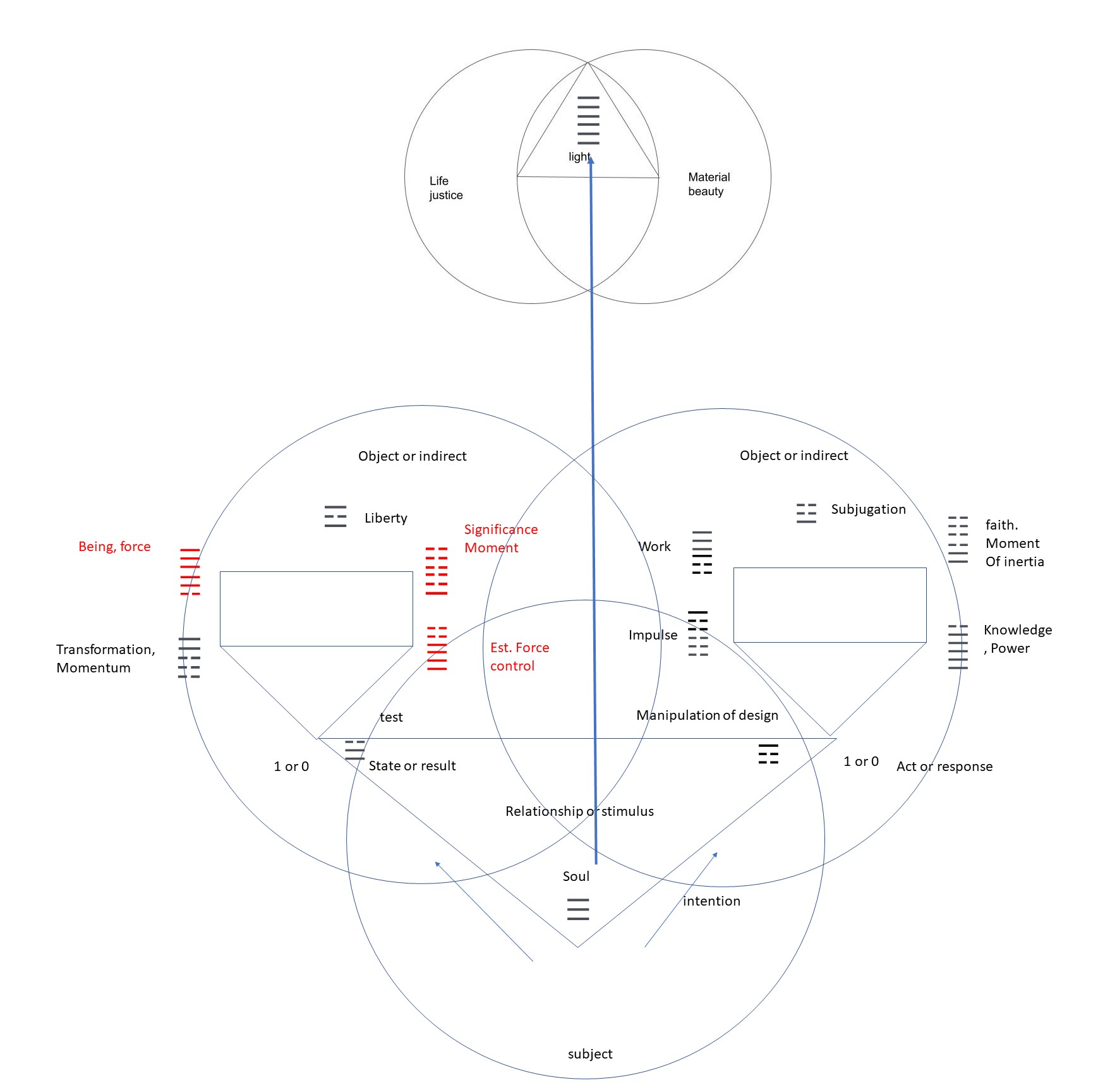
I’m going to make another post later today on the subreddit r/languageoflight containing all of the morphemes because it is an oligosynthetic language.
Each of the hexagrams, the characters with six lines are places containing “pieces” or trigrams that can be manipulated.
look at the subreddit for more info but the “sentence” I posted is a journey that was inspired by Langland – Piers Plowman, which is practically a memory palace turned into a story.
I have now come to understand that as a Modern English speaker, I can not understand the language of a Middle English author. Piers Plowman is thought to have been one of the most popular poems in Middle English literature. It is thought to have been written between 1360 and 1399. There are many versions of the original poem because its author, William Langland , constantly revised it. I understand the gist of the work to be about a poet who tries to find out what it means to be a true Christian and to lead a true Christian’s life. The poet falls asleep in the English Midlands and has a number of visions. He is guided in his visions by a virtuous plowman named Piers. In short, the poem all about Piers’ maturity as a Christian. The more interesting part at least for me however, is your claim that you have devised a mnemonic system which you have coined to be the Mnemonic Conlag (constructive language). You claim that there is so much more to the Mnemonic Conlag (constructive language than say something like the Major or Dominic Systems. You have claimed its a 2D language (whatever that may mean?) and that it works using binary and every place is interconnected. You’ve shown a diagram of sorts but I’m still failing to understand or appreciate what this phenomenon termed Mnemonic Conlag (constructive language) is really all about. Perhaps other forum members can unravel it better than I’m doing?
constructed
…as in Esperanto or toki pona
1 Like
I can give you some notes? I never use website so you can DM me. Besides what’s relevant about it is how he divides it into two sections then three. Visio and vita, then thought imagination and anima.
I have a new diagram that I know people will be interested in. it implements this idea and structures the organization of mnemonics even further.
Not sure if this is allowed but here is a link to the post:
https://www.reddit.com/r/languageoflight/comments/yqq4c6/language_of_light_morphemes_axioms_and_an_example/?utm_source=share&utm_medium=web2x&context=3
1 Like
A typo thanks for pointing that out to me but are you familiar with @giordanobruno system that he’s suggesting though?
This seems like a fascinating concept
Seems like you’re just renaming then rearranging the figures inherent in the I Ching
There may be some overlap with I ching but I’m no longer using it as a model. I’m pretty much putting a western spin on I ching characters. I’m not sure if I ching in some distant past was defined more formally but today it’s lacking mathematically.
As a philologist speacialized in conlangs and a conlanger myself, all I can say is… I’m really curious to see a final product I can properly judge. That pic you share with a chart seemed to be a way to visualize how its syntax works. It reminded me of the many projects of the XVII - XVIII centuries, like Wilkins’ or Leibniz’. Do you have something more like a proper grammar that I can take a look at?
I’m getting to the point where I can make a proper grammar. You’ll have to wait a few months before I have anything you can look at anything officially.
There are many things I’m trying to tie together.