I don’t add anything physically to the image. I just trained myself to visualize images or walls of a memory palace by using grids. It is just a way of organizing data. And I found it is very fast to store data in grids. Because your brain knows the grid pattern very well already. And it knows,how many locations are there in the image. So,it is very easy and fast for the brain to recall the data from each grid/square. It is not recommended to use more than 3x3 grid. The lower,the better! I usually use 3x3 grid though. There are different combinations of grid…ie,2x2…2x3…!
I used it to memorize all numbers of Dominic system. It took only two rooms to put all numbers of Dominic system using grids…
The “Grid technique” used to be used in the middle ages by the mnemonists of that time a lot. It is an age old technique!
Not sure whether you had this in mind, but this is a common way to structure a painting. The grid might not be uniform but it’s probably there in the painting.
Hi, Elitely. Thank you for the suggestion! This is very interesting!
I like your grid idea. It’s very orderly and could be consistently applied. That’s a great reason to adopt it.
Looking at my knucklebone players, I wonder if a spiral could also be possible, could be imposed on the image, and could be consistently applied. What do you think?
I feel the women’s skirts in this image suggest a circle or spiral, not a grid. At the center is the hand of the one in blue. When I create loci in rooms, I usually go around the room, and from top to bottom. The process feels like a circle to me more than a grid.
By starting at the outside, with the basket at the center, and going clockwise around, I feel I am working my way to the hand in the center. It feels more logical to me for this image. The scene culminates at the hand. And I can make the bone in the air the fifth spot, the hand the tenth.
Maybe some paintings will work better with the grid, some with the spiral, and we’ll have two types. Is that possible?
What fascinating ideas! Grids are medieval techniques, but I haven’t thought to use them in this way. I had thought more of doing the grid and then adding images to each rectangle. It is so common to remember where on a page you read something you are looking for, so the brain seems to grid things naturally. I must try gridding in this way.
I can see the logic of using a grid for many paintings, but I wonder if it is appropriate for Bruegel’s Children’s Games. The 80 games seem to form a natural set of locations.
I have decided to encode a course in classical music to the painting. I found a list of the supposedly 100 greatest classical composers and asked my social network friends to reduce it to 80 by eliminating those who I don’t need. They eliminated and added and I have ended up with more than I started with!
I believe this is a classical “triangle” composition. The red hat forms the apex. The behinds of both women forming the base. And it may have been a sly joke.
Composition usually tries to form some closed path of interest that keeps your eye on the picture as it roams
Hi,I think,all types of ‘shapes and patterns’ can be used…spiral,triangle,square,rectangle,circle……Whatever you are comfortable with! If you check out the literatures of the medieval age,you would see they(the mnemonists) used different types of shapes on images or walls.
But you need to have a ‘consistent’ pattern that your brain is ‘used to’ or comfortable with. For example, I consistently use ‘3x3’ square pattern. So,without any stress or worry,I can instantly see ‘nine loci’ on a Wall of a room or on an image! I like ‘square’ patterns and the ‘nine number’. So,I keep using them all the time
You provide so much content here, I feel guilty asking for more, but I will. I’d love to read a step-by-step walkthrough of what information you decided to store and how you’re actually encoding it to the painting(s). While I enjoy classical music, I’m really a rock/pop guy and have thought about what/how I might memorize information related to that music from the last 60 years or so. I’d be happy to follow your example once you’ve cleared the path…
I am being asked for the same from people on various social media who have been refining my initial list of composers to what is nearly the final list. I will blog the process once I get started which should be a week or so. I have a blog post to do first because my Bestiary for memorising names has finally come back from the printer and is on Amazon, so I need to blog about that and point people to it.
The following post will be on Bruegel and classical music. Of course, it may not work - all my experiments are just experiments. So far only two have defeated me completely - when I tried to copy the Yoruba method for memorising hundreds of stories using tosses of 16 cowrie shells, and also when trying to copy indigenous astronomy. I may return to them one day! But I am pretty sure Bruegel/music will work well.
So give me a week or two and then ask again if I haven’t said anything here. It will be a reminder not nagging!
After reading about the initial ideas here about miniature memory palaces I tried memorizing all the 75 wild mammal species of Sweden using a horse as the memory palace. I think I never made a journey so quickly before. And it seems to stick very well. Also it feels nice to have it all gathered “in one place”.
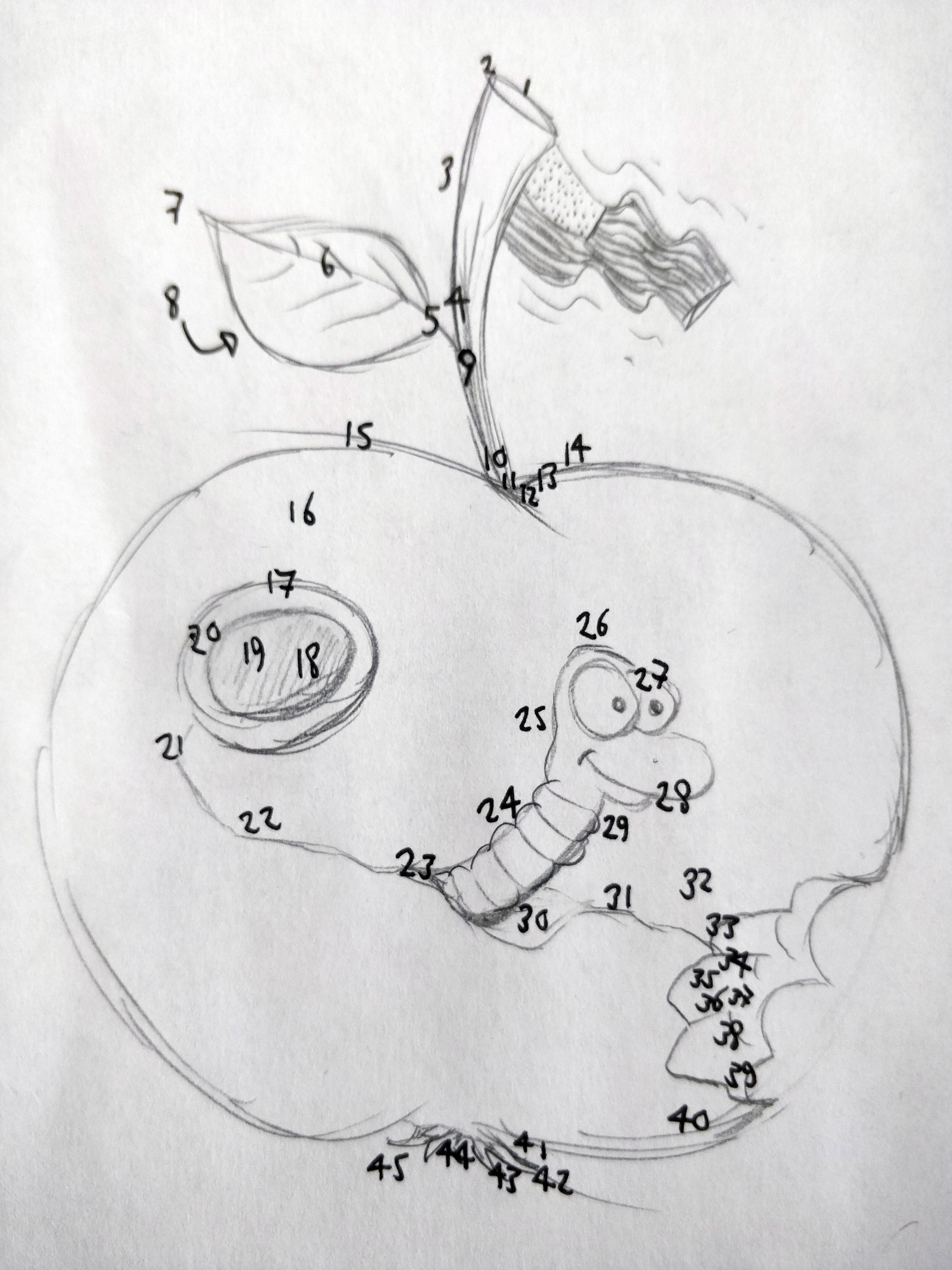
Yesterday I tried to take it a step further, putting all 45 presidents of the US on one apple. That also worked flawlessly and felt really cool!
Well, it may be considered cheating since I added a few small features. Typical apple-features though!
The first ten are just on the stem. To that I have added a leaf for variation. I think that the key is just imagining that you are very, very small, so that every little feature becomes really clear.
I made use of the classic “apple sticker” as well for four of the presidents and then I added an apple worm and a bite in the apple for some variation.
So I still believe that you need lots of variation for a good memory journey, but that variation seems to be possible to find/invent also in seemingly rather “variation-less” objects.
Thanks!
The difficult part is probably though just to realise that these kinds of memory palaces are possible, which you and the others in this thread did. When that is settled actually creating them seems comparatively a piece of cake!
Actually I just did the sketch to be able to share it here, when I created it it was only in my head. But sketching is probably a good idea, and at that very possible when you are using a single object for the whole journey.
Hi all and thanks for the interesting material and comments.
Over the last year I’ve been moving away from the traditional palace over to a simple object as just mentioned.
I mainly use minimalist objects as a old phone, camera, glasses, gates… any object (acting as a palace) that fits the info to be memorized.
I don’t make them small but large enough to be seen without zooming in. They seem to be more instant and solid to the memory. I typically get 10-12 points on a typical minimal palace and a lot more if needed.
I find these minimalist palaces to be more effective. If I want more I just add another aspect to the palace as flash to the camera, a cord to the phone etc.
Of course this can be done with a room and furniture placing multiple points on a chair for instance. These days I try and get as many location points on an object as possible, hence only needing a couple of minimal palaces like a camera.
I look back over the years and look at all the wasted location points on a loci that I could have used.
These are great for lists. However, for medicine biology and the like one would need a different type of palace; a kind of interactive palace.
Nothing new here of course but some may find this useful.
So if you use handy objects on a regular basis do you bother with sketching them occasionally? Also, do you pre-list of them, eg, for potential future use or afterwards sort of as a filing system for information stored in/ on them?
Yes, i sketch all my palaces in detail. This way I don’t have to reimage if I have forgotten in a year.
I use a tablet to sketch then I upload them to Dropbox. For me using a tablet to sketch is a basic requirement as I can make corrections/adjustments and always view them on my phone etc. I always print my palaces and file them. I still like the tactile.
I also purchased a cheap 12" LCD Digital Drawing eWriter Tablet about £6 Just great for picking up and sketching a palace from memory testing myself. Not all LCD Tablets are the same. The best I found is the ‘Howshow’.
Hope this helps someone as I’m sure there are many ideas others can contribute.
In conclusion I’m finding minimalist palaces the way to go for me.
I myself wouldn’t give up pencil and paper but I scan my images into the computer. I usually keep the original but I can print out a copy, add something to it and rescan it.
It’s settled, then. I will start sketching my memory palaces. I’ve avoided it before because it seemed
like only one particular memory guy advocated it. I thought that I could just find out what the other mnemonists were doing instead.
And now I have miniature memory palaces to add!