What can I use to memorize recipes ?? I am qualified as a cook and also worked as a bartender . What can I use to store massive amounts of cocktail recipes or dishes ? Keep in mind that I need to store the exact amounts of each element that goes in the recipe .
Thanks !!
3 Likes
How much have you done with memory techniques so far? Have you created number images for 00-99 yet?
Do you have some memory palaces created?
One idea is to create a memory palace with one stage for each drink. Then use a linking method to connect the recipe images within each location.
To find an example, I tried to find a less-common cocktail:
It says the recipe for “Red Bubbles” is:
40ml Cointreau / triple sec
50ml grape juice (obviously red because of the name)
Sparkling water
If you have images for numbers 00-99, then you could use your images for 40 and 50.
You could then make images for each drink. If you know the bottles well, you might be able to use the bottles or associations you have with each drink.
You could put all the images for a drink into a location in your memory palace, connecting them with a story, and attaching them to an image of red bubbles. If someone asks for “red bubbles” it should take you to the other images by association.
That’s just one idea for a way to memorize it…
6 Likes
I tried memorizing with the room that I live in a few years back… tried to attach every recipe to an object in my room and linking each element to each other and using the numbers from 0 to 9 for that. Tried to use the name of each drink … like a foreign language word . But I had to link the ingredients to former amounts . For example : 30 ml of Cointreau with 20 ml of Whiskey . The image of the Cointreau word was associated both with 30 ml and with 20 ml … because I used link method . I did not know how to go around that .It worked for maybe 50 cocktails … than I started getting confused a bit … which annoyed me to the point that I gave up completely. 
You guys are probably more accustomed with these sorts of things… so please help .
Can you give me a small example of how a story should be like ?
Thank you !!
1 Like
Could you give an example of your images/story for that mnemonic?
If it were me, I would attach the image for 30 (an Amazon warrior) to the Cointreau and the image for 20 (Einstein) to the whiskey. That way the Cointreau wouldn’t be attached to 20 in any way.
The first thing that cames to mind for “triple sec” is triplets. The first image for whiskey is a glass of whiskey with one ice cube.
Sample image:
Amazon warrior battling triplets which then fall backwards onto Einstein who is getting drunk on whiskey. Then attach that to the name of the drink.
One thing that I adopted from the Ben System is to always place images left-to-right or top-to-bottom. That preserves the order. The #20 (Einstein) can only be attached to the whiskey because of the order from left-to-right.
If you’re memorizing a lot of drinks and get repeated images, you could make several sets of images for 00-99.
Another idea to reduce the number of repeated images is to organize drinks in different rooms by category. (Just brainstorming out loud… you could try it and see if it works.)
3 Likes
Ok man … thanks .
Yea well … for example
30 ml of triple sec
40 ml of Tequila
For 30 I was using 3 - Marlyn Monroe ( a system based on shapes … Marlyn has the boobs like number 3 )
For 40 I was using a ship … the number 4 resembles a ship
Triple sec - 3 skulls (sec means without content in my language )
Tequila - Ila is a famous guy from my country and I used his image
So I would have for example Marlyn staying on 3 skulls on a ship talking to this guy Ila ( Talking to Ila = Tequila ) . But at times … I would not know anymore if the ship belonged to the skulls , to Ila or to Marlyn … it took a bit to figure out who’s who . This is a simple example … it would work out fine in the end … but you have recipes that included maybe 6 or 7 elements . In cooking … you can have many many more. And because of that you could mix up things really badly … to the point of becoming very annoyed .
From your examples … I see I must work on my stories a bit for things to become more relevant !!
1 Like
Hoping that this shows up properly, this is how I do it when presented with multiple proprietary recipes.
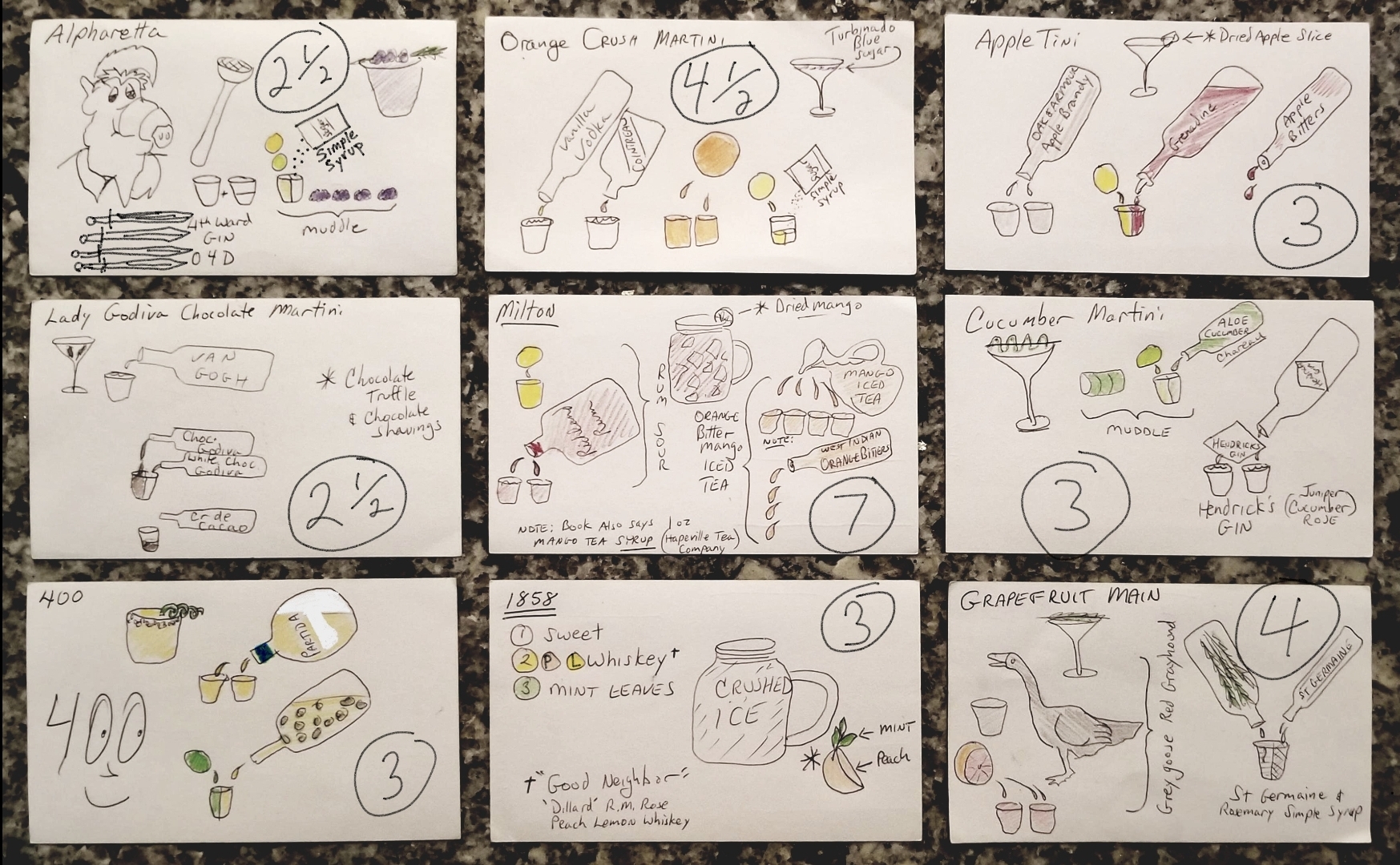
6 Likes
Taking the drink recipe “Alpharetta” as an example,
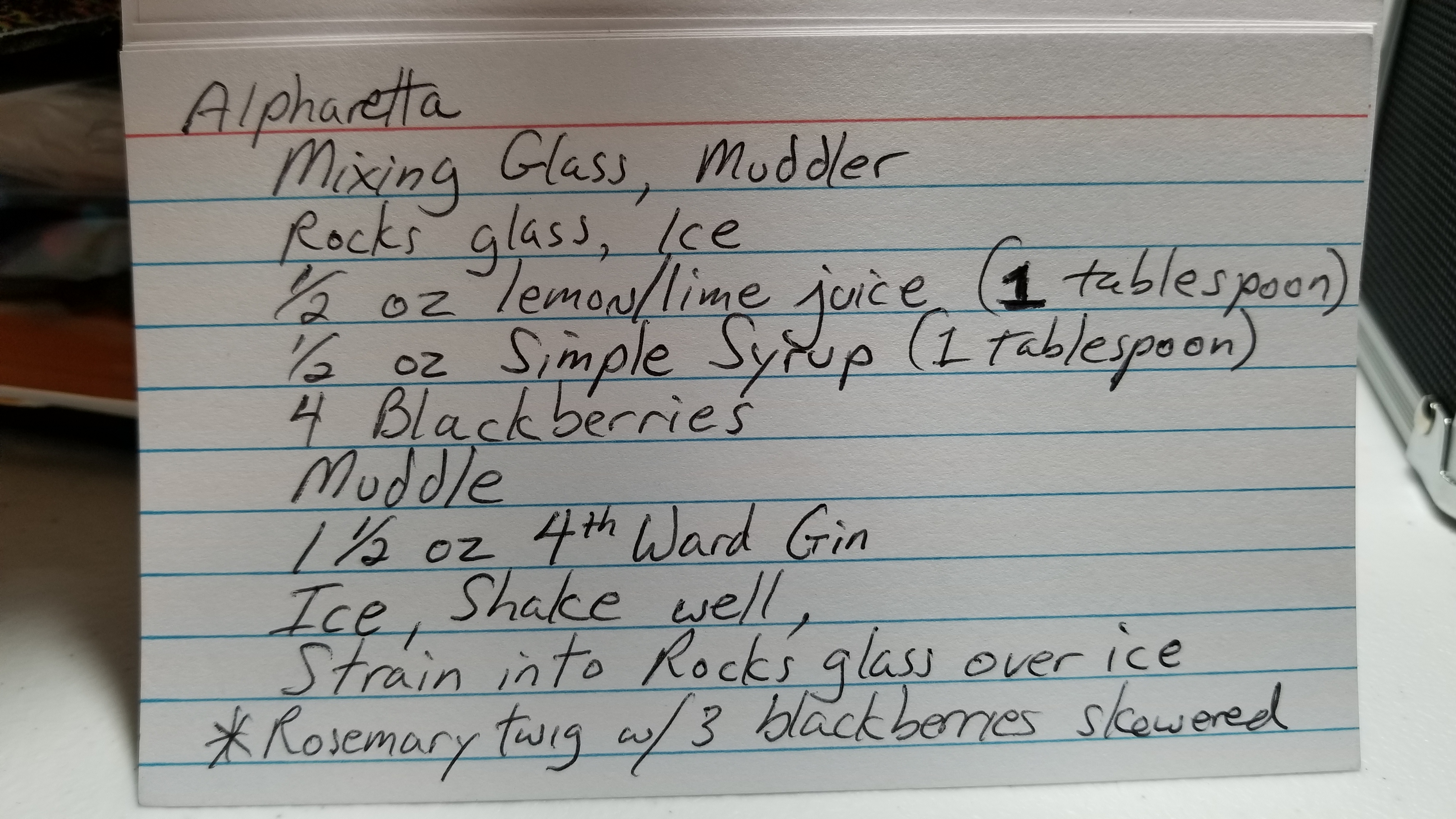
Just looking at t&e “4th Ward Gin” I created “4 thwords” (4 swords). Each image has a unique story.
2 Likes
If you’re new at this then I would suggest using lots of space.
I’m currently memorising a topic with 27 categories each with about 20 sub-points.
I’m using my old high school because there are many rooms that I know well. Each category (recipe) gets its own room.
The stations within each room are determined by this formula: four corners, four walls, ceiling, floor, middle space. Some of those stations are reserved for specific points: 1) name 2) number… This system means there is less to remember and more order for quick reference.
In Excel I’ve got a sheet with all the data organised. I recommend you do this too. Sort the recipes into a logical order. Sort the ingredients into order too - perhaps by size. I’d attach the ingredient and quantity to the same station: potatoes, 4
Also try to be as literal as possible. So if you need four eggs then see four eggs. And emphasise the tastes, colours, etc. When you use salt at a station then bring to mind the taste of salt. Do this for each ingredient because it will be more memorable.
Perhaps have a station - I’d use the middle space - where you taste the final product and remember where you’ve had it before. Say you had crepes in a cafe in France - bring that memory in so when you think about crepes you go straight to your room and you can look around and see all the ingredients.
I’m an experienced mnemonist and I could memorise all 27 categories and points in one sitting. But I’ve chosen not to do this because I want this knowledge for long term reference. So I’m doing one room per week and reviewing that room many times during the week. This chunks down the project and prevents overload. I think it helps to actually learn the category rather than just cramming factoids into my head.
Let us know how it goes!
Andrew.
1 Like
Another thing about memory palaces is that you can learn them by rote. The advantage of this is that it reduces the number of silly images that need interpretation.
So if you need 1/4 cup of 4th Ward Gin then imagine the bottle with swords in it and pouring into one of four cups.
In the past I would have imagined a lot of weird imagery and encoded all the details. Nowadays I prefer less encoding and more reliance on natural memory through increased reviewing.
I used to use a lot of violent and sexual imagery to make the images memorable but not so much these days. I think this has come from practice - images don’t need to be so dramatic anymore. It also from planning in Excel and relying on rote learning.
4 Likes
Thanks for the tips on the excel sheet use. I’ll try it.
For my numbers and glassware I’m using a combination of the major, pao, and a few conventions of my own. A boxing glove represents “Rocky” for rocks glass. Julia Child with a spatula is for a Specialty Glass. ½ oz is a hatchet embedded into the ingredient or acronym (if all ingredients in the acronym are half an ounce), “Dieter” (alpine hat on ingredient, or Dieter carrying a bottle) means 1¼ oz, noodle equals 2.5 oz, 3 American quarters equal 3 quarters of an ounce. Thirds are represented by the Mercedes hood ornament, and a few more. I’m combining various methods, using tips from Anthony Metivier’s MMM Master Class and some of the authors he’s recommended.
1 Like
This might be overly simplified (if you’re in the MMM Class then you’re probably quite proficient already) but I found this an interesting way to remember recipes:
2 Likes
Ok… THIS was 6 years ago already - it’s the point at which necessity created such a huge demand in me for something new that I had to come up with something better, the container object system, effectively embedding a list of lists within a narrative attached to the name of the drink (which may or may not be hooked to a station in a memory palace), each list with a different fractional numeric value (½ oz, ¼ oz, ¾ oz, 1½ oz, etc.n etc.) so that each ingredient in each individual list has the same value.
#NeccessityIsTheMotherOfInvention
2 Likes
Break the recipe into keywords
Store them in a memory palace.
Ginel, I take it that you’re using the metric system. I use ounces, but there’s no problem converting my system to your needs.
As bartenders we have recipes with multiple groups of two or more ingredients, each group with a different amount (group 1 of 3 ingredients 15 ml each, group 2 of 4 ingredients 7½ ml each, group 3 of 2 ingredients 30ml each - PLUS glassware type, type of ice, garnish(es), rim - Salt? Tajin? Sugar? Etc., method, muddled items, dumped, strained, or double strained? Etc).
My method works quite well. No complaints. But it IS a multi step process, so bear with me please.
To start with, I arrange each new batch of cocktails to be memorized into alphabetical order. I alphabetize them so I can fill in the blank spots more easily in case I draw a blank trying to recall what’s at a station between a Daiquiri and a Diablo… I know it starts with a D, and that the next letter is a vowel - an a, e, or i.
Then I attach each drink name to a memory station in a memory palace, and keep a journal with all the stations and drink names written by each station.
That helps extremely well for memorizing a hundred or so drinks at a time.
The first step is focusing on memorizing their names and anchoring them firmly to stations in the memory palace. If I’m given a small new group of several drinks I then see if I can create an acronym out of the alphabetized list. I then can either insert the drinks in between the stations in the big list of hundreds of drinks already memorized, OR just tack them onto new stations at the end of the big list. Either way though, an acronym for small lists helps running through the drinks names mentally without referring to index cards or paper.
So NOW organize your recipes by rewriting each one yourself on your index cards.
Go from highest quantity to lowest (or the other way around) all 30ml ingredients grouped, then all 15ml ingredients, then 5ml, etc. Do this because even if everything else fails you momentarily you know the top ingredient is the most, and the bottom is the least. That will help you. ALSO add the memory palace station location to the corner of the index card, to help you strengthen that association while you’re at it.
NOW we move in to HOW to memorize specific quantities with absolute precision and certainty.
Container Objects.
Create memorable container or platform objects each with an assigned value (7½ml, 15ml, 22½ml, 30 etc) which you can populate with your individual small groupings of ingredients of the same liquid amount.
I discovered that a basic PAO (person, action, object) principle works well for developing the container objects. Let me explain by illustrating one container object and how it works.
First take something that is a container or a platform (or both) - I’ll use mine for this. One Ounce (30ml) is the T, D, or TH sound to equal 1, (30ml) so I use a Ford Model-T. It is a container object, or platform with things on it or in it, (or even in the rumble seat/dickie seat/mother-in-law seat).
Now any ingredients I put into the Model-T are 1 ounce. I can also uses a Tea (cup) as my container, and often do. But the Model-T is cool because it’s an ACTION object, and it also has a bit of personality (Chitty Chitty Bang-Bang, and My Mother the Car - Old movie and television series references). That’s where the borrowing from the PAO comes in. I discovered that people and actions were very helpful when memorizing before I’d ever heard of PAO, btw.
Now you have a container object representing 30ml (1 oz), but for the most universal ingredients (juices and syrups) I use animated characters to represent them. Here’s my list (you do your own if you need to)
Lemon Juice = Sponge Bob Square Pants (he’s yellow)
Lime Juice = The Incredible Hulk (green)
Simple Syrup = Gorilla, Monkey… I’d post a picture of why, but it works for me.
Cranberry Juice = Ralph Cramden (Jackie Gleason) from “The Honeymooners”
Amaretto = Hell Boy (“Call me Red”) “I’m a Red-O”
Agave Syrup = Mr. Magoo - an old black and white television cartoon character from the United States (the native word for Agave is Magua)
Egg White = Humpty Dumpty
…and whatever else I need - I have a whole bunch, but you’ll create your own as you need, and you should - because THIS WORKS and yes it’s work - but it is fabulous.
I can say it’s fabulous because I’ve been bartending since 1980 and have been using mnemonics since 1973-4… and ALWAYS had problems with exact quantities in drink recipes. - PS I worked as a bartending school instructor too for a few years while recovering from surgery when I couldn’t bartend for a while and the INSTRUCTORS I was working with often forgot the quantities of each ingredient themselves (!!!) and had to look them up again - and they were currently working bartenders in Tampa area clubs and bars when they weren’t teaching in the school - so WOW! …and the school taught acrostics for many of their drinks, but nothing more advanced than that because the students relied on rote.
MY ADVICE:
Create Container Objects for each quantity.
Some of Mine are:
1/4 oz (7.5 ml)
Quarter Horse, Horse Shoe, Wall Sconce (1/4 of a sphere), Amphitheater (1/4 off a sphere)
1/2 oz (15 ml)
Canoe, Viking Long Ship
3/4 oz (22 1/2 ml)
Tree (tree quarters), Baby Carriage
1 oz - Model-T, (big) Tea Cup,
1 1/4 oz (37.5 ml) - German / Tiroler hat
1 1/2 oz (45 ml) - Cereal Box
2 oz (60 ml) - Noah (major system Noah)
2 1/2 oz (75 ml) - a Noodle.
From there, once you’re done that, start being creative and sketching out scenes with your containers and the actors in each recipe. The NAME is anchored in your memory palace - but the RECIPE is anchored in your narrative attached to that name.
Then start rehearsing every day, going over the associations in your mind half an hour before you fall off to sleep and half an hour before you get out of bed.
Pull a few Pomodoro sessions every day for 25 minutes. One in the morning, one on lunch, and another when you’re traveling home.
Do them on the grocery line, and flip your cards in your spare time. You’ll get to be incredible with your vast memory for as many hundreds of drinks as you need quickly and with perfect recall.
Don’t just use one method - use and become familiar with every method so that nothing can stop you.
PS - I also use AI now to quickly render mnemonic imagery (which is complicated because I have to give it several instructions and then modify it in layers as AI is still in the dream stage of the id and hasn’t woken up into true consciousness yet - if it ever will)
BUT THAT’s a story for another day.
1 Like