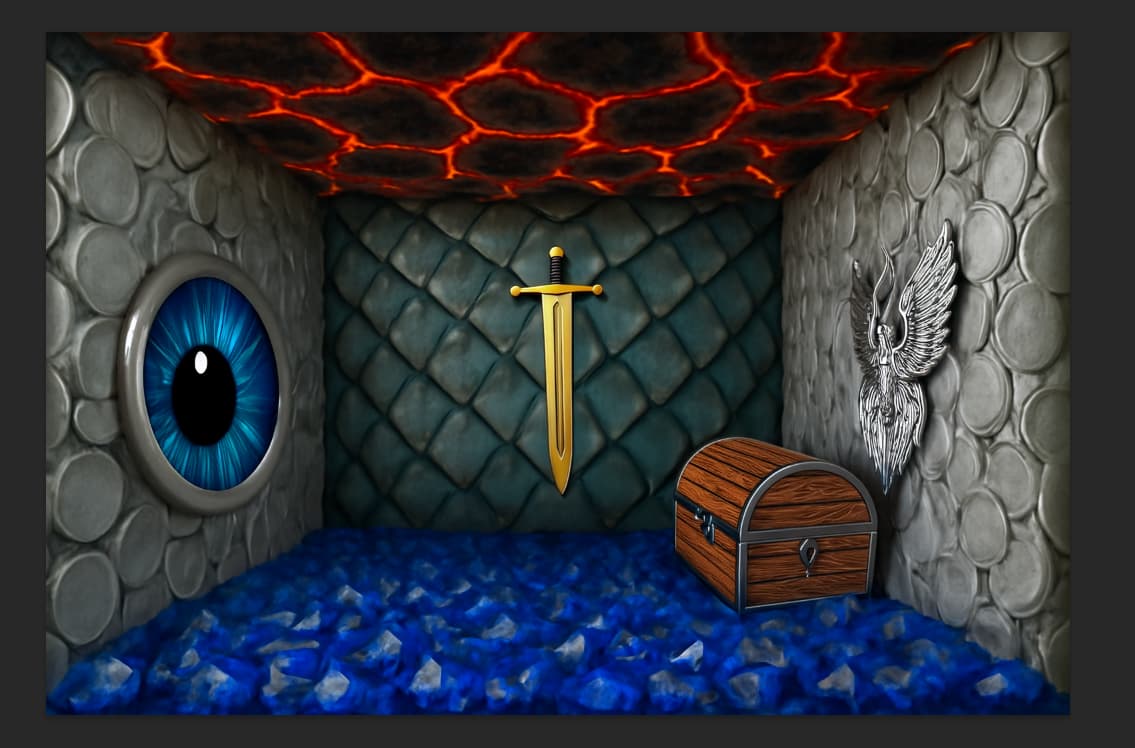
Good afternoon. I’ve been using memorization techniques for my studies, and the best approach I’ve found so far is combining the memory palace method with Anki. Whenever I struggled with a concept that kept tripping me up on practice questions—like which positions in government can only be held by native-born Brazilians—I would place that information inside a memory palace. Then I’d take a picture of that palace and use it in Anki: the question side would ask something like “Which positions require being a native-born Brazilian?” and the answer side would show the palace image. This worked really well, and I ended up passing the OAB exam to become a lawyer, both in the first and second phases.
Along the way, though, I ran into a few challenges. First, I ran out of locations. To solve this, I started using houses listed for rent on sites like Luxury Real Estate and Zillow. I’d pick an interesting property and visualize legal terms in absurd, memorable ways within it. I also created a kind of PAO (Person + Action + Object) system, but instead of numbers, I used legal jargon. Normally PAO is for memorizing digits, but it turned out to work surprisingly well for the most common legal terms that show up on exams.
The biggest issue from the start, however, has been the amount of time it takes me to actually memorize some of this material. I’ve thought of a couple of possible solutions, but I’m not sure if they’ll work, so I’d love your input:
First idea: Create a peg list to memorize certain sets of items.
Possible issue: If I reuse the same peg list multiple times a day, could it start to cause confusion?
Second idea: Just keep looking at rental houses online until I can recall them without needing to revisit the site.
Possible issue: I might forget the location and end up having to check the site again anyway.
Obs: I usually dont have any problem using or trying to remember them. They work very well for me.
I usually study through practice questions—it’s become my favorite way to learn. I’ll focus on questions about a specific subject for a few days or even two to three weeks. Throughout the day, I go over multiple topics and subjects.
Some subjects are more about pure memorization, where there isn’t much to understand beyond the central idea—you just have to know it. So, when I notice that I’m missing too many questions simply because I can’t recall certain details, I take that topic in its most summarized form, break it down into bullet points, then go to a rental site like Luxury Real Estate or Zillow. I look for a house with around 8–15 loci, and I turn each bullet point into a locus along the house.
That alone usually solves the problem, but I add one more step: I put the material into Anki. Since I create a lot of memory palaces throughout my studies, sometimes I forget exactly where I stored the information—especially because these palaces are “virtual/real” locations I don’t personally know. It’s harder to remember the exact spot, though I normally don’t forget the content itself, just the location at times. After putting everything into Anki, I keep working on practice questions until I find something new that needs a memory palace again, and then I repeat the process.
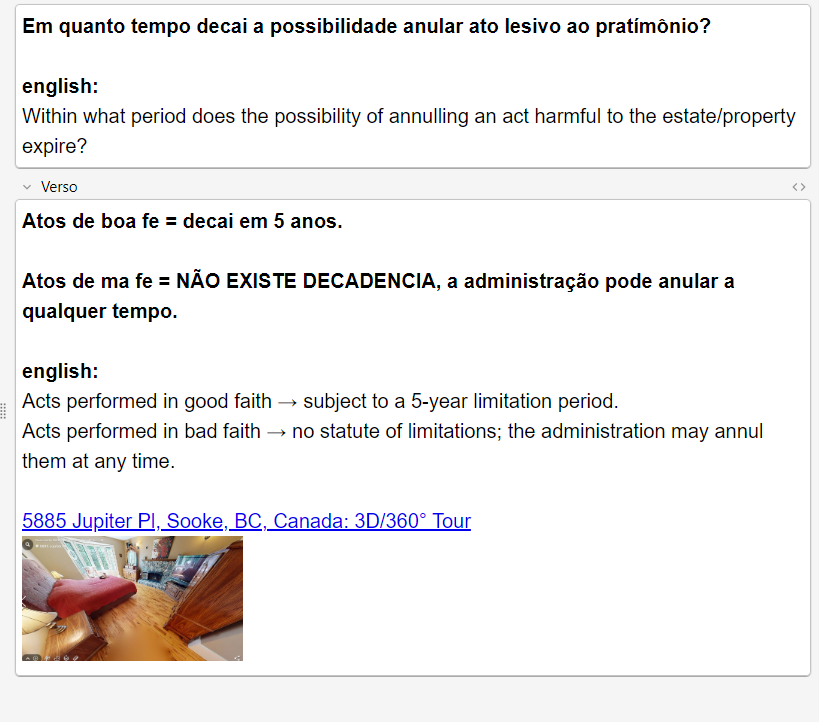
The time that i take to do all of this is about 15-25min. This one below i probably just used about 3-6min.
So my final card from my memory palace would look like this:
Using real estate site is good! I like to use 3D / virtual visit in real estate website…combine with my META quest it gives me great result since I also video record my path. If you have any good webstite to recommend I’m in.
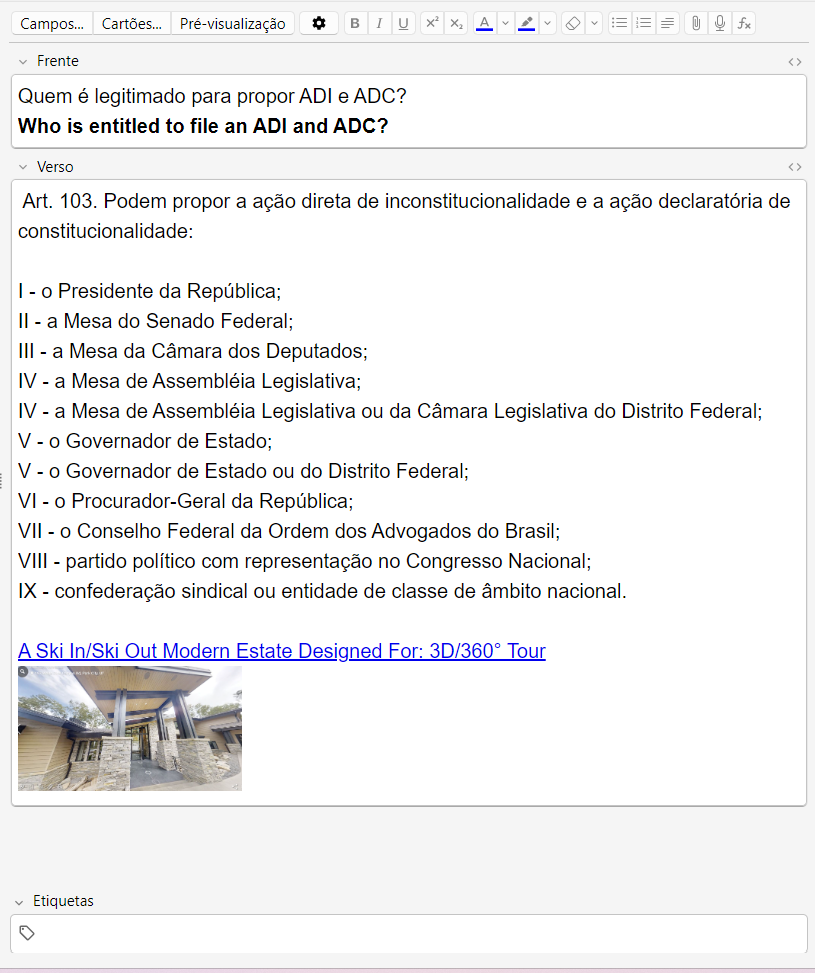
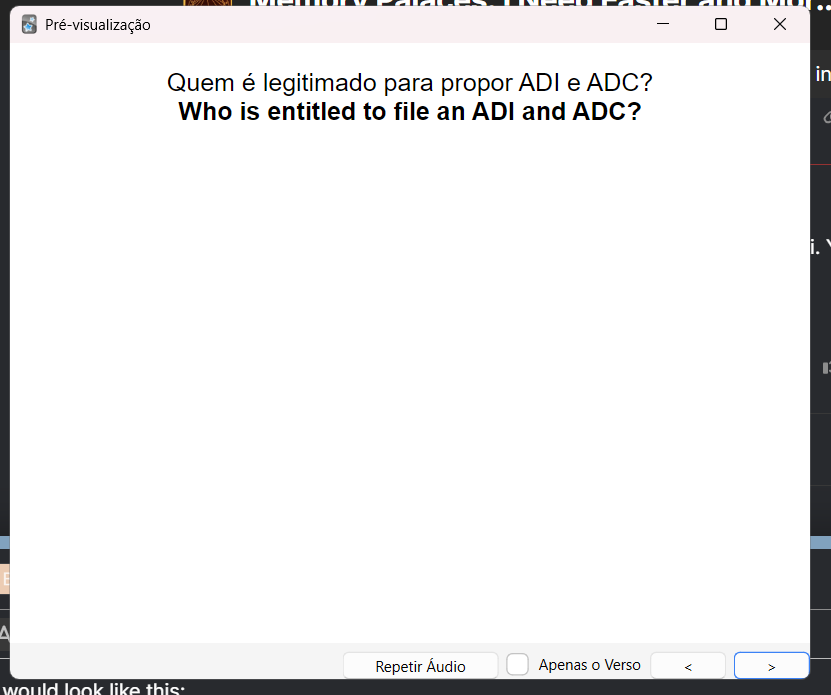
Exactly, if I want to remember who can file an ADI or ADC (constitutional remedies) in law, on the front of the card I put the question, which in this case was:
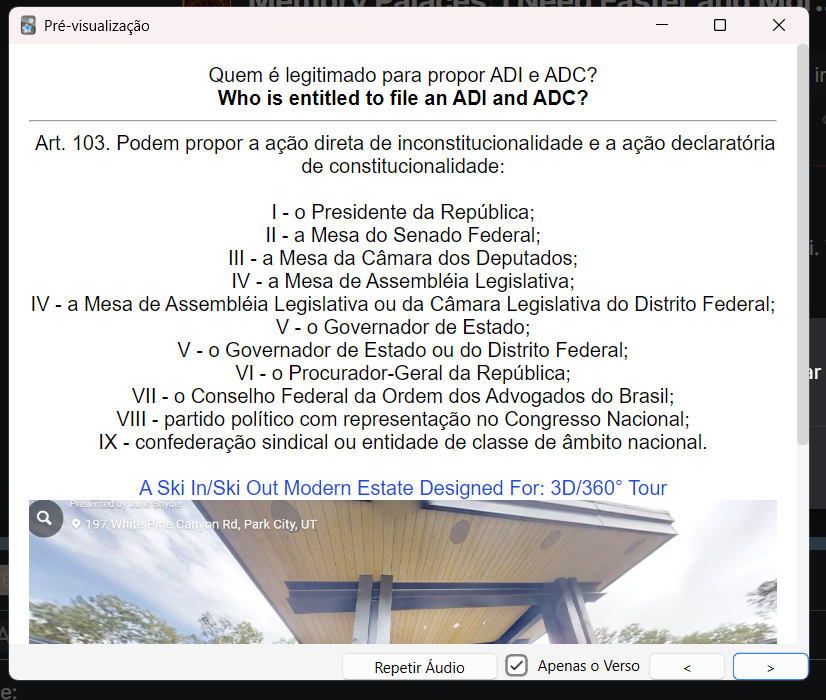
And on the back, I write the answer plus an image of the place where I stored it in the memory palace related to that information. This way, I can create as many memory palaces as I want, and I’ll never go too long without reviewing them. For example, I hadn’t reviewed this one in a few months, but just by seeing the card, I immediately remembered everything again. So, during the exam, whenever something related to ADI and ADC comes up, I always remember who is entitled to file them.
First i go to one of those websites where you can see places in 3D, there’s some links above that i posted. After find some good place, i take the information that i want do store and “walk” through the place imagining something that remember the thing that i want to remember. If i want to remember that the president can file an adi and adc, so i imagine him doind something crazy like kissing some other president. I do this type of thing to every information and make the cards like those that you saw. Is basically this. I like to copy the link from that especific house and post on the card in case to need to review the whole place again. The print is just to remember more or less where is stored the whole information, it’s not supposed to have all the things that i imagined there.
To my understanding the uniqueness of your system is that you are able to have the actual pic from the web to store to Anki. So if we stay with this base approach i‘d have the following suggestions:
To allow more info to one picture segment it to: top left, top right, bottom left, bottom right. That increases you capacity already x4. You would need to test what is the limit of segments you can properly distinguish per pic.
Regarding organizing the huge amount of houses: define a macro structure like neighbourhood x contains only topics related to tax legislation, neighbourhood y only criminal law, etc.
Obviously you can also start with streets and then go neighbourhoods, cities, regions countries etc.
I already tried the first tip and wasn’t very helpfull. But the second one is a very good one, i’ll definilly try this to organize my MP’s. Thank you very much, Euro!
Utilizo obsidian o excel, depende mucho de lo que quiera memorizar, si es un diccionario utilizo excel, si son formulas, datos o hechos utilizare obsidian.
GTD (Getting Things Done)
Es un sistema de gestión de tareas que se centra en capturar, procesar y organizar todas las tareas y proyectos para liberar la mente y aumentar la productividad.
Capturar: Recopilar todas las tareas e ideas.
Procesar: Decidir qué hacer con cada ítem capturado.
Organizar: Clasificar y priorizar las tareas.
Revisar: Evaluar regularmente las listas y el progreso.
Hacer: Ejecutar las tareas según su prioridad y contexto.
El arquero (centauro)
Ubicación:
El centauro caza con un arco → Un gato con una grantaza de cafe en la mano derecha y va montado encima de un dodo.
Mnemotecnia Visual:
Capturar: 01 → Robert Downey jr. → Capitan America + Centauro → Capturar ciervo
Procesar: 02 → Robert de Niro → Julio Cesar → Procesara de carne
Organizar: 03 → Rachel Weisz → Oruga → Estante de libros
Revisar: 04 → Aaron Eckhart → Revolver → Suicidio con revolver + Autopsia del cuerpo sin vida
Hacer: 05 → Ray Liotta → Hacha → Derrivar un arbol de hojas rojas
Historia Mnemotecnica: 1 CA captura solo los ciervos de todos los colores. 2 JC toma los ciervos cazados por CA y los mete a la procesadora de carne, pero solo tomando los ciervos de color rojo. 3 Una mujer mitad oruga que organiza los libros por categorias de colores, priorizando los libros rojos. 4 AE se suicida con un revolver y le hacen una autopsia. 5 RL derriva un arbol de hojas rojas con un hacha.
En realidad no, son muy memorables la verdad, pero muchas personas fallan al utilizar personajes, piensan que deben ser demasiado sorprendentes y no, el cerebro analiza las expresiones y emociones de las demas, es un sistema que ya viene de fábrica y eso es lo que suelo explotar… en mis escenas eacritas trato de ser breve, no me extiendo mucho, ya que utilizo varios sentidos y la verdad esto escrito romantiza demasiado el texto o escenas escritas, por lo que soy breve y directo… pero por ejemplo:
Luke evans con rostro enojado o fruncido (aqui aprovecho la capacidad del cerebro para analizar expresiones faciales) lanza un libro magico del cual emerge Chris evans, quien no puede hablar y muestra un rostro ansioso y rojo, etc.
El provecho de los personajes es el siguiente, puedes moverlos muy fácilmente por todo los lugares y pueden recorrer un lugar mas de una vez sin confundir tanto como otras imágenes, por ejemplo mi personaje lanza un libro, lo recoje y saca una manzana, la muerde y escupe porque la siente agria y muy ácida, etc.
Con esto utilizo mis personajes como si fueran actores de teatro y puedo memorizar muchas palabras en un mismo lugar.
Entiendo que a muchos les parece difícil, pero es cuestion de práctica, por ejemplo, trate de observar a alguien conocido subiendo por una cuerda, su rostro se pone rojo, abre la boca para tomar aire… se dara cuenta que va a ciertas partes a observar, si quiere puede ver el rostro completo a cierta distancia, solo debe tratar de observar como lo hace en la realidad física., sin tratar de detallar demasiado la imagen.
Yo no lo se usar esto. Pero me puse a practicar y es bueno. Es Q mí el palacio me cuesta pero si pongo personajes es mas fácil. Y después miras el lugar y ves el personaje. Y lo podes poner haciendo muchas cosas. Sino poner imágenes en el lugar me cuesta bastante.
Si y realmente es mas divertido la verdad… robert fludd en su libro recomienda utilizar personajes de historia o mitologicos, como cronos comiendo a su hijo o prometeo con el fuego robado, etc., son muy fuertes… ademas de que un personaje puede hacer lo que los demas y lo que sea con cualquier cosa, ademas de imitar.